
RNA 运输和亚细胞定位——机制、实验和预测方法综述。
RNA trafficking and subcellular localization-a review of mechanisms, experimental and predictive methodologies.
机构信息
Bioinformatics Centre, Department of Biology, University of Copenhagen, København Ø 2100, Denmark.
Computational Health Center, Helmholtz Center, Munich, Germany.
出版信息
Brief Bioinform. 2023 Sep 20;24(5). doi: 10.1093/bib/bbad249.
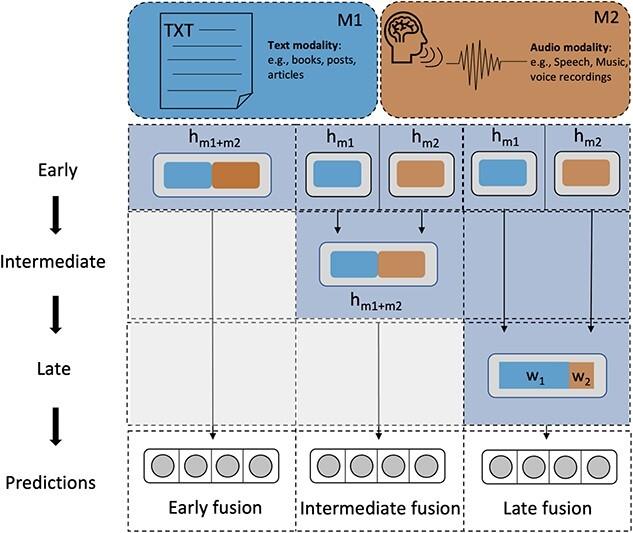
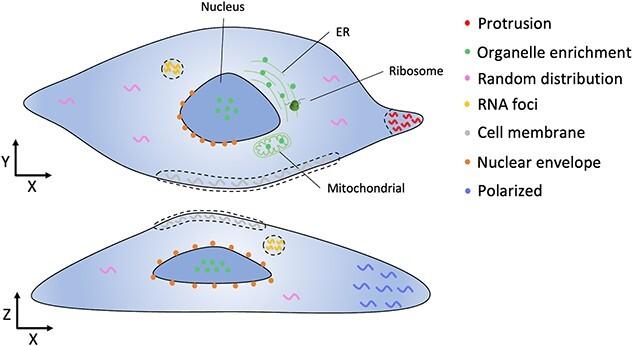
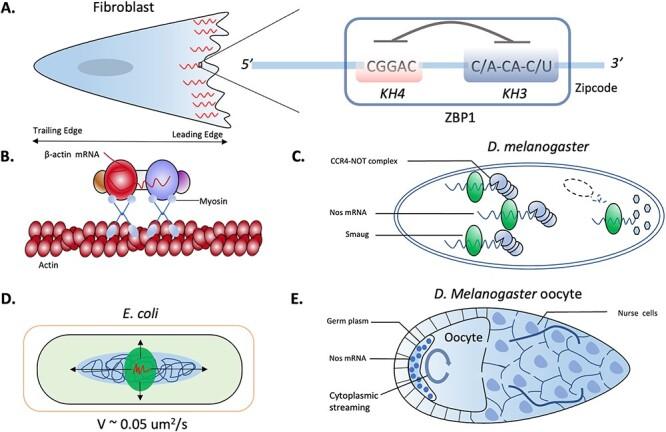
RNA localization is essential for regulating spatial translation, where RNAs are trafficked to their target locations via various biological mechanisms. In this review, we discuss RNA localization in the context of molecular mechanisms, experimental techniques and machine learning-based prediction tools. Three main types of molecular mechanisms that control the localization of RNA to distinct cellular compartments are reviewed, including directed transport, protection from mRNA degradation, as well as diffusion and local entrapment. Advances in experimental methods, both image and sequence based, provide substantial data resources, which allow for the design of powerful machine learning models to predict RNA localizations. We review the publicly available predictive tools to serve as a guide for users and inspire developers to build more effective prediction models. Finally, we provide an overview of multimodal learning, which may provide a new avenue for the prediction of RNA localization.
RNA 定位对于调节空间翻译至关重要,其中 RNA 通过各种生物机制被运输到其靶位。在这篇综述中,我们讨论了 RNA 定位的分子机制、实验技术和基于机器学习的预测工具。综述了三种主要的分子机制,它们控制 RNA 到不同细胞区室的定位,包括定向运输、保护 mRNA 免受降解,以及扩散和局部捕获。基于图像和序列的实验方法的进步提供了大量的数据资源,这使得设计强大的机器学习模型来预测 RNA 的定位成为可能。我们回顾了现有的预测工具,为用户提供指导,并激发开发者构建更有效的预测模型。最后,我们概述了多模态学习,它可能为 RNA 定位的预测提供新途径。

 Zotero 插件