
多种标本类型中 SARS-CoV-2 的抗原浓度、病毒载量和检测性能。
Antigen concentration, viral load, and test performance for SARS-CoV-2 in multiple specimen types.
机构信息
Diagnostics, PATH, Seattle, Washington, United States of America.
Centro de Pesquisa em Medicina Tropical (CEPEM), Porto Velho, Rondônia, Brazil.
出版信息
PLoS One. 2023 Jul 19;18(7):e0287814. doi: 10.1371/journal.pone.0287814. eCollection 2023.
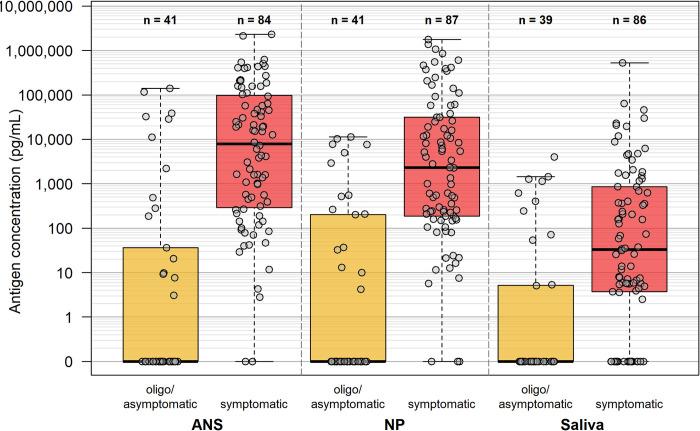
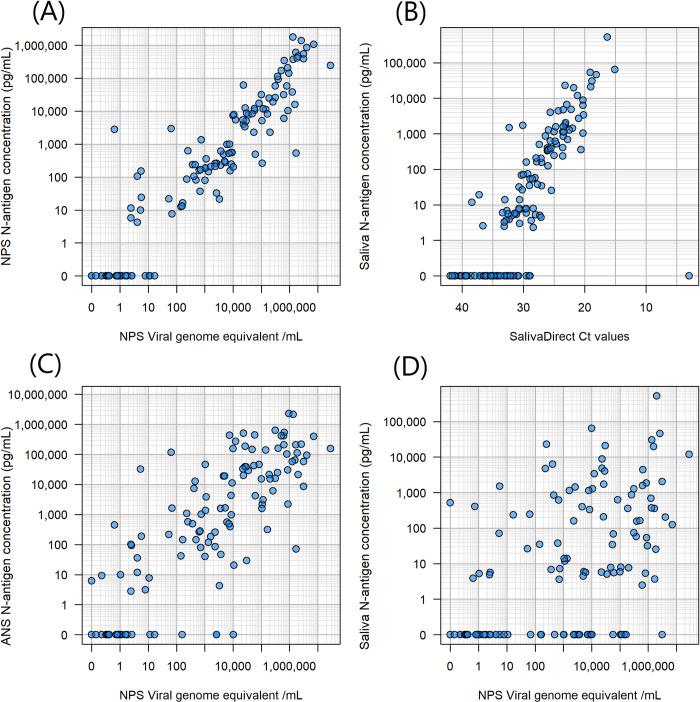
The relationship between N-antigen concentration and viral load within and across different specimens guides the clinical performance of rapid diagnostic tests (RDT) in different uses. A prospective study was conducted in Porto Velho, Brazil, to investigate RDT performance in different specimen types as a function of the correlation between antigen concentration and viral load. The study included 214 close contacts with recent exposures to confirmed cases, aged 12 years and older and with various levels of vaccination. Antigen concentration was measured in nasopharyngeal swab (NPS), anterior nares swab (ANS), and saliva specimens. Reverse transcriptase (RT)-PCR was conducted on the NPS and saliva specimens, and two RDTs were conducted on ANS and one RDT on saliva. Antigen concentration correlated well with viral load when measured in the same specimen type but not across specimen types. Antigen levels were higher in symptomatic cases compared to asymptomatic/oligosymptomatic cases and lower in saliva compared to NPS and ANS samples. Discordant results between the RDTs conducted on ANS and the RT-PCR on NPS were resolved by antigen concentration values. The analytical limit-of-detection of RDTs can be used to predict the performance of the tests in populations for which the antigen concentration is known. The antigen dynamics across different sample types observed in SARS-CoV-2 disease progression support use of RDTs with nasal samples. Given lower antigen concentrations in saliva, rapid testing using saliva is expected to require improved RDT analytical sensitivity to achieve clinical sensitivity similar to rapid testing of nasal samples.
N 抗原浓度与不同标本中病毒载量之间的关系指导着快速诊断检测(RDT)在不同用途中的临床性能。巴西波多韦柳市进行了一项前瞻性研究,旨在调查不同标本类型中 RDT 的性能,作为抗原浓度与病毒载量之间相关性的函数。该研究包括 214 名最近接触过确诊病例的密切接触者,年龄在 12 岁及以上,且具有不同程度的疫苗接种。在鼻咽拭子(NPS)、前鼻拭子(ANS)和唾液标本中测量抗原浓度。在 NPS 和唾液标本中进行逆转录酶(RT)-PCR,在 ANS 和唾液标本中进行两种 RDT,在唾液标本中进行一种 RDT。当在相同的标本类型中测量时,抗原浓度与病毒载量相关性良好,但在不同的标本类型之间不相关。与无症状/寡症状病例相比,有症状病例的抗原水平较高,与 NPS 和 ANS 样本相比,唾液中的抗原水平较低。通过抗原浓度值解决了在 ANS 上进行的 RDT 和在 NPS 上进行的 RT-PCR 之间的不一致结果。RDT 的分析检测限可用于预测已知抗原浓度人群中检测的性能。在 SARS-CoV-2 疾病进展过程中观察到的不同样本类型之间的抗原动力学支持使用鼻腔样本进行 RDT。鉴于唾液中的抗原浓度较低,使用唾液进行快速检测预计需要提高 RDT 的分析灵敏度,以达到与鼻腔样本快速检测相似的临床灵敏度。


 Zotero 插件