
黑色素瘤细胞诱导肿瘤微环境中存在的脂肪细胞去分化和代谢改变。
Melanoma cells induce dedifferentiation and metabolic changes in adipocytes present in the tumor niche.
机构信息
Department of Cell Pathology, Faculty of Biotechnology, University of Wroclaw, 50-383, Wroclaw, Poland.
Department of Oncology and Division of Surgical Oncology, Wroclaw Medical University, Plac Hirszfelda 12, 53-413, Wroclaw, Poland.
出版信息
Cell Mol Biol Lett. 2023 Jul 22;28(1):58. doi: 10.1186/s11658-023-00476-3.
BACKGROUND
One of the factors that affect the progression of melanoma is the tumor microenvironment, which consists of cellular elements, extracellular matrix, acidification, and a hypoxic state. Adipocytes are one of the types of cell present in the niche and are localized in the deepest layer of the skin. However, the relationship between fat cells and melanoma remains unclear.
METHODS
We assessed the influence of melanoma cells on adipocytes using an indirect coculture system. We estimated the level of cancer-associated adipocyte (CAA) markers through quantitative PCR analysis. The fibroblastic phenotype of CAAs was confirmed by cell staining and western blotting analysis. The lipid content was estimated by lipid detection in CAAs using LipidSpot and by quantitative analysis using Oil Red O. The expression of proteins involved in lipid synthesis, delipidation, and metabolic processes were assessed through quantitative PCR or western blotting analysis. Lactate secretion was established using a Lactate-Glo™ assay. Proteins secreted by CAAs were identified in cytokine and angiogenesis arrays. The proliferation of melanoma cells cocultured with CAAs was assessed using an XTT proliferation assay. Statistical analysis was performed using a one-way ANOVA followed by Tukey's test in GraphPad Prism 7 software.
RESULTS
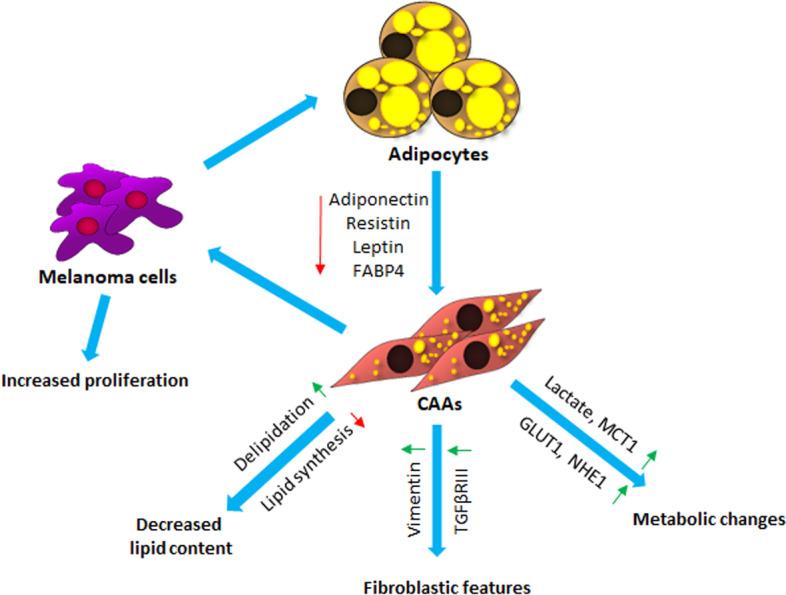
Obtained CAAs were identified by decreased levels of leptin, adiponectin, resistin, and FABP4. Adipocytes cocultured with melanoma presented fibroblastic features, such as a similar proteolytic pattern to that of 3T3L1 fibroblasts and increased levels of vimentin and TGFβRIII. Melanoma cells led to a reduction of lipid content in CAAs, possibly by downregulation of lipid synthesis pathways (lower FADS, SC4MOL, FASN) or enhancement of lipolysis (higher level of phosphorylation of ERK and STAT3). Adipocytes cocultured with melanoma cells secreted higher IL6 and SerpinE1 levels and produced less CCL2, CXCL1, and angiogenic molecules. CAAs also showed metabolic changes comprising the increased secretion of lactate and enhanced production of glucose, lactate, and ion transporters. In addition, changes in adipocytes observed following melanoma coculture resulted in a higher proliferation rate of cancer cells.
CONCLUSIONS
Melanoma cells led to decreased lipid content in adipocytes, which might be related to enhanced delipidation or reduction of lipid synthesis. Fibroblast-like CAAs showed metabolic changes that may be the reason for accelerated proliferation of melanoma cells.
背景
影响黑色素瘤进展的因素之一是肿瘤微环境,它由细胞成分、细胞外基质、酸化和缺氧状态组成。脂肪细胞是基质中的一种细胞类型,位于皮肤的最深层。然而,脂肪细胞与黑色素瘤之间的关系尚不清楚。
方法
我们使用间接共培养系统评估了黑色素瘤细胞对脂肪细胞的影响。通过定量 PCR 分析评估癌症相关脂肪细胞 (CAA) 标志物的水平。通过细胞染色和 Western blot 分析确认 CAA 的成纤维细胞表型。通过 LipidSpot 检测 CAA 中的脂质含量,并通过油红 O 定量分析来估计脂质含量。通过定量 PCR 或 Western blot 分析评估参与脂质合成、去脂化和代谢过程的蛋白质的表达。通过乳酸-Glo™测定法确定乳酸分泌。通过细胞因子和血管生成阵列鉴定 CAA 分泌的蛋白质。使用 XTT 增殖测定法评估与 CAA 共培养的黑色素瘤细胞的增殖。使用 GraphPad Prism 7 软件中的单向方差分析(one-way ANOVA) followed by Tukey's test 进行统计分析。
结果
获得的 CAA 通过瘦素、脂联素、抵抗素和 FABP4 水平降低来鉴定。与黑色素瘤共培养的脂肪细胞表现出成纤维细胞特征,例如与 3T3L1 成纤维细胞相似的蛋白水解模式和波形蛋白和 TGFβRIII 水平升高。黑色素瘤细胞导致 CAA 中的脂质含量减少,可能是通过下调脂质合成途径(较低的 FADS、SC4MOL、FASN)或增强脂肪分解(ERK 和 STAT3 磷酸化水平升高)。与黑色素瘤细胞共培养的脂肪细胞分泌更高水平的 IL6 和 SerpinE1,并产生更少的 CCL2、CXCL1 和血管生成分子。CAA 还表现出代谢变化,包括乳酸分泌增加和葡萄糖、乳酸和离子转运蛋白产生增加。此外,黑色素瘤共培养后观察到的脂肪细胞变化导致癌细胞增殖率升高。
结论
黑色素瘤细胞导致脂肪细胞中的脂质含量减少,这可能与增强的去脂化或脂质合成减少有关。成纤维样 CAA 表现出代谢变化,这可能是黑色素瘤细胞增殖加速的原因。


 Zotero 插件