
野生传粉昆虫肠道微生物组的趋同与趋异。
Divergence and convergence of gut microbiomes of wild insect pollinators.
机构信息
State Key Laboratory of Resource Insects, Institute of Apicultural Research, Chinese Academy of Agricultural Science, Beijing, China. , Beijing, China.
School of Biological Sciences, Illinois State University , Normal, Illinois, USA.
出版信息
mBio. 2023 Aug 31;14(4):e0127023. doi: 10.1128/mbio.01270-23. Epub 2023 Jul 28.
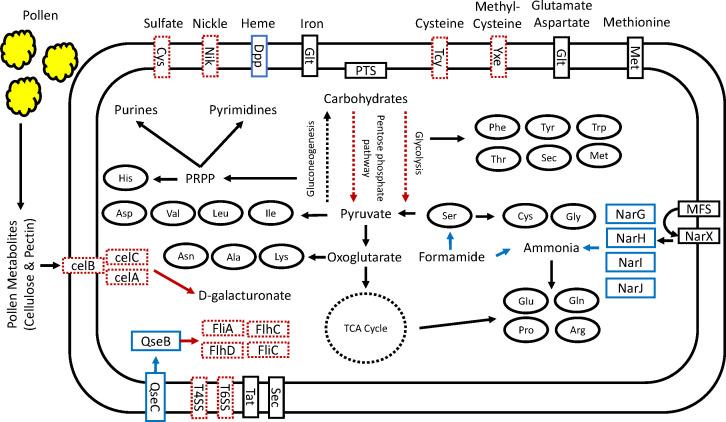
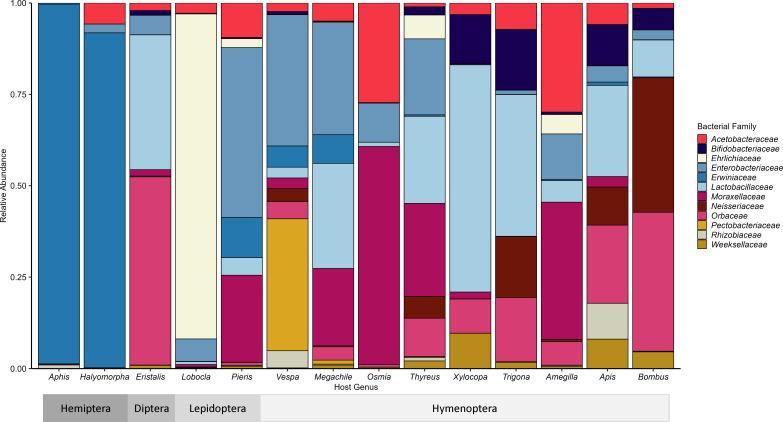
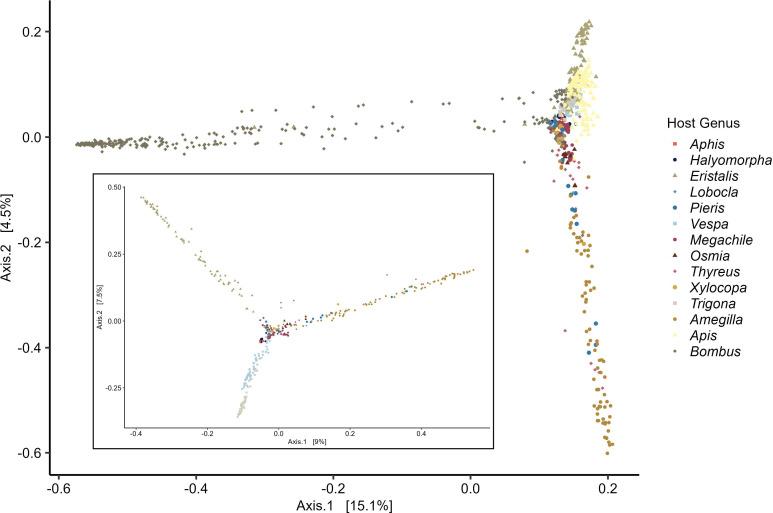
Pollination services provided by wild insect pollinators are critical to natural ecosystems and crops around the world. There is an increasing appreciation that the gut microbiota of these insects influences their health and consequently their services. However, pollinator gut microbiota studies have focused on well-described social bees, but rarely include other, more phylogenetically divergent insect pollinators. To expand our understanding, we explored the insect pollinator microbiomes across three insect orders through two DNA sequencing approaches. First, in an exploratory 16S amplicon sequencing analysis of taxonomic community assemblages, we found lineage-specific divergences of dominant microbial genera and microbiota community composition across divergent insect pollinator genera. However, we found no evidence for a strong broad-scale phylogenetic signal, which we see for community relatedness at finer scales. Subsequently, we utilized metagenomic shotgun sequencing to obtain metagenome-assembled genomes and assess the functionality of the microbiota from pollinating flies and social wasps. We uncover a novel gut microbe from pollinating flies in the family Orbaceae that is closely related to spp. from social bees but with divergent functions. We propose this novel species be named . Further metagenomes of dominant fly and wasp microbiome members suggest that they are largely not host-insect adapted and instead may be environmentally derived. Overall, this study suggests selective processes involving ecology or physiology, or neutral processes determining microbe colonization may predominate in the turnover of lineages in insect pollinators broadly, while evolution with hosts may occur only under certain circumstances and on smaller phylogenetic scales. IMPORTANCE Wild insect pollinators provide many key ecosystem services, and the microbes associated with these insect pollinators may influence their health. Therefore, understanding the diversity in microbiota structure and function, along with the potential mechanisms shaping the microbiota across diverse insect pollinators, is critical. Our study expands beyond existing knowledge of well-studied social bees, like honey bees, including members from other bee, wasp, butterfly, and fly pollinators. We infer ecological and evolutionary factors that may influence microbiome structure across diverse insect pollinator hosts and the functions that microbiota members may play. We highlight significant differentiation of microbiomes among diverse pollinators. Closer analysis suggests that dominant members may show varying levels of host association and functions, even in a comparison of closely related microbes found in bees and flies. This work suggests varied importance of ecological, physiological, and non-evolutionary filters in determining structure and function across largely divergent wild insect pollinator microbiomes.
传粉服务由野生昆虫传粉媒介提供,对世界各地的自然生态系统和作物至关重要。人们越来越认识到,这些昆虫的肠道微生物群会影响它们的健康,进而影响它们的服务。然而,传粉媒介肠道微生物群的研究主要集中在描述良好的社会性蜜蜂上,但很少包括其他更系统发育上有差异的昆虫传粉媒介。为了扩大我们的理解,我们通过两种 DNA 测序方法探索了三个昆虫目昆虫传粉媒介的微生物组。首先,在对分类群组合的 16S 扩增子测序分析的探索性研究中,我们发现主导微生物属的谱系特异性差异和不同昆虫传粉媒介属之间的微生物群落组成。然而,我们没有发现强有力的广泛系统发育信号的证据,而在更精细的尺度上,我们看到了群落相关性的证据。随后,我们利用宏基因组鸟枪法测序获得了授粉蝇和社会性胡蜂的宏基因组组装基因组,并评估了微生物群的功能。我们从授粉蝇科中发现了一种新的肠道微生物,它与社会性蜜蜂的 spp.密切相关,但功能不同。我们建议将这种新物种命名为 。占主导地位的蝇和胡蜂微生物群成员的进一步宏基因组表明,它们在很大程度上不是宿主昆虫适应的,而是可能来自环境。总的来说,这项研究表明,在广泛的昆虫传粉媒介中,涉及生态学或生理学的选择性过程,或决定微生物定殖的中性过程可能占主导地位,而与宿主的进化可能仅在某些情况下和较小的系统发育尺度上发生。重要性野生昆虫传粉媒介提供了许多关键的生态系统服务,而与这些昆虫传粉媒介相关的微生物可能会影响它们的健康。因此,了解微生物组结构和功能的多样性,以及塑造不同昆虫传粉媒介微生物组的潜在机制,至关重要。我们的研究扩展了对研究充分的社会性蜜蜂(如蜜蜂)的现有知识,包括来自其他蜜蜂、胡蜂、蝴蝶和蝇传粉媒介的成员。我们推断了可能影响不同昆虫传粉媒介宿主微生物组结构的生态和进化因素,以及微生物组成员可能发挥的功能。我们强调了不同传粉媒介之间微生物组的显著差异。更仔细的分析表明,即使在比较蜜蜂和蝇中发现的密切相关的微生物时,主要成员可能表现出不同程度的宿主关联和功能。这项工作表明,在很大程度上不同的野生昆虫传粉媒介微生物组中,生态、生理和非进化过滤器的重要性各不相同。


 Zotero 插件