
静脉-动脉二氧化碳分压差在组织灌注和氧合监测中的作用:一篇叙述性综述。
Venous Minus Arterial Carbon Dioxide Gradients in the Monitoring of Tissue Perfusion and Oxygenation: A Narrative Review.
机构信息
Facultad de Ciencias Médicas, Universidad Nacional de La Plata, Cátedras de Terapia Intensiva y Farmacología Aplicada, 60 y 120, La Plata B1902AGW, Argentina.
Servicio de Terapia Intensiva, Sanatorio Otamendi, Azcuénaga 870, Ciudad Autónoma de Buenos Aires C1115AAB, Argentina.
出版信息
Medicina (Kaunas). 2023 Jul 6;59(7):1262. doi: 10.3390/medicina59071262.
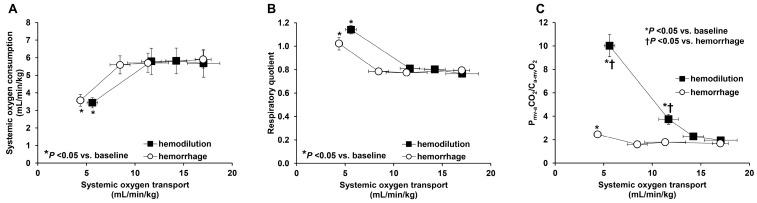
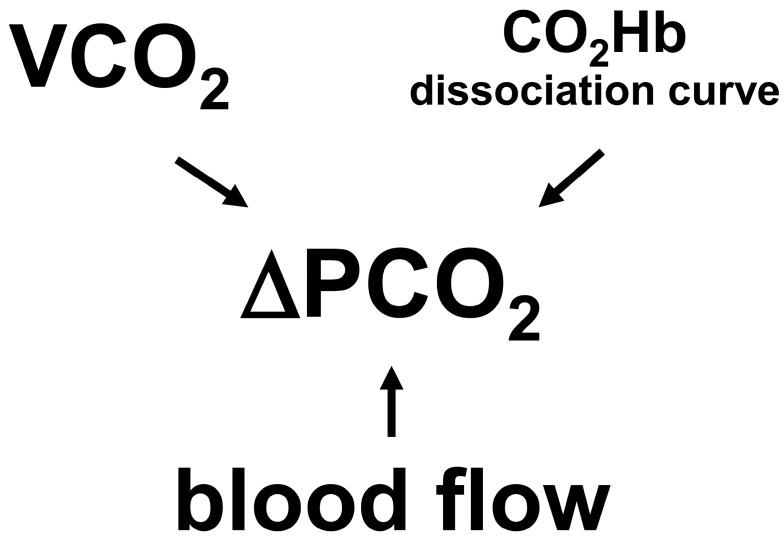
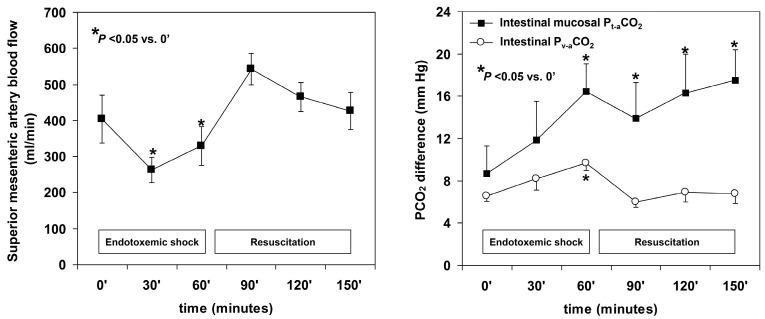
According to Fick's principle, the total uptake of (or release of) a substance by tissues is the product of blood flow and the difference between the arterial and the venous concentration of the substance. Therefore, the mixed or central venous minus arterial CO content difference depends on cardiac output (CO). Assuming a linear relationship between CO content and partial pressure, central or mixed venous minus arterial PCO differences (PCO and PCO) are directly related to CO. Nevertheless, this relationship is affected by alterations in the COHb dissociation curve induced by metabolic acidosis, hemodilution, the Haldane effect, and changes in CO production (VCO). In addition, PCO and PCO are not interchangeable. Despite these confounders, CO is a main determinant of PCO. Since in a study performed in septic shock patients, PCO was correlated with changes in sublingual microcirculation but not with those in CO, it has been proposed as a monitor for microcirculation. The respiratory quotient (RQ)-RQ = VCO/O consumption-sharply increases in anaerobic situations induced by exercise or critical reductions in O transport. This results from anaerobic VCO secondary to bicarbonate buffering of anaerobically generated protons. The measurement of RQ requires expired gas analysis by a metabolic cart, which is not usually available. Thus, some studies have suggested that the ratio of PCO to arterial minus central venous O content (PCO/CO) might be a surrogate for RQ and tissue oxygenation. In this review, we analyze the physiologic determinants of PCO and PCO/CO and their potential usefulness and limitations for the monitoring of critically ill patients. We discuss compelling evidence showing that they are misleading surrogates for tissue perfusion and oxygenation, mainly because they are systemic variables that fail to track regional changes. In addition, they are strongly dependent on changes in the COHb dissociation curve, regardless of changes in systemic and microvascular perfusion and oxygenation.
根据菲克定律,组织对物质的总摄取量(或释放量)是血流量与物质动脉和静脉浓度差的乘积。因此,混合或中心静脉与动脉 CO 含量差取决于心输出量(CO)。假设 CO 含量与分压之间存在线性关系,中心或混合静脉与动脉 PCO 差(PCO 和 PCO)与 CO 直接相关。然而,这种关系受到代谢性酸中毒、血液稀释、Haldane 效应引起的 COHb 解离曲线改变以及 CO 生成(VCO)改变的影响。此外,PCO 和 PCO 不能互换。尽管存在这些混杂因素,但 CO 是 PCO 的主要决定因素。由于在一项脓毒性休克患者的研究中,PCO 与舌下微循环变化相关,但与 CO 变化不相关,因此它被提议作为微循环的监测指标。呼吸商(RQ)-RQ = VCO/O 消耗在运动或 O 转运严重减少引起的无氧情况下急剧增加。这是由于无氧 VCO 继发于无氧产生的质子的碳酸氢盐缓冲。RQ 的测量需要通过代谢车进行呼出气体分析,但通常无法获得。因此,一些研究表明,PCO 与动脉与中心静脉 O 含量之差的比值(PCO/CO)可能是 RQ 和组织氧合的替代指标。在这篇综述中,我们分析了 PCO 和 PCO/CO 的生理决定因素及其在危重病患者监测中的潜在有用性和局限性。我们讨论了令人信服的证据,表明它们是组织灌注和氧合的误导性替代指标,主要是因为它们是系统变量,无法跟踪区域变化。此外,它们强烈依赖于 COHb 解离曲线的变化,而与全身和微血管灌注和氧合的变化无关。




 Zotero 插件