
硫代硫酸钠治疗腹膜透析患者钙化防御:系统评价。
Sodium Thiosulfate for Calciphylaxis Treatment in Patients on Peritoneal Dialysis: A Systematic Review.
机构信息
Division of Nephrology and Hypertension, Mayo Clinic, Rochester, MN 55905, USA.
Chakri Naruebodindra Medical Institute, Faculty of Medicine Ramathibodi Hospital, Mahidol University, Samut Prakan 10400, Thailand.
出版信息
Medicina (Kaunas). 2023 Jul 14;59(7):1306. doi: 10.3390/medicina59071306.
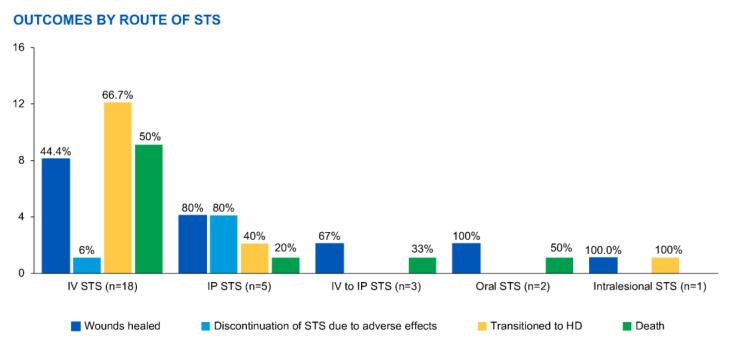
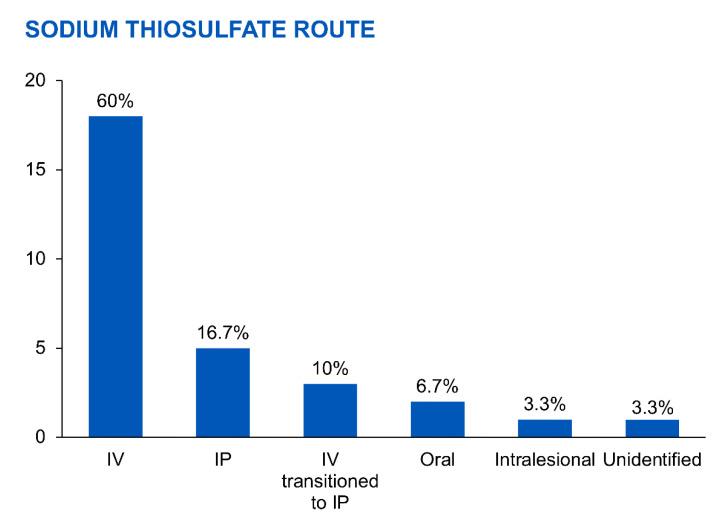
Limited data are available on the utilization of sodium thiosulfate (STS) treatment for calciphylaxis in peritoneal dialysis (PD) patients, while it is well-studied in hemodialysis (HD) patients. A systematic literature search was conducted using Ovid MEDLINE, EBM Reviews-Cochrane Central Register of Controlled Trials, and EBM Reviews-Cochrane Database of Systematic Reviews to identify reported cases of PD patients with calciphylaxis who received STS. The search covered the inception of the databases through August 2022. Across 19 articles, this review identified 30 PD patients with calciphylaxis who received STS. These included 15 case reports, 2 case series, and 2 cohort studies. The administration routes and doses varied depending on the study. For intravenous (IV) administration ( = 18), STS doses ranged from 3.2 g twice daily to 25 g three times weekly for 5 weeks to 8 months. Outcomes included 44% of patients experiencing successful wound healing, 6% discontinuing STS due to adverse effects, 67% transitioning to HD, and 50% dying from calciphylaxis complications. For intraperitoneal (IP) administration ( = 5), STS doses ranged from 12.5 to 25 g three to four times weekly for 12 h to 3 months. Results showed 80% of patients achieving successful wound healing, 80% discontinuing STS due to adverse effects, 40% transitioning to HD, and 20% dying from IP STS-related chemical peritonitis. In cases where patients switched from IV to IP STS ( = 3), doses ranged from 12.5 to 25 g two to three times weekly for 2.5 to 5 months. Among them, 67% experienced successful wound healing, while 33% died from sepsis. Two cases utilized oral STS at a dose of 1500 mg twice daily for 6 and 11 months, resulting in successful wound healing without adverse effects or need for HD. However, one patient (50%) died due to small bowel obstruction. This systematic review provides an overview of STS treatment for PD patients with calciphylaxis. Although successful treatment cases exist, adverse effects were significant. Further research, including larger clinical studies and pharmacokinetic data, is necessary to establish the optimal route, dose, and efficacy of STS in PD patients.
关于在腹膜透析(PD)患者中使用硫代硫酸钠(STS)治疗钙化防御的利用,目前仅有有限的数据,而在血液透析(HD)患者中,这方面已经有充分的研究。我们使用 Ovid MEDLINE、EBM Reviews-Cochrane 对照试验中心注册库和 EBM Reviews-Cochrane 系统评价数据库进行了系统文献检索,以确定报告的接受 STS 治疗的 PD 患者钙化防御病例。检索涵盖了数据库的起始时间到 2022 年 8 月。在 19 篇文章中,本综述共确定了 30 例接受 STS 治疗的 PD 患者钙化防御病例。这些病例包括 15 例病例报告、2 例病例系列和 2 项队列研究。给药途径和剂量因研究而异。对于静脉内(IV)给药(=18),STS 剂量范围从每天两次 3.2g 到每周三次 25g,持续 5 周至 8 个月。结果包括 44%的患者成功治愈伤口,6%的患者因不良反应停止 STS 治疗,67%的患者转为 HD 治疗,50%的患者死于钙化防御并发症。对于腹腔内(IP)给药(=5),STS 剂量范围从每周三次 12.5 至 25g,持续 12 小时至 3 个月。结果显示,80%的患者成功治愈伤口,80%的患者因不良反应停止 STS 治疗,40%的患者转为 HD 治疗,20%的患者死于 IP STS 相关化学性腹膜炎。在将患者从 IV 转为 IP STS 的情况下(=3),剂量范围从每周两次 12.5 至 25g,持续 2.5 至 5 个月。其中,67%的患者成功治愈伤口,而 33%的患者死于败血症。有 2 例患者使用口服 STS,剂量为每天两次 1500mg,持续 6 个月和 11 个月,成功治愈伤口,无不良反应,无需进行 HD 治疗。然而,有 1 例患者(50%)死于小肠梗阻。本系统综述提供了 STS 治疗 PD 患者钙化防御的概述。尽管存在成功治疗的病例,但不良反应显著。需要进一步研究,包括更大规模的临床研究和药代动力学数据,以确定 PD 患者中 STS 的最佳途径、剂量和疗效。


 Zotero 插件