
墨西哥洞穴鱼种群在不同洞穴中的声信号特征。
Acoustic signatures in Mexican cavefish populations inhabiting different caves.
机构信息
Paris-Saclay Institute of Neuroscience, CNRS, Université Paris-Saclay, 91400, Saclay, France.
Department of Genetics, Harvard Medical School, Blavatnik Institute, Boston, MA, United States of America.
出版信息
PLoS One. 2023 Aug 3;18(8):e0289574. doi: 10.1371/journal.pone.0289574. eCollection 2023.
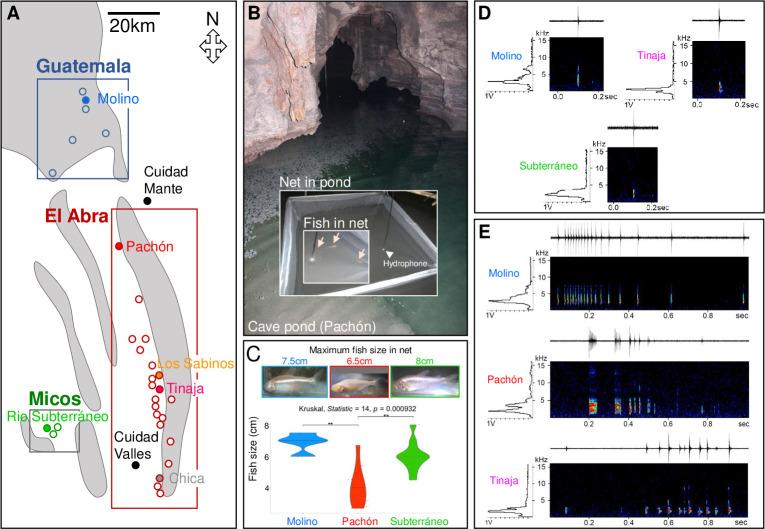
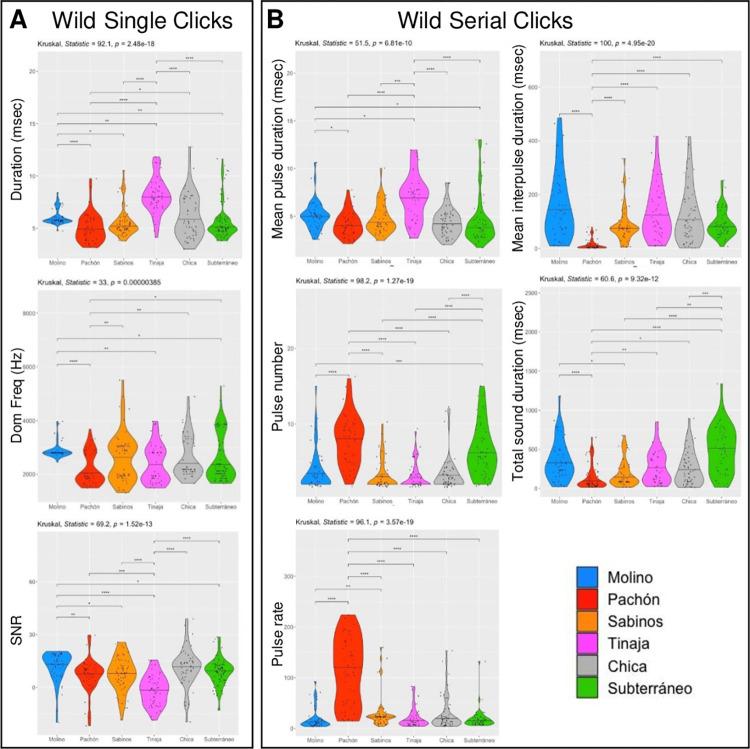
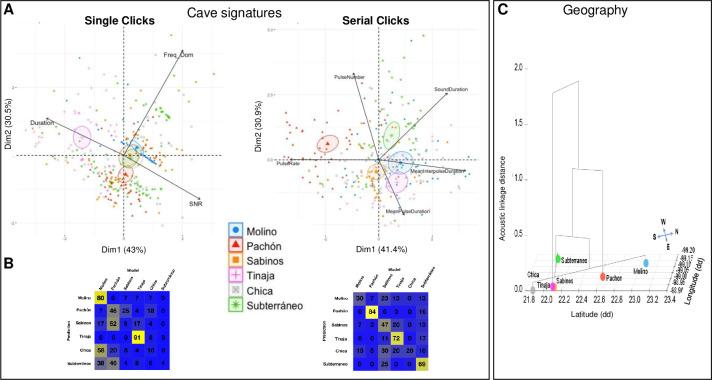
Complex patterns of acoustic communication exist throughout the animal kingdom, including underwater. The river-dwelling and the Pachón cave-adapted morphotypes of the fish Astyanax mexicanus are soniferous and share a repertoire of sounds. Their function and significance is mostly unknown. Here, we explored whether and how sounds produced by blind cavefishes inhabiting different Mexican caves may vary. We compared "Clicks" and "Serial Clicks" produced by cavefish in six different caves distributed in three mountain ranges in Mexico. We also sampled laboratory-bred cavefish lines originating from four of these caves. Sounds were extracted and analyzed using both a manual method and a machine learning-based automation tool developed in-house. Multi-parametric analyses suggest wild cave-specific acoustic signatures, or "accents". An acoustic code also existed in laboratory cavefish lines, suggesting a genetic basis for the evolution of this trait. The variations in acoustic parameters between caves of origin did not seem related to fish phenotypes, phylogeography or ecological conditions. We propose that the evolution of such acoustic signatures would progressively lead to the differentiation of local accents that may prevent interbreeding and thus contribute to speciation.
动物王国中存在着复杂的声学通讯模式,包括水下环境。墨西哥盲眼脂鲤的河栖和帕雄洞穴适应形态具有发声能力,并共享一系列声音。但其功能和意义大多未知。在这里,我们探讨了栖息在不同墨西哥洞穴中的盲眼洞穴鱼类所产生的声音是否存在差异,以及如何存在差异。我们比较了分布在墨西哥三个山脉的六个不同洞穴中,洞穴鱼类所产生的“咔哒声”和“连续咔哒声”。我们还对来自其中四个洞穴的实验室养殖洞穴鱼类系进行了采样。使用手动方法和我们内部开发的基于机器学习的自动化工具提取和分析声音。多参数分析表明,野生洞穴鱼类具有特定的声学特征,或“口音”。实验室养殖洞穴鱼类系也存在声学代码,这表明这种特征的进化具有遗传基础。起源洞穴之间的声学参数变化似乎与鱼类表型、系统发生或生态条件无关。我们提出,这种声学特征的进化可能会导致当地口音的逐渐分化,这可能会阻止杂交,从而有助于物种形成。



 Zotero 插件