
谵妄与阿尔茨海默病之间的因果关系:一项双向双样本孟德尔随机化研究。
Causal relationships between delirium and Alzheimer's disease: a bidirectional two-sample Mendelian randomization study.
机构信息
Department of Anesthesiology, Chongqing Emergency Medical Center, Chongqing University Central Hospital, School of Medicine, Chongqing University, Chongqing, China.
Department of Neurology, Chongqing Emergency Medical Center, Chongqing University Central Hospital, School of Medicine, Chongqing University, Chongqing, China.
出版信息
Eur J Med Res. 2023 Aug 7;28(1):271. doi: 10.1186/s40001-023-01245-w.
BACKGROUND
Previous observational studies have reported that delirium has an association with an increased risk of Alzheimer's disease (AD), and that patients with AD have a higher risk of developing delirium. However, due to the limitations of observational study, it is challenging to confirm whether delirium has a causal effect on AD or reverse causation exists.
METHODS
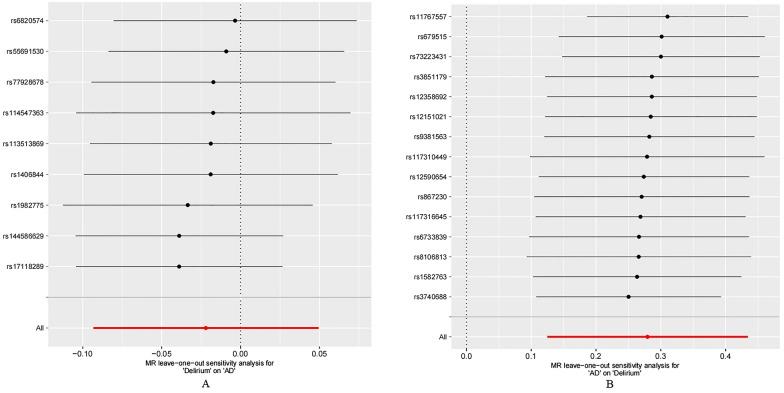
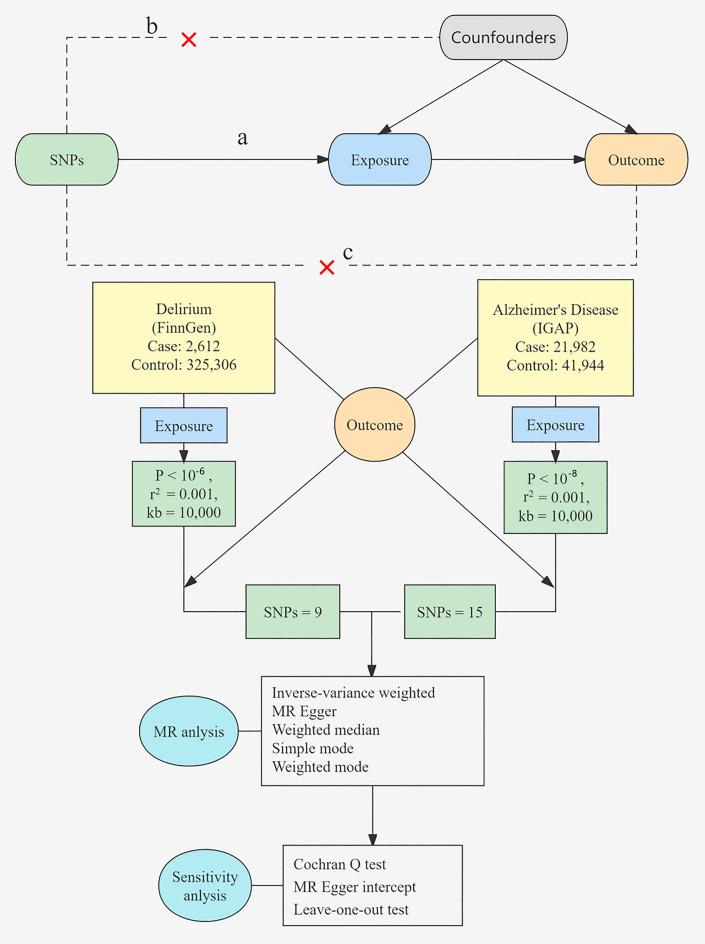
A bidirectional two-sample Mendelian randomization (MR) was performed to investigate the relationship between delirium and AD. Summary statistics from genome-wide association studies of delirium and AD phenotypes were utilized. Inverse-variance weighted (IVW) method was used as the main analysis approach, and additional analyses were performed using MR Egger, weighted median, simple mode and weighted mode to ensure result accuracy. Heterogeneity and horizontal pleiotropy were assessed using Cochran's Q statistics and MR Egger intercept, separately.
RESULTS
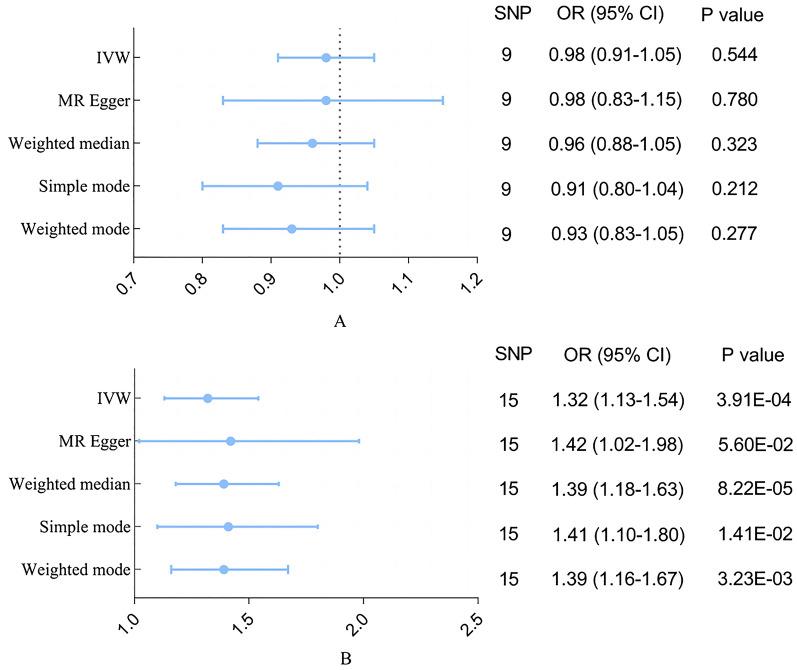
The MR analyses showed that genetically predicted delirium was not associated with AD (IVW: odds ratio [OR] 0.98, 95% CI 0.91-1.05, P = 0.544; MR Egger: OR 0.98, 95% CI 0.83-1.15, P = 0.780; weighted median: OR 0.96, 95% CI 0.88-1.05, P = 0.323; simple mode: OR 0.91, 95% CI 0.80-1.04, P = 0.212; weighted mode: OR 0.93, 95% CI 0.83-1.05, P = 0.277). However, in the reverse direction, AD was associated with delirium (IVW: OR 1.32, 95% CI 1.13-1.54, P = 3.91E-04; MR Egger: OR 1.42, 95% CI 1.02-1.98, P = 5.60E-02; Weighted median: OR 1.39, 95% CI 1.18-1.63, P = 8.22E-05; Simple mode: OR 1.41, 95% CI 1.10-1.80, P = 1.41E-02; Weighted mode: OR 1.39, 95% CI 1.16-1.67, P = 3.23E-03).
CONCLUSION
Based on the results of our MR study, there is no bidirectional causality between delirium and AD, delirium is not associated with an increased risk of AD, while genetically predicted AD is a potential causal risk factor for delirium.
背景
先前的观察性研究报告称,谵妄与阿尔茨海默病(AD)风险增加有关,而 AD 患者发生谵妄的风险更高。然而,由于观察性研究的局限性,难以确认谵妄是否对 AD 具有因果关系,或者是否存在反向因果关系。
方法
采用双向两样本 Mendelian 随机化(MR)方法研究谵妄与 AD 之间的关系。使用谵妄和 AD 表型的全基因组关联研究的汇总统计数据。采用逆方差加权(IVW)法作为主要分析方法,并使用 MR Egger、加权中位数、简单模式和加权模式进行额外分析,以确保结果准确性。分别采用 Cochran's Q 统计量和 MR Egger 截距评估异质性和水平偏倚。
结果
MR 分析表明,遗传预测的谵妄与 AD 无关(IVW:比值比[OR]0.98,95%置信区间[CI]0.91-1.05,P=0.544;MR Egger:OR 0.98,95% CI 0.83-1.15,P=0.780;加权中位数:OR 0.96,95% CI 0.88-1.05,P=0.323;简单模式:OR 0.91,95% CI 0.80-1.04,P=0.212;加权模式:OR 0.93,95% CI 0.83-1.05,P=0.277)。然而,在相反的方向上,AD 与谵妄有关(IVW:比值比[OR]1.32,95%置信区间[CI]1.13-1.54,P=3.91E-04;MR Egger:OR 1.42,95% CI 1.02-1.98,P=5.60E-02;加权中位数:OR 1.39,95% CI 1.18-1.63,P=8.22E-05;简单模式:OR 1.41,95% CI 1.10-1.80,P=1.41E-02;加权模式:OR 1.39,95% CI 1.16-1.67,P=3.23E-03)。
结论
基于我们的 MR 研究结果,谵妄与 AD 之间没有双向因果关系,谵妄与 AD 风险增加无关,而遗传预测的 AD 是谵妄的潜在因果风险因素。

 Zotero 插件