
CCL24在系统性硬化症中的作用。
The Role of CCL24 in Systemic Sclerosis.
作者信息
Levy Hilit, Gluschnaider Udi, Balbir-Gurman Alexandra
机构信息
R&D, Chemomab Ltd, Tel Aviv, Israel.
Rheumatology Institute, Rambam Health Care Campus, Haifa, Israel.
出版信息
Rambam Maimonides Med J. 2023 Jul 31;14(3):e0016. doi: 10.5041/RMMJ.10504.
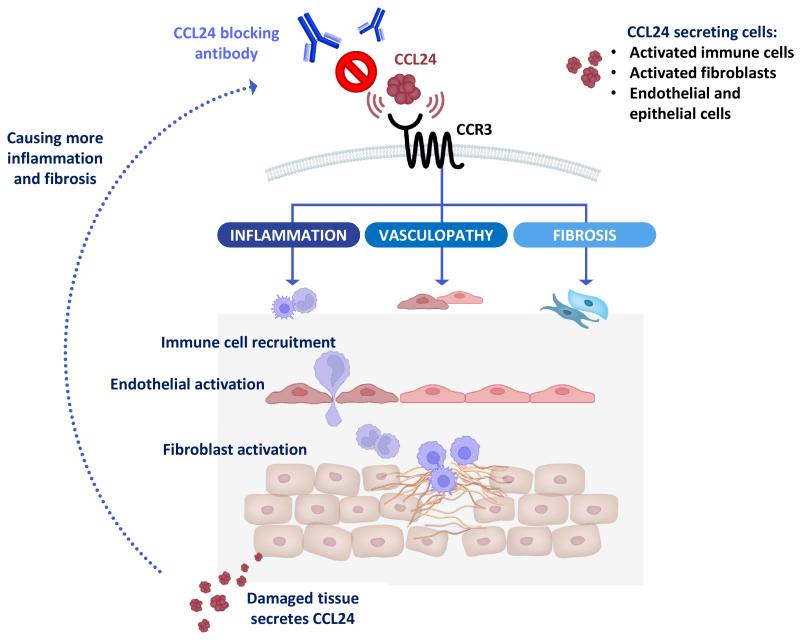
Systemic sclerosis (SSc) is a chronic immune-mediated disease characterized by microangiopathy, immune dysregulation, and progressive fibrosis of the skin and internal organs. Though not fully understood, the pathogenesis of SSc is dominated by microvascular injury, endothelial dysregulation, and immune response that are thought to be associated with fibroblast activation and related fibrogenesis. Among the main clinical subsets, diffuse SSc (dSSc) is a progressive form with rapid and disseminated skin thickening accompanied by internal organ fibrosis and dysfunction. Despite recent advances and multiple randomized clinical trials in early dSSc patients, an effective disease-modifying treatment for progressive skin fibrosis is still missing, and there is a crucial need to identify new targets for therapeutic intervention. Eotaxin-2 (CCL24) is a chemokine secreted by immune cells and epithelial cells, which promotes trafficking of immune cells and activation of pro-fibrotic cells through CCR3 receptor binding. Higher levels of CCL24 and CCR3 were found in the skin and sera of patients with SSc compared with healthy controls; elevated levels of CCL24 and CCR3 were associated with fibrosis and predictive of greater lung function deterioration. Growing evidence supports the potency of a CCL24-blocking antibody as an anti-inflammatory and anti-fibrotic modulating agent in multiple preclinical models that involve liver, skin, and lung inflammation and fibrosis. This review highlights the role of CCL24 in orchestrating immune, vascular, and fibrotic pathways, and the potential of CCL24 inhibition as a novel treatment for SSc.
系统性硬化症(SSc)是一种慢性免疫介导性疾病,其特征为微血管病变、免疫失调以及皮肤和内脏器官的进行性纤维化。尽管尚未完全了解,但SSc的发病机制主要由微血管损伤、内皮细胞失调和免疫反应主导,这些被认为与成纤维细胞活化及相关纤维化形成有关。在主要的临床亚组中,弥漫性SSc(dSSc)是一种进行性形式,皮肤快速弥漫性增厚,伴有内脏器官纤维化和功能障碍。尽管近期在早期dSSc患者中有多项进展和随机临床试验,但仍缺乏针对进行性皮肤纤维化的有效疾病改善治疗方法,因此迫切需要确定新的治疗干预靶点。嗜酸性粒细胞趋化因子-2(CCL24)是一种由免疫细胞和上皮细胞分泌的趋化因子,它通过与CCR3受体结合促进免疫细胞的转运和成纤维细胞的活化。与健康对照相比,SSc患者的皮肤和血清中CCL24和CCR3水平更高;CCL24和CCR3水平升高与纤维化相关,并预示着肺功能会有更大程度的恶化。越来越多的证据支持在涉及肝脏、皮肤和肺部炎症及纤维化的多种临床前模型中,CCL24阻断抗体作为一种抗炎和抗纤维化调节剂的效力。本综述强调了CCL24在协调免疫、血管和纤维化途径中的作用,以及抑制CCL24作为SSc新治疗方法的潜力。
 Zotero 插件