
在一款领先的戒烟智能手机应用程序中开发一款游戏(《内在之龙》):设计与可行性评估研究。
Developing a Game (Inner Dragon) Within a Leading Smartphone App for Smoking Cessation: Design and Feasibility Evaluation Study.
作者信息
White Justin S, Salem Marie K, Toussaert Séverine, Westmaas J Lee, Raiff Bethany R, Crane David, Warrender Edward, Lyles Courtney, Abroms Lorien, Thrul Johannes
机构信息
Philip R Lee Institute for Health Policy Studies, University of California, San Francisco, CA, United States.
Department of Epidemiology and Biostatistics, University of California, San Francisco, CA, United States.
出版信息
JMIR Serious Games. 2023 Aug 11;11:e46602. doi: 10.2196/46602.
BACKGROUND
Several stand-alone smartphone apps have used serious games to provide an engaging approach to quitting smoking. So far, the uptake of these games has been modest, and the evidence base for their efficacy in promoting smoking cessation is still evolving. The feasibility of integrating a game into a popular smoking cessation app is unclear.
OBJECTIVE
The aim of this paper was to describe the design and iterative development of the Inner Dragon game within Smoke Free, a smartphone app with proven efficacy, and the results of a single-arm feasibility trial as part of a broad program that seeks to assess the effectiveness of the gamified app for smoking cessation.
METHODS
In phase 1, the study team undertook a multistep process to design and develop the game, including web-based focus group discussions with end users (n=15). In phase 2, a single-arm study of Smoke Free users who were trying to quit (n=30) was conducted to assess the feasibility and acceptability of the integrated game and to establish the feasibility of the planned procedures for a randomized pilot trial.
RESULTS
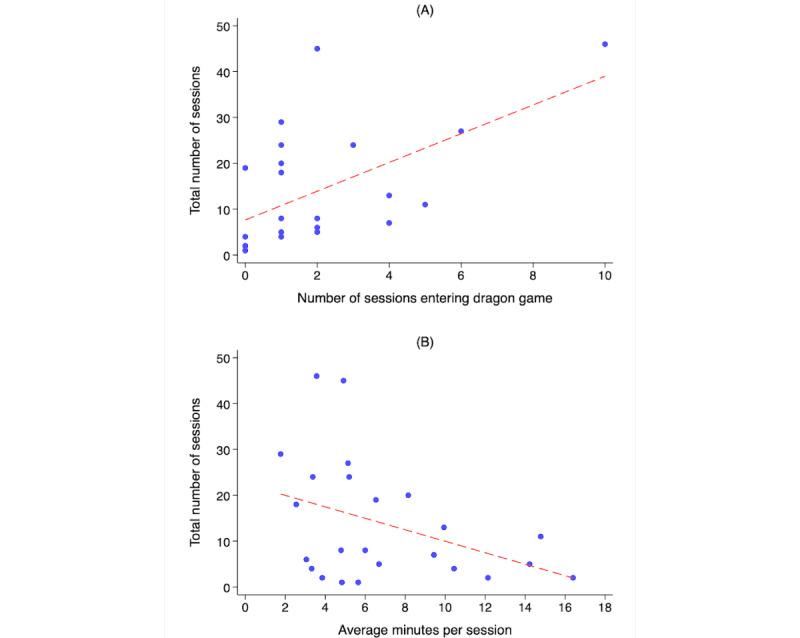
Phase 1 led to the final design of Inner Dragon, informed by principles from psychology and behavioral economics and incorporating several game mechanics designed to increase user engagement and retention. Inner Dragon users maintain an evolving pet dragon that serves as a virtual avatar for the users' progress in quitting. The phase-2 study established the feasibility of the study methods. The mean number of app sessions completed per user was 13.8 (SD 13.1; median 8; range 1-46), with a mean duration per session of 5.8 (median 1.1; range 0-81.1) minutes. Overall, three-fourths (18/24, 75%) of the participants entered the Inner Dragon game at least once and had a mean of 2.4 (SD 2.4) sessions of game use. The use of Inner Dragon was positively associated with the total number of app sessions (correlation 0.57). The mean satisfaction score of participants who provided ratings (11/24, 46%) was 4.2 (SD 0.6) on a 5-point scale; however, satisfaction ratings for Inner Dragon were only completed by 13% (3/24) of the participants.
CONCLUSIONS
Findings supported further development and evaluation of Inner Dragon as a beneficial feature of Smoke Free. The next step of this study is to conduct a randomized pilot trial to determine whether the gamified version of the app increases user engagement over a standard version of the app.
背景
几款独立的智能手机应用程序利用严肃游戏提供了一种有趣的戒烟方法。到目前为止,这些游戏的采用率不高,其促进戒烟效果的证据基础仍在不断发展。将一款游戏集成到一款广受欢迎的戒烟应用程序中的可行性尚不清楚。
目的
本文旨在描述“无烟”(一款已证实具有疗效的智能手机应用程序)中“内心之龙”游戏的设计与迭代开发,以及作为一项广泛计划一部分的单臂可行性试验结果,该计划旨在评估这款游戏化应用程序对戒烟的有效性。
方法
在第1阶段,研究团队采用多步骤流程来设计和开发这款游戏,包括与终端用户进行基于网络的焦点小组讨论(n = 15)。在第2阶段,对试图戒烟的“无烟”用户进行了单臂研究(n = 30),以评估集成游戏的可行性和可接受性,并确定随机试点试验计划程序的可行性。
结果
第1阶段促成了“内心之龙”的最终设计,该设计借鉴了心理学和行为经济学原理,并融入了多种旨在提高用户参与度和留存率的游戏机制。“内心之龙”的用户饲养一只不断成长的宠物龙,它是用户戒烟进展的虚拟化身。第2阶段的研究确定了研究方法的可行性。每位用户完成的应用程序会话平均次数为13.8次(标准差13.1;中位数8;范围1 - 46),每次会话的平均时长为5.8分钟(中位数1.1;范围0 - 81.1)。总体而言,四分之三(18/24,75%)的参与者至少进入过一次“内心之龙”游戏,游戏使用的平均次数为2.4次(标准差2.4)。“内心之龙”的使用与应用程序会话总数呈正相关(相关性为0.57)。给出评分的参与者(11/24,46%)的平均满意度评分为4.2(标准差0.6)(满分5分);然而,只有13%(3/24)的参与者完成了对“内心之龙”的满意度评级。
结论
研究结果支持进一步开发和评估“内心之龙”,将其作为“无烟”应用程序的一项有益功能。本研究的下一步是进行随机试点试验,以确定该应用程序的游戏化版本是否比标准版本能提高用户参与度。


 Zotero 插件