
印度低出生体重和早产的相关因素。
Correlates of low birth weight and preterm birth in India.
机构信息
Department of Population & Development, International Institute for Population Sciences, Mumbai, Maharashtra, India.
出版信息
PLoS One. 2023 Aug 17;18(8):e0287919. doi: 10.1371/journal.pone.0287919. eCollection 2023.
BACKGROUND
In the 21st century, India is still struggling to reduce the burden of malnutrition and child mortality, which is much higher than the neighbouring countries such as Nepal and Shri Lanka. Preterm birth (PTB) and low birth weight (LBW) predispose early-age growth faltering and premature mortality among children below the age of five. Thus, highlighting the determinants of LBW and PTB is necessary to achieve sustainable development goals.
OBJECTIVE
The present study provides macro-level estimates of PTB and LBW and aims to highlight the nature of the association between various demographic, socioeconomic, and maternal obstetric variables with these outcomes using a nationally representative dataset.
METHODS
Data on 170,253 most recent births from the National Family health survey (NFHS-5) 2019-21 was used for the analysis. The estimates of PTB and LBW are measured by applying sample weights. The correlates of LBW and PTB were analyzed using logistic models.
RESULTS
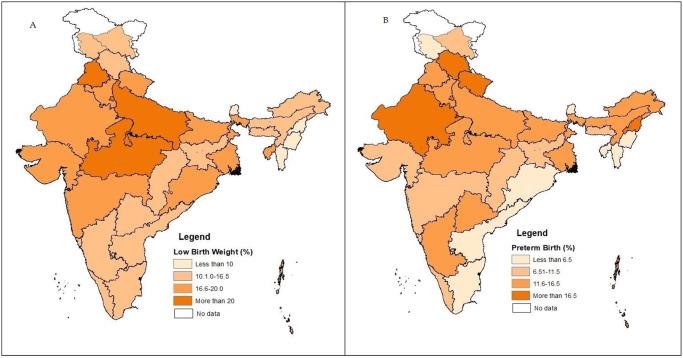
There were cross-state disparities in the prevalence of PTB and LBW. In India, an estimated 12% and 18% of children were LBW and PTB, respectively, in 2019-21. Maternal obstetric and anthropometric factors such as lack of antenatal care, previous caesarean delivery, and short-stature mothers were associated positively with adverse birth outcomes such as LBW and PTB. However, a few correlates were found to be differently associated with PTB and LBW. Mothers belonging to richer wealth status had higher chances of having a preterm birth (OR = 1.16, 95% CI: 1.11-1.20) in comparison to poor mothers. In contrast, the odds of having LBW infants were found to be increased with the decreasing level of the mother's education and wealth quintile.
CONCLUSIONS
In India, PTB and LBW can be improved by strengthening existing ante-natal care services and evaluating the effects of the history of caesarean births on future pregnancies.
背景
在 21 世纪,印度仍在努力减轻营养不良和儿童死亡率的负担,而印度的这两项指标均远高于尼泊尔和斯里兰卡等邻国。早产和低出生体重使五岁以下儿童的早期生长发育迟缓,并导致其过早死亡。因此,强调导致低出生体重和早产的因素对于实现可持续发展目标是必要的。
目的
本研究提供了早产和低出生体重的宏观估计,并旨在利用全国代表性数据集,突出各种人口统计学、社会经济和产妇产科变量与这些结果之间的关联性质。
方法
使用来自 2019-21 年全国家庭健康调查(NFHS-5)的 170253 名最近出生的儿童的数据进行分析。早产和低出生体重的估计是通过应用样本权重来衡量的。使用逻辑模型分析低出生体重和早产的相关因素。
结果
早产和低出生体重在各州之间存在差异。在印度,2019-21 年,估计有 12%和 18%的儿童分别为低出生体重和早产。产妇产科和人体测量因素,如缺乏产前护理、先前剖腹产和身材矮小的母亲,与低出生体重和早产等不良出生结果呈正相关。然而,一些相关因素被发现与早产和低出生体重的关联不同。与贫困母亲相比,属于较富裕财富状况的母亲早产的几率更高(OR=1.16,95%CI:1.11-1.20)。相反,发现母亲教育程度和财富五分位数的降低与低出生体重婴儿的几率增加有关。
结论
在印度,可以通过加强现有的产前护理服务和评估剖腹产历史对未来妊娠的影响,来改善早产和低出生体重的状况。
 Zotero 插件