
印度宫内暴露于细颗粒物与不良出生结局:利用2019 - 2021年遥感和人口健康调查数据的地理统计建模
In-utero exposure to PM2.5 and adverse birth outcomes in India: Geostatistical modelling using remote sensing and demographic health survey data 2019-21.
作者信息
Jana Arup, Pramanik Malay, Maiti Arabinda, Chattopadhyay Aparajita, Abed Al Ahad Mary
机构信息
Department of Humanities and Social Sciences, Indian Institute of Technology Delhi, Hauz Khas, New Delhi, India.
Urban Innovation and Sustainability, School of Environment, Resources and Development (SERD), Asian Institute of Technology (AIT), Klong Luang, Pathumthani, Thailand.
出版信息
PLOS Glob Public Health. 2025 Jul 2;5(7):e0003798. doi: 10.1371/journal.pgph.0003798. eCollection 2025.
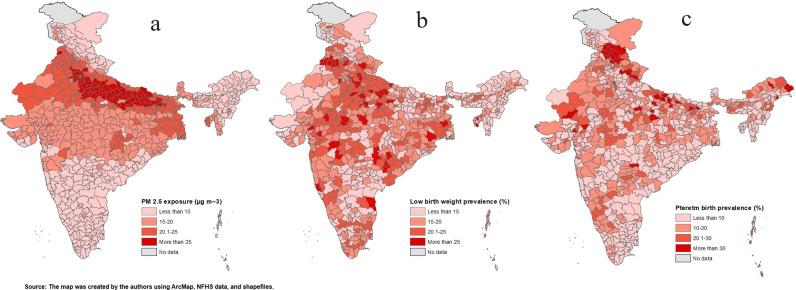
This study investigates the influence of air quality on birth weight and preterm birth. Utilizing data from the national family health survey and raster images, the study employs various statistical analyses and spatial models to elucidate the connection between in-utero exposure to air pollution and birth outcomes, both at the individual and district levels. It was observed that approximately 13% of children were born prematurely, and 17% were born with low birth weight. Increased ambient particulate matter 2.5 concentrations during pregnancy were associated with higher odds of low birth weight (AOR: 1.4; 95% CI: 1.29-1.45). Mothers exposed to particulate matter 2.5 during pregnancy had a heightened likelihood of delivering prematurely (AOR: 1.7; 95% CI: 1.57-1.77) in comparison to unexposed mothers. Climatic factors such as rainfall and temperature had a greater association with adverse birth outcomes. Children residing in the Northern districts of India appeared to be more susceptible to the adverse effects of ambient air pollution. Employing a distributed spline approach, the study identified a discernible upward trend in the risk of adverse birth outcomes as the level of exposure increased, particularly following an exposure level of 40 particulate matter 2.5 ug/m3. A 10 μg m - 3 increase in particulate matter 2.5 exposure was associated with a 5% increase in the prevalence of low birth weight and a 12% increase in preterm birth. Among the different spatial models used in this study, the multiscale geographically weighted regression spatial model showed the best fit to the actual scenario, effectively capturing the spatial relationships between particulate matter 2.5 exposure and adverse birth outcomes. In addition to addressing immediate determinants such as nutrition and maternal healthcare, it is imperative to collaboratively address distal factors encompassing both indoor and outdoor pollution to attain lasting enhancements in child health.
本研究调查空气质量对出生体重和早产的影响。该研究利用全国家庭健康调查数据和栅格图像,采用各种统计分析和空间模型,以阐明子宫内接触空气污染与个体和地区层面出生结局之间的联系。据观察,约13%的儿童早产,17%出生时体重过低。孕期环境中细颗粒物2.5浓度增加与低出生体重几率较高相关(调整后比值比:1.4;95%置信区间:1.29 - 1.45)。与未接触细颗粒物2.5的母亲相比,孕期接触细颗粒物2.5的母亲早产的可能性更高(调整后比值比:1.7;95%置信区间:1.57 - 1.77)。降雨和温度等气候因素与不良出生结局的关联更大。居住在印度北部地区的儿童似乎更容易受到环境空气污染的不利影响。采用分布式样条方法,该研究发现随着接触水平的增加,不良出生结局风险呈现明显上升趋势,尤其是在接触水平达到每立方米40微克细颗粒物2.5之后。细颗粒物2.5接触量每增加10微克/立方米,低出生体重患病率增加5%,早产率增加12%。在本研究使用的不同空间模型中,多尺度地理加权回归空间模型对实际情况的拟合效果最佳,有效捕捉了细颗粒物2.5接触与不良出生结局之间的空间关系。除了解决营养和孕产妇保健等直接决定因素外,必须共同解决包括室内和室外污染在内的远端因素,以实现儿童健康的持久改善。



 Zotero 插件