
津巴布韦哈拉雷开展全面伤寒结合疫苗运动对儿童抗菌药物处方的影响:一项混合方法研究。
The effect of a comprehensive typhoid conjugate vaccine campaign on antimicrobial prescribing in children in Harare, Zimbabwe: a mixed methods study.
机构信息
Biomedical Research and Training Institute, Harare, Zimbabwe; Clinical Research Department, London School of Hygiene & Tropical Medicine, London, UK; Institute of Medical Microbiology, University Hospital Münster, Münster, Germany.
Biomedical Research and Training Institute, Harare, Zimbabwe.
出版信息
Lancet Glob Health. 2023 Sep;11(9):e1422-e1431. doi: 10.1016/S2214-109X(23)00319-4.
BACKGROUND
Vaccines prevent infections and could subsequently reduce antimicrobial use. A 1-week mass vaccination campaign was done with Typbar-TCV (Bharat Biotech, Hyderabad, India) between Feb 25 and March 4, 2019. We investigated whether this typhoid conjugate vaccine campaign could affect antimicrobial prescribing in children presenting to primary care in Harare, Zimbabwe.
METHODS
In this mixed methods study, data for acute paediatric outpatient consultations between Jan 1, 2018, and March 31, 2020, were collected from five clinics in Harare. Interrupted time series analysis was done to compare prescription data before and after the campaign. To contextualise findings, qualitative data were collected between April 20, 2021, and July 20, 2022, comprising ethnographic research (ie, workshops, surveys, observations, and interviews) in 14 clinics. Ethnographic data were used for thematic analysis. The primary outcome was monthly antimicrobial prescriptions in children aged 6 months to 15 years, normalised by the number of trauma events in all age groups.
FINDINGS
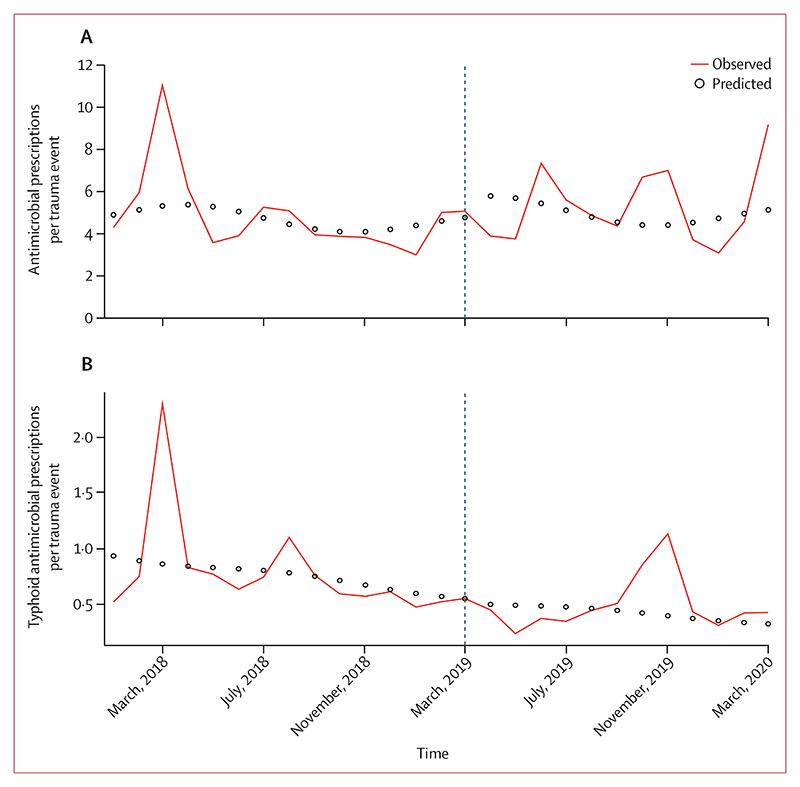
In the data collection period, 27 107 paediatric consultations were recorded. 17 951 (66·2%) of 27 107 children were prescribed antimicrobials. Despite the perceived reduction in typhoid cases and a decreasing trend in the prescription of antimicrobials commonly used to treat typhoid (ie, ciprofloxacin and azithromycin), mass vaccination with Typbar-TCV did not affect the total rate of antimicrobials (adjusted rate ratio, 1·20, 95% CI 0·70-2·05, p=0·51) or the rate of typhoid antimicrobials prescribed (0·93, 0·44-1·96, p=0·85). Unsafe water sources and insufficient diagnostic services were reported to contribute to the continued disease burden and antimicrobial prescription.
INTERPRETATION
Non-specific febrile illness caused by confirmed or suspected typhoid is a common cause of antimicrobial use in endemic areas. Although effective in preventing typhoid fever, we were unable to identify any effect of Typbar-TCV on antimicrobial prescribing. Ethnographic research showed the effect of contextual factors on antimicrobial prescribing, including concerns regarding safe water access, appropriate sewage disposal, health-care and diagnostic availability. To realise effects beyond disease burden reduction, holistic approaches addressing these concerns are needed so that the value of vaccines mitigating the effects of antimicrobial use as a driver of antimicrobial resistance is fully achieved.
FUNDING
Wellcome Trust.
TRANSLATION
For the Shona translation of the abstract see Supplementary Materials section.
背景
疫苗可预防感染,并可随后减少抗菌药物的使用。2019 年 2 月 25 日至 3 月 4 日,使用 Bharat Biotech(印度海德拉巴)的 Typbar-TCV 进行了为期一周的大规模疫苗接种运动。我们调查了这种伤寒结合疫苗接种运动是否会影响津巴布韦哈拉雷初级保健机构就诊的儿童的抗菌药物处方。
方法
在这项混合方法研究中,收集了 2018 年 1 月 1 日至 2020 年 3 月 31 日期间五个诊所的急性儿科门诊就诊数据。使用中断时间序列分析比较了运动前后的处方数据。为了使研究结果具有背景意义,于 2021 年 4 月 20 日至 2022 年 7 月 20 日期间收集了定性数据,包括在 14 个诊所进行的民族志研究(即研讨会、调查、观察和访谈)。民族志数据用于主题分析。主要结局是 6 个月至 15 岁儿童每月的抗菌药物处方,按所有年龄段的创伤事件数量进行标准化。
结果
在数据收集期间,共记录了 27107 例儿科就诊。27107 例儿童中,17951 例(66.2%)开具了抗菌药物。尽管伤寒病例的数量减少,并且治疗伤寒常用的抗菌药物(即环丙沙星和阿奇霉素)的处方呈下降趋势,但使用 Typbar-TCV 进行大规模疫苗接种并未影响抗菌药物的总使用率(调整后的比值比,1.20,95%CI 0.70-2.05,p=0.51)或伤寒抗菌药物的处方率(0.93,0.44-1.96,p=0.85)。报告称不安全的水源和不足的诊断服务是导致疾病负担和抗菌药物处方持续存在的原因。
解释
确认或疑似伤寒引起的非特异性发热性疾病是在流行地区使用抗菌药物的常见原因。尽管 Typbar-TCV 对预防伤寒有效,但我们无法确定它对抗菌药物处方的任何影响。民族志研究表明,上下文因素对抗菌药物处方的影响,包括对安全用水获取、适当的污水排放、卫生保健和诊断服务的可用性的关注。为了实现除减少疾病负担以外的效果,需要采取整体方法来解决这些问题,以使疫苗减轻抗菌药物作为抗菌药物耐药性驱动因素的影响的价值得到充分实现。
资助
惠康信托基金会。
 Zotero 插件