
意大利那不勒斯兽医教学医院犬类、其主人及兽医工作人员中的抗菌药物耐药菌定植情况
Antimicrobial Resistant Species Colonization in Dogs, Their Owners, and Veterinary Staff of the Veterinary Teaching Hospital of Naples, Italy.
作者信息
Nocera Francesca Paola, Pizzano Francesca, Masullo Angelo, Cortese Laura, De Martino Luisa
机构信息
Department of Veterinary Medicine and Animal Production, University of Naples 'Federico II', Via F. Delpino 1, 80137 Naples, Italy.
Task Force on Microbiome Studies, University of Naples 'Federico II', 80137 Naples, Italy.
出版信息
Pathogens. 2023 Aug 5;12(8):1016. doi: 10.3390/pathogens12081016.
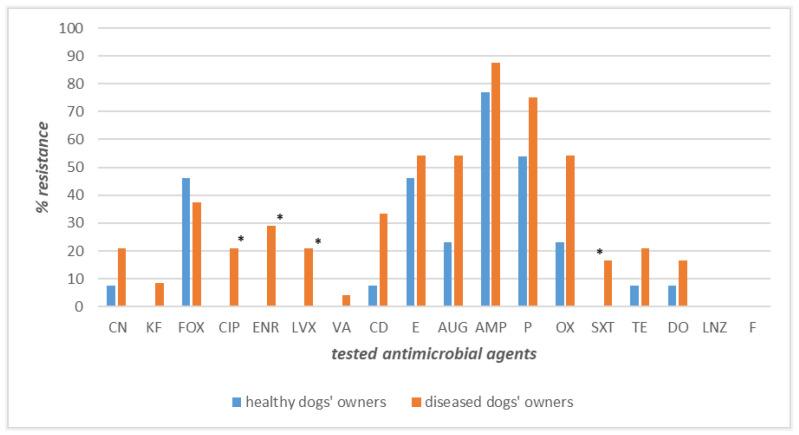
This study aimed to identify species isolated from nasal swabs of both healthy and diseased dogs, and those of human origin, obtained from nasal swabs of both owners and veterinary staff. Firstly, pet owners were requested to complete a questionnaire relating to the care and relationship with their pets, whose results mainly showed a statistically significant higher frequency of hand washing in diseased dogs' owners than in healthy dogs' owners. Canine nasal swabs were obtained from 43 diseased dogs and 28 healthy dogs, while human nasal swabs were collected from the respective dogs' owners (71 samples) and veterinary staff (34 samples). The isolation and identification of spp. were followed by disk diffusion method to define the antimicrobial resistance profiles against 18 different molecules. was the most frequent isolated strain in both diseased (33.3%) and healthy (46.1%) dogs. was the most frequent isolated bacterium in diseased dogs' owners (66.6%), while in nasal samples of healthy dogs' owners, the same frequency of isolation (38.4%) was observed for both and . All the isolated strains showed good susceptibility levels to the tested antimicrobials; however, the carriage of oxacillin-resistant strains was significantly higher in diseased dogs than in healthy ones (71% and 7.7%, respectively). Only in three cases the presence of the same bacterial species with similar antimicrobial resistance profiles in dogs and their owners was detected, suggesting the potential bacterial transmission. In conclusion, this study suggests potential transmission risk of staphylococci from dogs to humans or , and highlights that the clinical relevance of transmission from dog to human should not be underestimated, as well as the role of from human to dog transmission.
本研究旨在鉴定从健康和患病犬的鼻拭子以及从主人和兽医工作人员的鼻拭子中获取的人源分离株。首先,要求宠物主人填写一份关于其与宠物的护理及关系的问卷,结果主要显示,患病犬主人洗手的频率在统计学上显著高于健康犬主人。从43只患病犬和28只健康犬获取犬鼻拭子,同时从各自犬的主人(71份样本)和兽医工作人员(34份样本)处采集人鼻拭子。采用纸片扩散法对分离出的 spp. 进行分离和鉴定,以确定其对18种不同分子的抗菌药物耐药谱。在患病犬(33.3%)和健康犬(46.1%)中, 都是最常分离出的菌株。在患病犬主人中, 是最常分离出的细菌(66.6%),而在健康犬主人的鼻样本中, 和 的分离频率相同(均为38.4%)。所有分离菌株对所测试的抗菌药物均表现出良好的敏感性;然而,耐苯唑西林菌株在患病犬中的携带率显著高于健康犬(分别为71%和7.7%)。仅在3例中检测到犬及其主人中存在具有相似抗菌药物耐药谱的相同细菌种类,提示存在潜在的细菌传播。总之,本研究提示葡萄球菌从犬传播至人或 的潜在风险,并强调不应低估犬向人传播 的临床相关性以及人向犬传播 的作用。


 Zotero 插件