
评估薰衣草精油和芳樟醇对犬外耳炎白色念珠菌与金黄色葡萄球菌和表皮葡萄球菌双重生物膜的抗菌和抗生物膜功效。
Evaluating the Antimicrobial and Antibiofilm Efficacy of Lavender Essential Oil and Linalool on Dual Candida albicans Biofilms With Staphylococcus aureus and Staphylococcus epidermidis From Canine External Otitis.
作者信息
Neisari Navid, Sharifzadeh Aghil, Fasaei Bahar Nayeri, Asadi Sepideh, Khosravi Alireza, Rafati Zomorodi Abolfazl, Malakootikhah Javad
机构信息
Department of Microbiology and Immunology, Faculty of Veterinary Medicine, University of Tehran, Tehran, Iran.
Department of Pathobiology, Faculty of Veterinary Medicine, Amol University of Special Modern Technologies, Amol, Iran.
出版信息
Vet Med Sci. 2025 May;11(3):e70407. doi: 10.1002/vms3.70407.
BACKGROUND
Biofilm formation significantly contributes to the rise of antimicrobial resistance, treatment failures and recurrent infections. Essential oils (EOs), particularly lavender EO (LEO), have gained attention for their antimicrobial and antibiofilm activities. This study investigates the effects of LEO and linalool on Staphylococcus aureus (S. aureus), Staphylococcus epidermidis (S. epidermidis), and Candida albicans (C. albicans) isolates.
MATERIALS AND METHODS
The chemical composition of LEO was analysed using gas chromatography-mass spectrometry (GC-MS). Eight clinical and reference microorganisms were tested, including four C. albicans, three S. aureus, and three S. epidermidis isolates, to assess their biofilm-producing potential with the tissue microtiter plate method. Antimicrobial and antibiofilm activities of LEO and linalool were evaluated in planktonic, single-biofilm, and dual-biofilm phases through microbroth dilution and scanning electron microscopy (SEM).
RESULTS
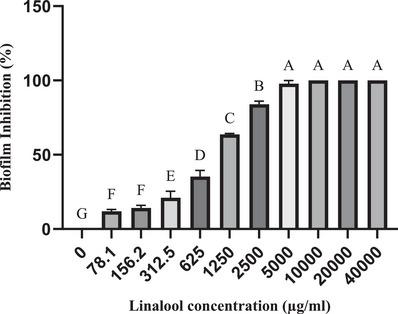
The minimum inhibitory concentration (MIC) and minimum bactericidal/fungicidal concentration (MBC/MFC) of LEO in the planktonic phase were 1250 µg/mL and 2500 µg/mL against Staphylococcus isolates, respectively, while the corresponding value for C. albicans isolates was 5000 µg/mL. 90% biofilm inhibition was achieved at concentrations of 5000 µg/mL and 40,000 µg/mL for Staphylococcus and C. albicans, respectively. LEO completely inhibited dual biofilms formed by C. albicans/S. aureus and C. albicans/S. epidermidis at 20,000 µg/mL, whereas linalool attained 100% inhibition at 40,000 µg/mL.
CONCLUSION
LEO demonstrates significant antimicrobial and antibiofilm activity against Staphylococcus and C. albicans isolates, effective in both planktonic and biofilm phases.
背景
生物膜形成显著促进了抗菌药物耐药性的上升、治疗失败和反复感染。精油(EOs),特别是薰衣草精油(LEO),因其抗菌和抗生物膜活性而受到关注。本研究调查了LEO和芳樟醇对金黄色葡萄球菌(S. aureus)、表皮葡萄球菌(S. epidermidis)和白色念珠菌(C. albicans)分离株的影响。
材料与方法
采用气相色谱-质谱联用(GC-MS)分析LEO的化学成分。测试了8种临床和参考微生物,包括4株白色念珠菌、3株金黄色葡萄球菌和3株表皮葡萄球菌分离株,采用组织微量滴定板法评估它们形成生物膜的潜力。通过微量肉汤稀释法和扫描电子显微镜(SEM),在浮游、单生物膜和双生物膜阶段评估LEO和芳樟醇的抗菌和抗生物膜活性。
结果
LEO在浮游阶段对葡萄球菌分离株的最低抑菌浓度(MIC)和最低杀菌/杀真菌浓度(MBC/MFC)分别为1250 μg/mL和2500 μg/mL,而白色念珠菌分离株的相应值为5000 μg/mL。对于葡萄球菌和白色念珠菌,分别在5000 μg/mL和40000 μg/mL的浓度下实现了90%的生物膜抑制。LEO在20000 μg/mL时完全抑制了白色念珠菌/金黄色葡萄球菌和白色念珠菌/表皮葡萄球菌形成的双生物膜,而芳樟醇在40000 μg/mL时达到100%的抑制率。
结论
LEO对葡萄球菌和白色念珠菌分离株具有显著的抗菌和抗生物膜活性,在浮游和生物膜阶段均有效。




 Zotero 插件