
用于生物医学应用的壳聚糖/海藻酸盐薰衣草精油膜的抗菌活性评估
Antibacterial Activity Assessment of Chitosan/Alginate Lavender Essential Oil Membranes for Biomedical Applications.
作者信息
Cruz Sánchez Encarnación, García María Teresa, Gracia Ignacio, Fernández-Bermejo Soledad Illescas, Rodríguez Juan Francisco, García-Vargas Jesús Manuel, Vidal Roig Dolors
机构信息
Department of Chemical Engineering, Facultad de Ciencias y Tecnologías Químicas, University of Castilla-La Mancha, Avda. Camilo José Cela 12, 13071 Ciudad Real, Spain.
Department of Medical Sciences, Microbiology Area, Facultad de Medicina, University of Castilla-La Mancha, Paseo de Moledores s/n, 13071 Ciudad Real, Spain.
出版信息
Membranes (Basel). 2024 Jan 1;14(1):12. doi: 10.3390/membranes14010012.
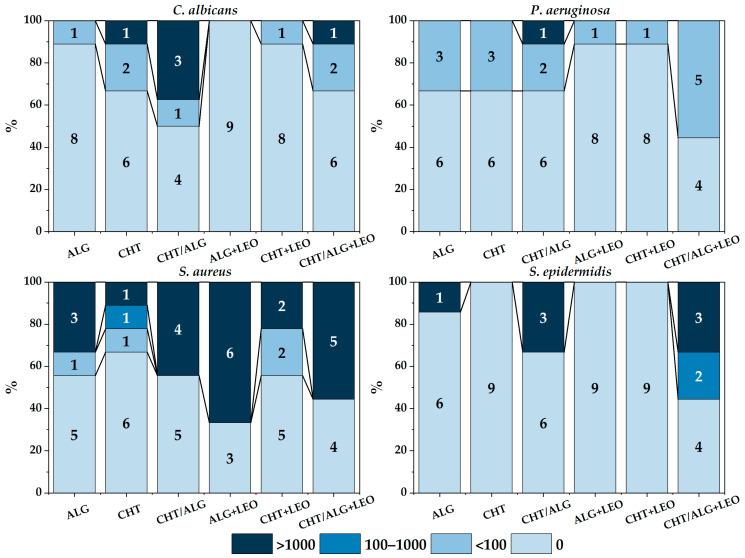
The demand for natural products in the treatment of dermatological pathologies has boosted the use of bioactive substances such as lavender essential oil (LEO), which stands out for its anti-inflammatory and antioxidant properties and its antimicrobial potential. Biopolymers such as chitosan (CHT) and alginate (ALG) are biodegradable and biocompatible and have proven their viability in biomedical applications such as skin regeneration. The inhibitory effect of LEO on the growth of skin-related bacterial species , , and the fungus was studied by incorporating 1% LEO encapsulated in CHT, ALG, and CHT/ALG membranes. Despite the verification of the antimicrobial effect of all type of membranes, no synergistic effect was observed following the addition of LEO. and showed the most growth on the different substrates and demonstrated the highest inhibition. This is a first approach using microorganisms isolated from clinical samples or skin microbiota. Further investigation would be advisable using more clinical strains for each microorganism to validate their biomedical applicability.
对天然产物用于治疗皮肤病的需求推动了生物活性物质的使用,如薰衣草精油(LEO),它以其抗炎、抗氧化特性以及抗菌潜力而脱颖而出。壳聚糖(CHT)和藻酸盐(ALG)等生物聚合物具有生物可降解性和生物相容性,并已在皮肤再生等生物医学应用中证明了其可行性。通过将1%封装在CHT、ALG和CHT/ALG膜中的LEO掺入,研究了LEO对与皮肤相关的细菌物种、和真菌生长的抑制作用。尽管验证了所有类型膜的抗菌效果,但添加LEO后未观察到协同效应。和在不同底物上生长最多,而表现出最高的抑制作用。这是首次使用从临床样本或皮肤微生物群中分离出的微生物进行的研究。建议进一步使用更多每种微生物的临床菌株进行调查,以验证它们的生物医学适用性。




 Zotero 插件