
米力农与多巴酚丁胺治疗心源性休克的疗效:一项更新的系统评价与荟萃分析
Efficacy of Milrinone and Dobutamine in Cardiogenic Shock: An Updated Systematic Review and Meta-Analysis.
作者信息
Abdel-Razek Omar, Di Santo Pietro, Jung Richard G, Parlow Simon, Motazedian Pouya, Prosperi-Porta Graeme, Visintini Sarah, Marbach Jeffrey A, Ramirez F Daniel, Simard Trevor, Labinaz Marino, Mathew Rebecca, Hibbert Benjamin
机构信息
CAPITAL Research Group, University of Ottawa Heart Institute, Ottawa, Ontario, Canada.
Division of Cardiology, University of Ottawa Heart Institute, Ottawa, Ontario, Canada.
出版信息
Crit Care Explor. 2023 Aug 28;5(9):e0962. doi: 10.1097/CCE.0000000000000962. eCollection 2023 Sep.
OBJECTIVES
Inotropic support is commonly used in patients with cardiogenic shock (CS). High-quality data guiding the use of dobutamine or milrinone among this patient population is limited. We compared the efficacy and safety of these two inotropes among patients with low cardiac output states (LCOS) or CS.
DATA SOURCES
MEDLINE, Embase, and Cochrane Central Register of Controlled Trials were searched up to February 1, 2023, using key terms and index headings related to LCOS or CS and inotropes.
DATA EXTRACTION
Two independent reviewers included studies that compared dobutamine to milrinone on all-cause in-hospital mortality, length of ICU stay, length of hospital stay, and significant arrhythmias in hospitalized patients.
DATA SYNTHESIS
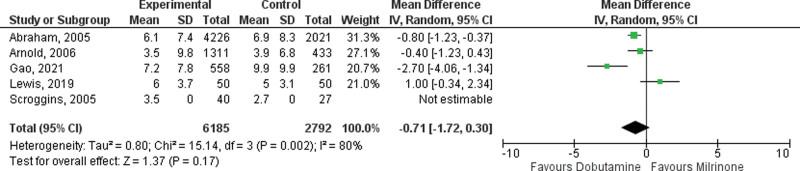
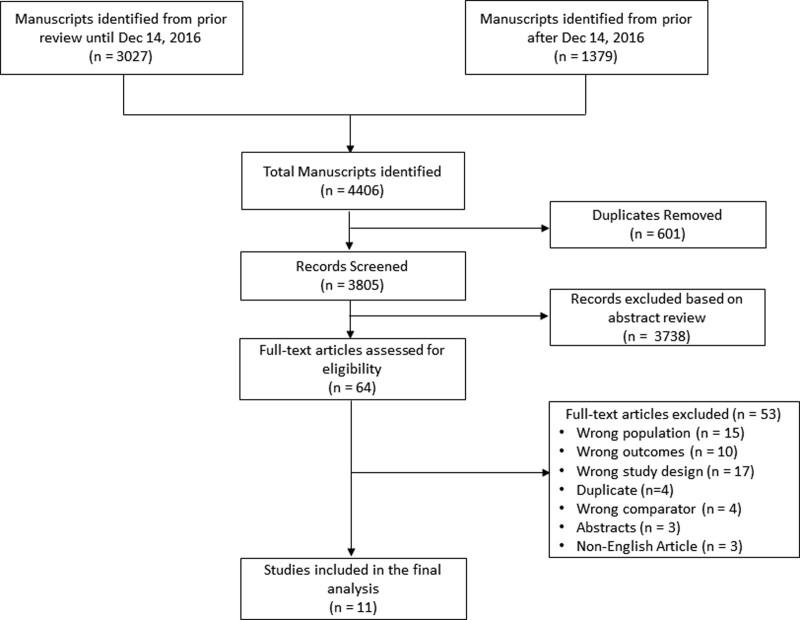
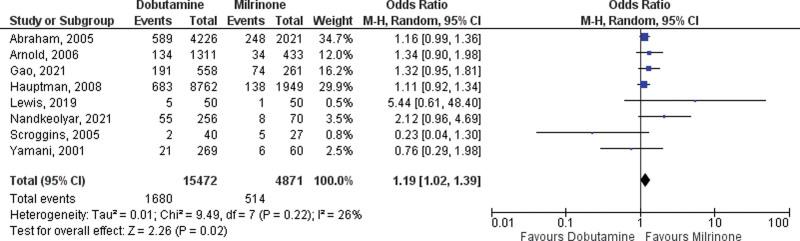
A total of eleven studies with 21,084 patients were included in the meta-analysis. Only two randomized controlled trials were identified. The primary outcome, all-cause mortality, favored milrinone in observational studies only (odds ratio [OR] 1.19 (95% CI, 1.02-1.39; = 0.02). In-hospital length of stay (LOS) was reduced with dobutamine in observational studies only (mean difference -1.85 d; 95% CI -3.62 to -0.09; = 0.04). There was no difference in the prevalence of significant arrhythmias or in ICU LOS.
CONCLUSIONS
Only limited data exists supporting the use of one inotropic agent over another exists. Dobutamine may be associated with a shorter hospital LOS; however, there is also a potential for increased all-cause mortality. Larger randomized studies sufficiently powered to detect a difference in these outcomes are required to confirm these findings.
目的
正性肌力支持常用于心源性休克(CS)患者。指导该患者群体使用多巴酚丁胺或米力农的高质量数据有限。我们比较了这两种正性肌力药物在低心排血量状态(LCOS)或CS患者中的疗效和安全性。
数据来源
检索了截至2023年2月1日的MEDLINE、Embase和Cochrane对照试验中央注册库,使用了与LCOS或CS以及正性肌力药物相关的关键词和索引词。
数据提取
两名独立的评审员纳入了比较多巴酚丁胺和米力农对住院患者全因院内死亡率、ICU住院时间、住院时间和严重心律失常影响的研究。
数据综合
荟萃分析共纳入了11项研究,涉及21,084名患者。仅识别出两项随机对照试验。主要结局,全因死亡率,仅在观察性研究中米力农更具优势(优势比[OR] 1.19(95% CI,1.02 - 1.39;P = 0.02)。仅在观察性研究中多巴酚丁胺可缩短住院时间(平均差 -1.85天;95% CI -3.62至 -0.09;P = 0.04)。严重心律失常的发生率或ICU住院时间无差异。
结论
支持一种正性肌力药物优于另一种药物使用的数据有限。多巴酚丁胺可能与较短的住院时间相关;然而,全因死亡率也有增加的可能性。需要更大规模的随机研究,有足够的能力检测这些结局的差异,以证实这些发现。


 Zotero 插件