
剖析精神分裂症患者抗精神病药物处方中的种族差异:基于电子临床记录的回顾性队列研究。
Unraveling ethnic disparities in antipsychotic prescribing among patients with psychosis: A retrospective cohort study based on electronic clinical records.
机构信息
Institute of Psychiatry, Psychology and Neuroscience, King's College London, Denmark Hill, London SE5 8AF, United Kingdom.
Institute of Psychiatry, Psychology and Neuroscience, King's College London, Denmark Hill, London SE5 8AF, United Kingdom; South London and Maudsley National Health Service (NHS) Foundation Trust, Denmark Hill, London SE5 8AZ, United Kingdom.
出版信息
Schizophr Res. 2023 Oct;260:168-179. doi: 10.1016/j.schres.2023.08.024. Epub 2023 Sep 3.
BACKGROUND
Previous studies have shown mixed evidence on ethnic disparities in antipsychotic prescribing among patients with psychosis in the UK, partly due to small sample sizes. This study aimed to examine the current state of antipsychotic prescription with respect to patient ethnicity among the entire population known to a large UK mental health trust with non-affective psychosis, adjusting for multiple potential risk factors.
METHODS
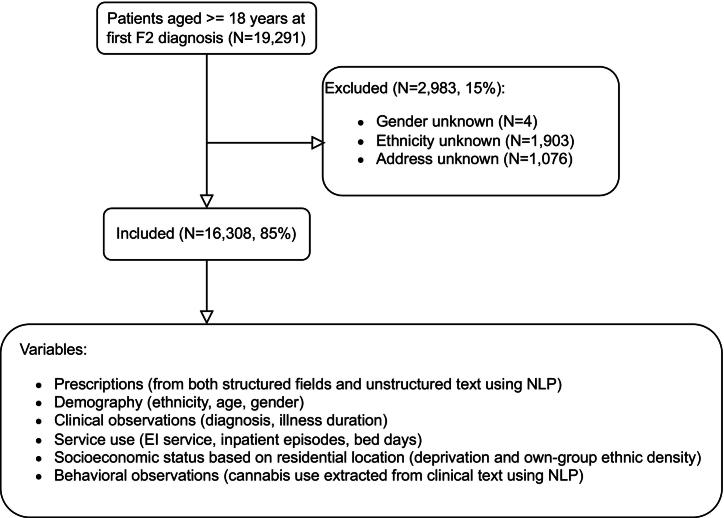
This retrospective cohort study included all patients (N = 19,291) who were aged 18 years or over at their first diagnoses of non-affective psychosis (identified with the ICD-10 codes of F20-F29) recorded in electronic health records (EHRs) at the South London and Maudsley NHS Trust until March 2021. The most recently recorded antipsychotic treatments and patient attributes were extracted from EHRs, including both structured fields and free-text fields processed using natural language processing applications. Multivariable logistic regression models were used to calculate the odds ratios (OR) for antipsychotic prescription according to patient ethnicity, adjusted for multiple potential contributing factors, including demographic (age and gender), clinical (diagnoses, duration of illness, service use and history of cannabis use), socioeconomic factors (level of deprivation and own-group ethnic density in the area of residence) and temporal changes in clinical guidelines (date of prescription).
RESULTS
The cohort consisted of 43.10 % White, 8.31 % Asian, 40.80 % Black, 2.64 % Mixed, and 5.14 % of patients from Other ethnicity. Among them, 92.62 % had recorded antipsychotic receipt, where 24.05 % for depot antipsychotics and 81.72 % for second-generation antipsychotic (SGA) medications. Most ethnic minority groups were not significantly different from White patients in receiving any antipsychotic. Among those receiving antipsychotic prescribing, Black patients were more likely to be prescribed depot (adjusted OR 1.29, 95 % confidence interval (CI) 1.14-1.47), but less likely to receive SGA (adjusted OR 0.85, 95 % CI 0.74-0.97), olanzapine (OR 0.82, 95 % CI 0.73-0.92) and clozapine (adjusted OR 0.71, 95 % CI 0.6-0.85) than White patients. All the ethnic minority groups were less likely to be prescribed olanzapine than the White group.
CONCLUSIONS
Black patients with psychosis had a distinct pattern in antipsychotic prescription, with less use of SGA, including olanzapine and clozapine, but more use of depot antipsychotics, even when adjusting for the effects of multiple demographic, clinical and socioeconomic factors. Further research is required to understand the sources of these ethnic disparities and eliminate care inequalities.
背景
先前的研究表明,在英国,精神疾病患者的抗精神病药物处方存在种族差异,证据不一,这在一定程度上是由于样本量较小。本研究旨在调查在调整了多个潜在风险因素后,在一个大型英国精神卫生信托机构中,所有已知患有非情感性精神病的人群中,抗精神病药物处方与患者种族之间的当前状况。
方法
本回顾性队列研究纳入了在南伦敦和莫兹利国民保健信托基金(South London and Maudsley NHS Trust)电子健康记录(EHR)中首次记录为非情感性精神病(ICD-10 编码为 F20-F29)的年龄在 18 岁及以上的所有患者(N=19291)。从 EHR 中提取了最近记录的抗精神病治疗方法和患者特征,包括使用自然语言处理应用程序处理的结构化字段和自由文本字段。使用多变量逻辑回归模型计算了根据患者种族的抗精神病药物处方的优势比(OR),并调整了多个潜在的促成因素,包括人口统计学因素(年龄和性别)、临床因素(诊断、疾病持续时间、服务使用和大麻使用史)、社会经济因素(居住地的贫困程度和本族裔密度)以及临床指南的时间变化(处方日期)。
结果
队列中包括 43.10%的白人、8.31%的亚洲人、40.80%的黑人、2.64%的混血儿和 5.14%的其他族裔患者。其中,92.62%的患者有记录抗精神病药物的使用,其中 24.05%的患者使用长效抗精神病药物,81.72%的患者使用第二代抗精神病药物(SGA)。在接受抗精神病药物治疗的患者中,大多数少数民族群体与白人患者在接受任何抗精神病药物治疗方面没有显著差异。在接受抗精神病药物治疗的患者中,黑人患者更有可能接受长效(调整后的 OR 1.29,95%置信区间(CI)为 1.14-1.47),但不太可能接受 SGA(调整后的 OR 0.85,95%CI 为 0.74-0.97)、奥氮平(OR 0.82,95%CI 为 0.73-0.92)和氯氮平(调整后的 OR 0.71,95%CI 为 0.6-0.85)。所有少数民族群体接受奥氮平治疗的可能性均低于白人患者。
结论
患有精神病的黑人患者的抗精神病药物处方模式明显不同,较少使用 SGA,包括奥氮平和氯氮平,但更多使用长效抗精神病药物,即使在调整了多个人口统计学、临床和社会经济因素的影响后也是如此。需要进一步研究以了解这些种族差异的来源,并消除护理不平等现象。


 Zotero 插件