
用于宫颈癌筛查的细胞学DNA甲基化:一个验证集。
Cytological DNA methylation for cervical cancer screening: a validation set.
作者信息
Kong Linghua, Wang Linhai, Wang Ziyun, Xiao Xiaoping, You Yan, Wu Huanwen, Wu Ming, Liu Pei, Li Lei
机构信息
Department of Obstetrics and Gynecology, National Clinical Research Center for Obstetric & Gynecologic Diseases, Peking Union Medical College Hospital, Beijing, China.
Department of Technology, Beijing OriginPoly Biotechnology CO., Ltd., Beijing, China.
出版信息
Front Oncol. 2023 Aug 21;13:1181982. doi: 10.3389/fonc.2023.1181982. eCollection 2023.
BACKGROUND
In a previous training set with a case-controlled design, cutoff values for host and gene methylation were obtained for the detection of cervical intraepithelial neoplasia (CIN) 2 or more severe lesions (CIN2+). This validation trial was conducted to evaluate the role of DNA methylation in screening for CIN2+ by cervical cytology among unselected participants.
METHODS
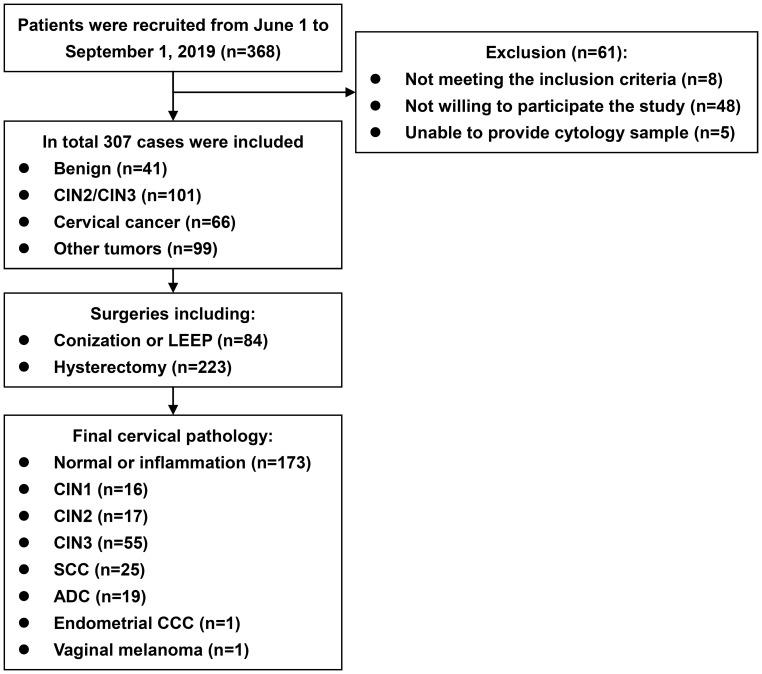
From June 1, 2019, to September 1, 2019, in our study center, we collected liquid-based samples from cervical swabs for methylation assays and hrHPV testing in eligible patients. The primary endpoint was the diagnostic accuracy of DNA methylation and hrHPV genotyping for CIN2+ according to confirmed histology results.
RESULTS
Among 307 participants, compared with hrHPV testing, the methylation assay for CIN2+ had lower sensitivity (68.7% versus 86.1%, =0.002) but higher specificity (96.7% versus 0.696, 0.001). The methylation assay also had favorable sensitivity and specificity in patients with negative hrHPV testing (56.3% and 96.9%) and in patients with cervical adenocarcinoma (73.7% and 92.7%). DNA methylation had higher specificity than the hrHPV assay (100.0% versus 44.4%, 0.001) for identifying residual CIN2+ in patients without residual lesions. Positive cervical DNA methylation was associated with a diagnostic probability of endometrial carcinoma (odds ratio 15.5 [95% confidence interval 4.1-58.6]) but not of ovarian epithelial carcinoma (1.4 [0.3-6.5]).
CONCLUSIONS
The host and gene methylation assay in cervical cytology had favorable diagnostic accuracy for CIN2+ and was highly specific for residual CIN2+ lesions The methylation assay is a promising triage tool in hrHPV+ women, or even an independent tool for cervical cancer screening. The methylation status in cervical cytology could also serve as a prognostic biomarker. Its role in detecting endometrial carcinomas is worthy of further exploration.
背景
在先前一项病例对照设计的训练集中,已获得宿主和基因甲基化的临界值,用于检测宫颈上皮内瘤变(CIN)2级或更严重病变(CIN2+)。本验证试验旨在评估DNA甲基化在未筛选参与者中通过宫颈细胞学筛查CIN2+的作用。
方法
2019年6月1日至2019年9月1日,在我们的研究中心,我们从宫颈拭子中收集液基样本,用于符合条件患者的甲基化检测和高危型人乳头瘤病毒(hrHPV)检测。主要终点是根据确诊的组织学结果,DNA甲基化和hrHPV基因分型对CIN2+的诊断准确性。
结果
在307名参与者中,与hrHPV检测相比,CIN2+的甲基化检测敏感性较低(68.7%对86.1%,P=0.002),但特异性较高(96.7%对89.6%,P=0.001)。甲基化检测在hrHPV检测阴性的患者(56.3%和96.9%)以及宫颈腺癌患者(73.7%和92.7%)中也具有良好的敏感性和特异性。在识别无残留病变患者中的残留CIN2+方面,DNA甲基化比hrHPV检测具有更高的特异性(100.0%对44.4%,P=0.001)。宫颈DNA甲基化阳性与子宫内膜癌的诊断概率相关(优势比15.5[95%置信区间4.1-58.6]),但与卵巢上皮癌无关(1.4[0.3-6.5])。
结论
宫颈细胞学中的宿主和基因甲基化检测对CIN2+具有良好的诊断准确性,对残留CIN2+病变具有高度特异性。甲基化检测是hrHPV阳性女性中有前景的分流工具,甚至是宫颈癌筛查的独立工具。宫颈细胞学中的甲基化状态也可作为预后生物标志物。其在检测子宫内膜癌中的作用值得进一步探索。
 Zotero 插件