
尖峰时间依赖可塑性部分补偿了运动敏感神经元的多层网络中的神经延迟。
Spike-timing dependent plasticity partially compensates for neural delays in a multi-layered network of motion-sensitive neurons.
机构信息
Melbourne School of Psychological Sciences, The University of Melbourne, Victoria, Australia.
Department of Biomedical Engineering, The University of Melbourne, Victoria, Australia.
出版信息
PLoS Comput Biol. 2023 Sep 6;19(9):e1011457. doi: 10.1371/journal.pcbi.1011457. eCollection 2023 Sep.
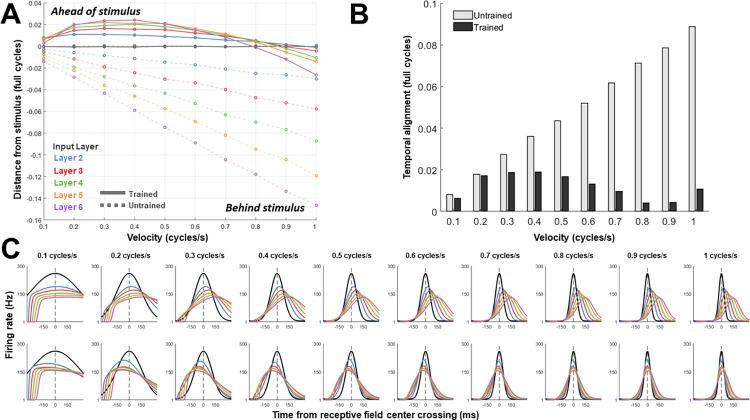
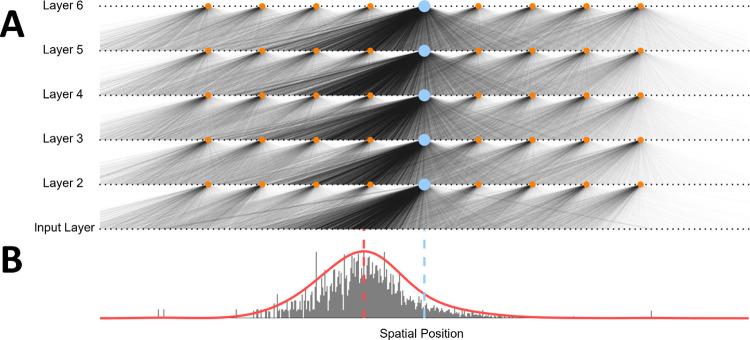
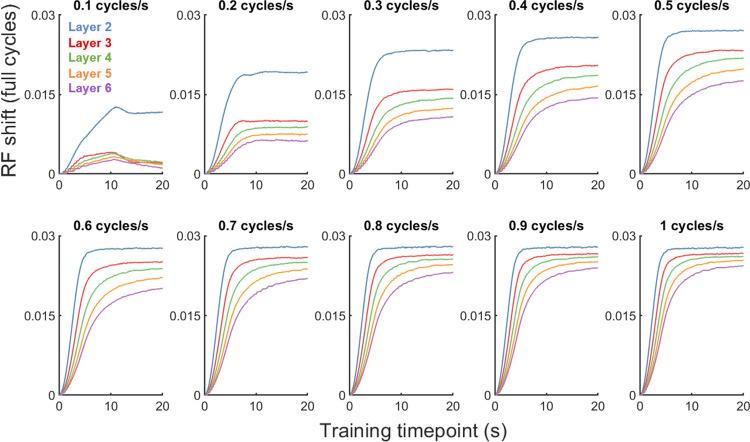
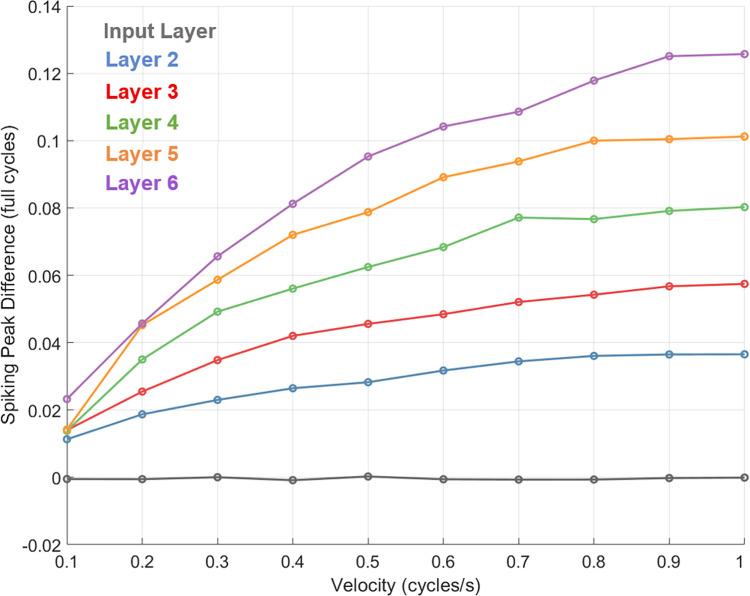
The ability of the brain to represent the external world in real-time is impacted by the fact that neural processing takes time. Because neural delays accumulate as information progresses through the visual system, representations encoded at each hierarchical level are based upon input that is progressively outdated with respect to the external world. This 'representational lag' is particularly relevant to the task of localizing a moving object-because the object's location changes with time, neural representations of its location potentially lag behind its true location. Converging evidence suggests that the brain has evolved mechanisms that allow it to compensate for its inherent delays by extrapolating the position of moving objects along their trajectory. We have previously shown how spike-timing dependent plasticity (STDP) can achieve motion extrapolation in a two-layer, feedforward network of velocity-tuned neurons, by shifting the receptive fields of second layer neurons in the opposite direction to a moving stimulus. The current study extends this work by implementing two important changes to the network to bring it more into line with biology: we expanded the network to multiple layers to reflect the depth of the visual hierarchy, and we implemented more realistic synaptic time-courses. We investigate the accumulation of STDP-driven receptive field shifts across several layers, observing a velocity-dependent reduction in representational lag. These results highlight the role of STDP, operating purely along the feedforward pathway, as a developmental strategy for delay compensation.
大脑实时表示外部世界的能力受到神经处理需要时间这一事实的影响。由于随着信息在视觉系统中传递,神经延迟会不断累积,因此每个层次结构的编码表示都基于与外部世界相比逐渐过时的输入。这种“表示滞后”对于定位移动目标的任务特别重要,因为目标的位置随时间变化,其位置的神经表示可能滞后于其真实位置。越来越多的证据表明,大脑已经进化出了一些机制,可以通过沿着物体的轨迹对其位置进行外推,从而补偿其固有的延迟。我们之前已经展示了如何通过依赖尖峰时间的可塑性(STDP)使具有速度调谐神经元的两层前馈网络中的第二层神经元的感受野朝与移动刺激相反的方向移动,从而实现运动外推。本研究通过对网络进行两个重要的更改来扩展这项工作,使其更符合生物学:我们将网络扩展到多层,以反映视觉层次的深度,并实现更逼真的突触时间过程。我们研究了 STDP 驱动的感受野在多个层中的累积变化,观察到代表滞后的速度依赖性降低。这些结果突出了 STDP 的作用,它纯粹沿着前馈途径运行,是一种用于延迟补偿的发展策略。


 Zotero 插件