
肾移植后腹泻:危险因素和结局研究。
Diarrhea after kidney transplantation: A study of risk factors and outcomes.
机构信息
Department of Nephrology, Seth GS Medical College and KEM Hospital, Mumbai, Maharashtra, India.
出版信息
J Postgrad Med. 2023 Oct-Dec;69(4):205-214. doi: 10.4103/jpgm.jpgm_601_22.
BACKGROUND
Diarrhea in kidney transplant recipients (KTRs) can be associated with significant morbidity.
MATERIAL AND METHODS
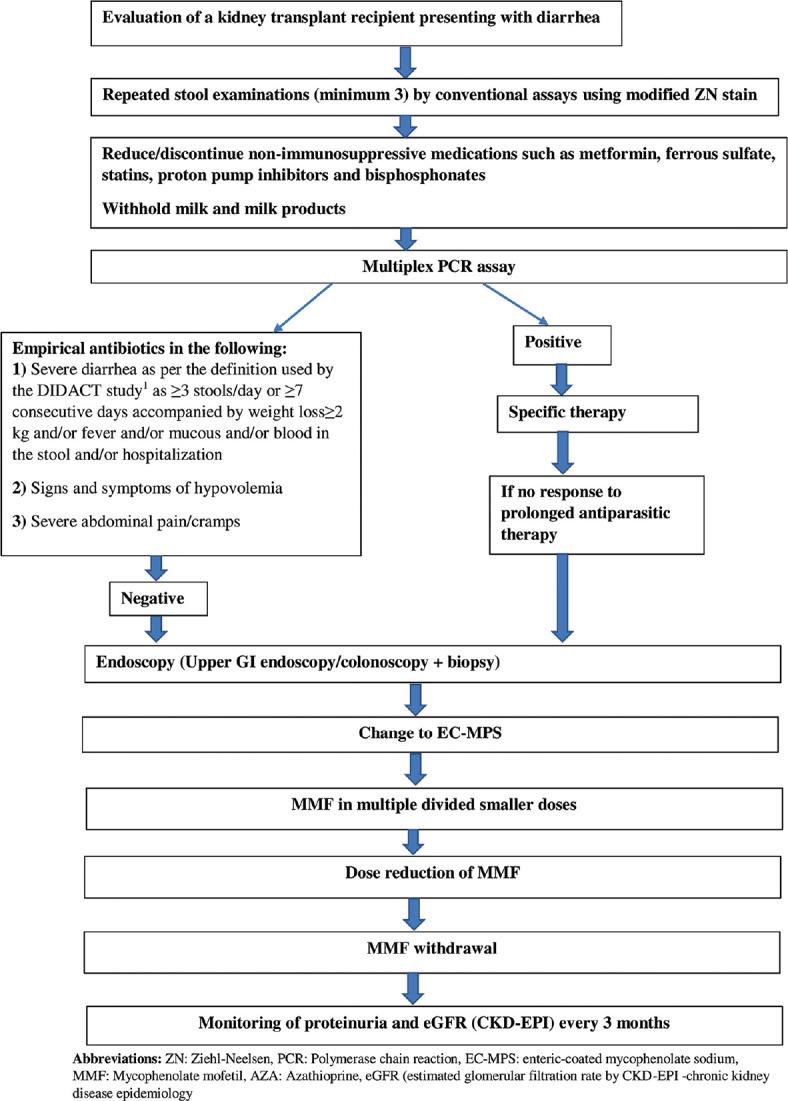
We evaluated 198 KTRs for a history of diarrhea post-kidney transplant at a tertiary care center in western India over 1 year. A protocol-based evaluation of diarrhea was done with respect to clinical features, diagnostic evaluation, associated acute allograft dysfunction, and its impact on long-term allograft function. Primary outcomes of interest were: chronic allograft injury (CAI) and the need for mycophenolate mofetil (MMF) withdrawal. We also assessed the effect of MMF withdrawal on the risk of the development of CAI.
RESULTS
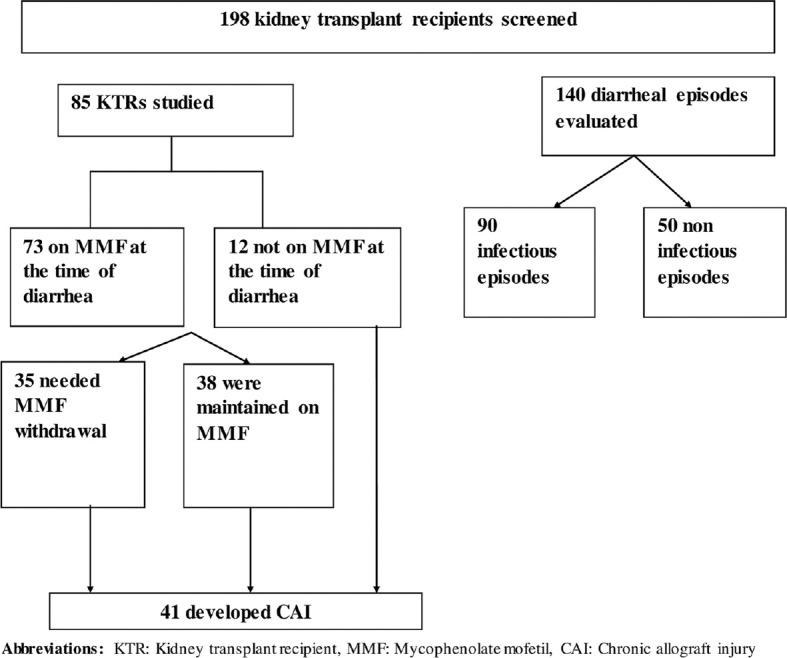
Eighty-five of 198 (42.5%) recipients experienced diarrhea and a total of 140 diarrheal episodes were evaluated. The mean age of these 85 recipients was 38 ± 12 years and 72 (84.7%) were males. 73 of 85 recipients were on MMF at the time of diarrhea and in 35 (48%) of them MMF withdrawal was needed for chronic and persistent symptoms. Diarrhea was attributed to infective etiologies in 90 of 140 (64.2%) cases. Among the microbiologically confirmed infective diarrheal episodes, giardia and cryptosporidium were the common pathogens in 11/28 (39%) and 6/28 (21.4%) episodes respectively. One hundred and twenty-eight episodes out of 140 (91.4%) episodes were complicated by acute allograft dysfunction. Forty-one of 85 recipients (48.2%) developed chronic allograft injury and 12 (14.1%) developed allograft rejection (acute and/or chronic). Probability of chronic allograft injury was higher in those with MMF withdrawal.
CONCLUSION
Diarrhea post-kidney transplant adversely affects graft function, especially after MMF withdrawal.
背景
肾移植受者(KTR)的腹泻可导致严重的发病率。
材料和方法
我们在印度西部的一家三级护理中心评估了 198 例 KTR 在肾移植后腹泻的病史,为期 1 年。根据临床特征、诊断评估、相关急性移植物功能障碍及其对长期移植物功能的影响,对腹泻进行了基于方案的评估。主要观察结果为:慢性移植物损伤(CAI)和需要停用吗替麦考酚酯(MMF)。我们还评估了 MMF 停药对 CAI 发展风险的影响。
结果
198 例受者中有 85 例(42.5%)发生腹泻,共评估了 140 例腹泻发作。这 85 例受者的平均年龄为 38 ± 12 岁,72 例(84.7%)为男性。腹泻时 73 例接受 MMF 治疗,其中 35 例(48%)因慢性和持续症状需要停用 MMF。140 例腹泻发作中有 90 例(64.2%)归因于感染性病因。在微生物学确诊的感染性腹泻发作中,贾第虫和隐孢子虫分别为 28 例中的 11 例(39%)和 6 例(21.4%)。140 例腹泻发作中有 128 例(91.4%)并发急性移植物功能障碍。85 例受者中有 41 例(48.2%)发生慢性移植物损伤,12 例(14.1%)发生移植物排斥(急性和/或慢性)。在停用 MMF 的患者中,慢性移植物损伤的概率更高。
结论
肾移植后腹泻会对移植物功能产生不利影响,尤其是在停用 MMF 后。

 Zotero 插件