
探索与胶质瘤患者放射敏感性相关的预后风险特征:基于微阵列数据的证据。
Exploration of the radiosensitivity-related prognostic risk signature in patients with glioma: evidence from microarray data.
机构信息
Department of Radiation Oncology, Nanfang Hospital of Southern Medical University, Guangzhou, China.
Department of Neurosurgery, Nanfang Hospital of Southern Medical University, Guangzhou, China.
出版信息
J Transl Med. 2023 Sep 12;21(1):618. doi: 10.1186/s12967-023-04388-w.
BACKGROUND
Gene expression signatures can be used as prognostic biomarkers in various types of cancers. We aim to develop a gene signature for predicting the response to radiotherapy in glioma patients.
METHODS
Radio-sensitive and radio-resistant glioma cell lines (M059J and M059K) were subjected to microarray analysis to screen for differentially expressed mRNAs. Additionally, we obtained 169 glioblastomas (GBM) samples and 5 normal samples from The Cancer Genome Atlas (TCGA) database, as well as 80 GBM samples and 4 normal samples from the GSE7696 set. The "DESeq2" R package was employed to identify differentially expressed genes (DEGs) between the normal brain samples and GBM samples. Combining the prognostic-related molecules identified from the TCGA, we developed a radiosensitivity-related prognostic risk signature (RRPRS) in the training set, which includes 152 patients with glioblastoma. Subsequently, we validated the reliability of the RRPRS in a validation set containing 616 patients with glioma from the TCGA database, as well as an internal validation set consisting of 31 glioblastoma patients from the Nanfang Hospital, Southern Medical University.
RESULTS
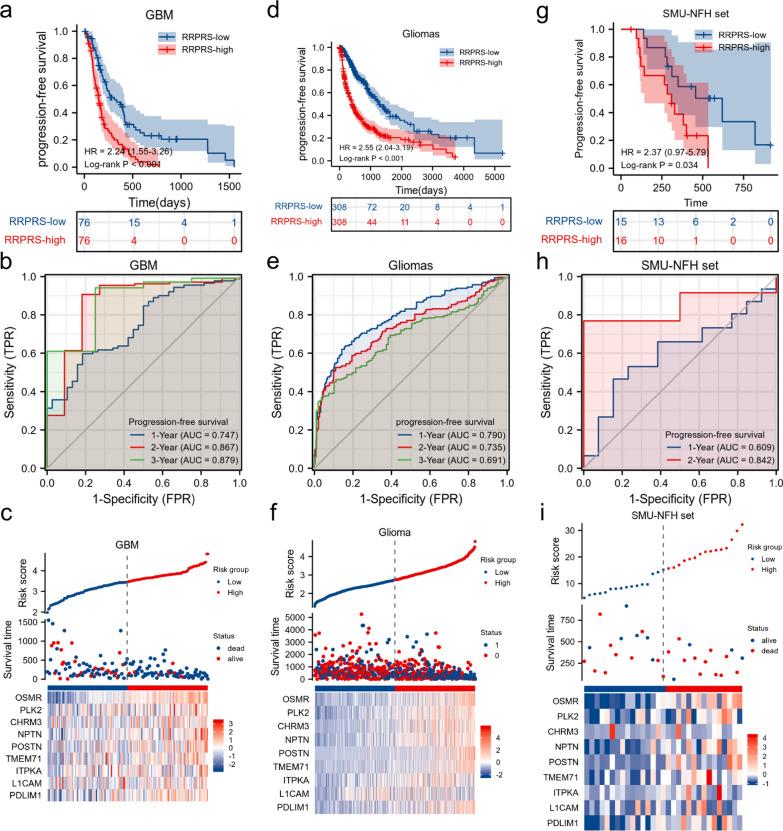
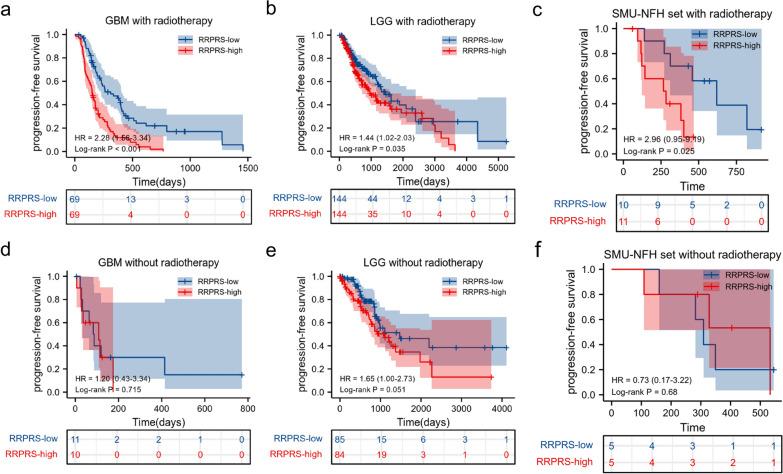
Based on the microarray and LASSO COX regression analysis, we developed a nine-gene radiosensitivity-related prognostic risk signature. Patients with glioma were divided into high- or low-risk groups based on the median risk score. The Kaplan-Meier survival analysis showed that the progression-free survival (PFS) of the high-risk group was significantly shorter. The signature accurately predicted PFS as assessed by time-dependent receiver operating characteristic curve (ROC) analyses. Stratified analysis demonstrated that the signature is specific to predict the outcome of patients who were treated using radiotherapy. Univariate and multivariate Cox regression analysis revealed that the predictor was an independent predictor for the prognosis of patients with glioma. The prognostic nomograms accompanied by calibration curves displayed the 1-, 2-, and 3-year PFS and OS in patients with glioma.
CONCLUSION
Our study established a new nine-gene radiosensitivity-related prognostic risk signature that can predict the prognosis of patients with glioma who received radiotherapy. The nomogram showed great potential to predict the prognosis of patients with glioma treated using radiotherapy.
背景
基因表达谱可作为各种癌症的预后生物标志物。我们旨在开发一种预测胶质母细胞瘤患者放疗反应的基因签名。
方法
对放射敏感和放射抵抗的胶质母细胞瘤细胞系(M059J 和 M059K)进行微阵列分析,以筛选差异表达的 mRNAs。此外,我们从癌症基因组图谱(TCGA)数据库中获得了 169 个胶质母细胞瘤(GBM)样本和 5 个正常样本,以及从 GSE7696 集中获得了 80 个 GBM 样本和 4 个正常样本。使用“DESeq2”R 包鉴定正常脑样本和 GBM 样本之间的差异表达基因(DEGs)。结合从 TCGA 中鉴定出的与预后相关的分子,我们在包含 152 名胶质母细胞瘤患者的训练集中开发了一个与放射敏感性相关的预后风险签名(RRPRS)。随后,我们在包含来自 TCGA 数据库的 616 名胶质瘤患者的验证集中以及来自南方医科大学南方医院的 31 名胶质母细胞瘤患者的内部验证集中验证了 RRPRS 的可靠性。
结果
基于微阵列和 LASSO COX 回归分析,我们开发了一个由九个基因组成的与放射敏感性相关的预后风险签名。根据中位风险评分将胶质母细胞瘤患者分为高或低风险组。Kaplan-Meier 生存分析显示,高风险组的无进展生存期(PFS)明显更短。时间依赖性接受者操作特征曲线(ROC)分析准确预测了 PFS。分层分析表明,该签名特异性预测了接受放疗治疗的患者的预后。单因素和多因素 Cox 回归分析表明,该预测因子是胶质母细胞瘤患者预后的独立预测因子。预后列线图及其校准曲线显示了胶质母细胞瘤患者的 1、2 和 3 年 PFS 和 OS。
结论
我们的研究建立了一种新的与放射敏感性相关的九个基因预后风险签名,可预测接受放疗的胶质母细胞瘤患者的预后。列线图显示了预测接受放疗的胶质母细胞瘤患者预后的巨大潜力。




 Zotero 插件