
人羊膜在组织工程和再生医学中的生物学重要性。
Biological importance of human amniotic membrane in tissue engineering and regenerative medicine.
作者信息
Hu Zeming, Luo Yang, Ni Renhao, Hu Yiwei, Yang Fang, Du Tianyu, Zhu Yabin
机构信息
Health Science Center, Ningbo University, Ningbo, 315211, China.
出版信息
Mater Today Bio. 2023 Sep 1;22:100790. doi: 10.1016/j.mtbio.2023.100790. eCollection 2023 Oct.
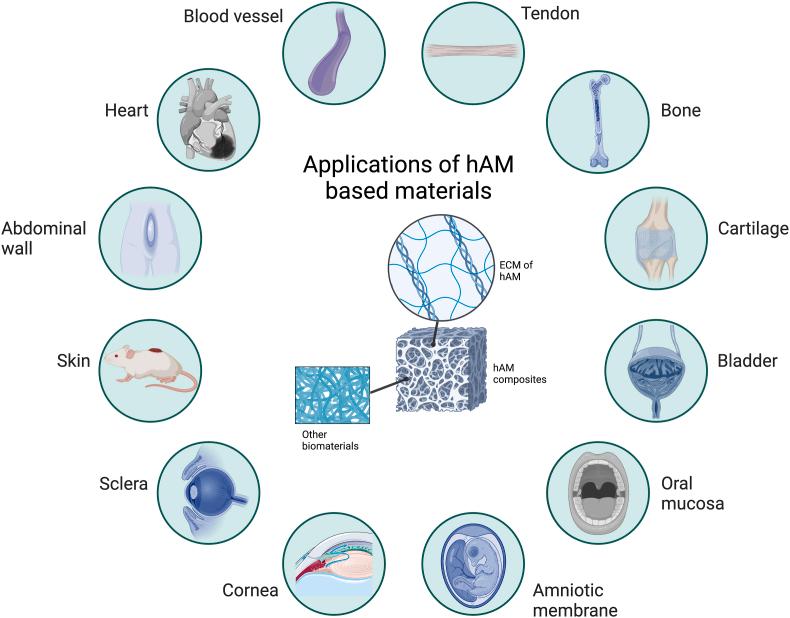
The human amniotic membrane (hAM) is the innermost layer of the placenta. Its distinctive structure and the biological and physical characteristics make it a highly biocompatible material in a variety of regenerative medicine applications. It also acts as a supply of bioactive factors and cells, which indicate the advantages over other tissues. In this review, we firstly discussed the biological properties of hAM-derived cells , along with their stemness of markers, pointing out a promising source of stem cells for regenerative medicine. Then, we systematically summarized current knowledge on the collection, preparation, preservation, and decellularization of hAM, as well as their characteristics helping to improve the understanding of applications in tissue engineering. Finally, we highlighted the recent advances in which hAM has undergone additional modifications to achieve an adequate perspective of regenerative medicine applications. More investigations are required in utilizing appropriate modifications to enhance the therapeutic effectiveness of hAM in the future.
人羊膜(hAM)是胎盘的最内层。其独特的结构以及生物学和物理特性使其成为多种再生医学应用中具有高度生物相容性的材料。它还作为生物活性因子和细胞的来源,这显示出其相对于其他组织的优势。在本综述中,我们首先讨论了hAM衍生细胞的生物学特性及其干性标志物,指出其是再生医学中很有前景的干细胞来源。然后,我们系统地总结了目前关于hAM的采集、制备、保存和脱细胞处理的知识,以及它们的特性,有助于增进对其在组织工程中应用的理解。最后,我们强调了hAM为实现再生医学应用的适当前景而进行的额外修饰的最新进展。未来需要更多研究来利用适当的修饰提高hAM的治疗效果。


 Zotero 插件