
评估 SARS-CoV-2 感染和接种疫苗后的血清学检测抗体动态和中和活性。
Assessment of antibody dynamics and neutralizing activity using serological assay after SARS-CoV-2 infection and vaccination.
机构信息
Department of Clinical Laboratory, Juntendo University Hospital, Tokyo, Japan.
Department of Clinical Laboratory Medicine, Juntendo University Graduate School of Medicine, Tokyo, Japan.
出版信息
PLoS One. 2023 Sep 19;18(9):e0291670. doi: 10.1371/journal.pone.0291670. eCollection 2023.
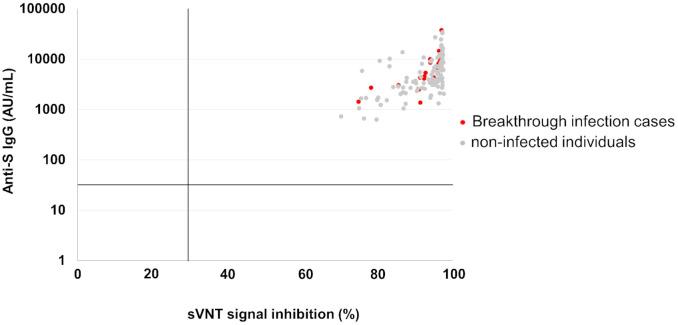
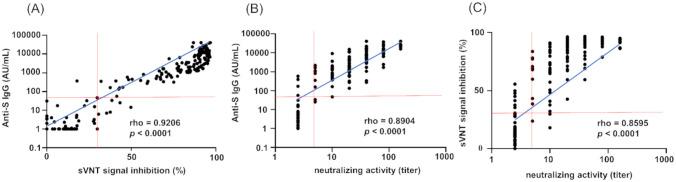
The COVID-19 antibody test was developed to investigate the humoral immune response to SARS-CoV-2 infection. In this study, we examined whether S antibody titers measured using the anti-SARS-CoV-2 IgG II Quant assay (S-IgG), a high-throughput test method, reflects the neutralizing capacity acquired after SARS-CoV-2 infection or vaccination. To assess the antibody dynamics and neutralizing potency, we utilized a total of 457 serum samples from 253 individuals: 325 samples from 128 COVID-19 patients including 136 samples from 29 severe/critical cases (Group S), 155 samples from 71 mild/moderate cases (Group M), and 132 samples from 132 health care workers (HCWs) who have received 2 doses of the BNT162b2 vaccinations. The authentic virus neutralization assay, the surrogate virus neutralizing antibody test (sVNT), and the Anti-N SARS-CoV-2 IgG assay (N-IgG) have been performed along with the S-IgG. The S-IgG correlated well with the neutralizing activity detected by the authentic virus neutralization assay (0.8904. of Spearman's rho value, p < 0.0001) and sVNT (0.9206. of Spearman's rho value, p < 0.0001). However, 4 samples (2.3%) of S-IgG and 8 samples (4.5%) of sVNT were inconsistent with negative results for neutralizing activity of the authentic virus neutralization assay. The kinetics of the SARS-CoV-2 neutralizing antibodies and anti-S IgG in severe cases were faster than the mild cases. All the HCWs elicited anti-S IgG titer after the second vaccination. However, the HCWs with history of COVID-19 or positive N-IgG elicited higher anti-S IgG titers than those who did not have it previously. Furthermore, it is difficult to predict the risk of breakthrough infection from anti-S IgG or sVNT antibody titers in HCWs after the second vaccination. Our data shows that the use of anti-S IgG titers as direct quantitative markers of neutralizing capacity is limited. Thus, antibody tests should be carefully interpreted when used as serological markers for diagnosis, treatment, and prophylaxis of COVID-19.
COVID-19 抗体检测旨在研究针对 SARS-CoV-2 感染的体液免疫反应。在这项研究中,我们研究了使用 SARS-CoV-2 IgG II Quant 检测试剂盒(S-IgG)测量的 S 抗体滴度是否反映了 SARS-CoV-2 感染或接种疫苗后获得的中和能力。为了评估抗体动态和中和效力,我们总共使用了来自 253 个人的 457 份血清样本:128 例 COVID-19 患者的 325 份样本,包括 29 例重症/危重症病例的 136 份样本(S 组),71 例轻症/中症病例的 155 份样本(M 组),以及已接受 2 剂 BNT162b2 疫苗接种的 132 名医护人员的 132 份样本。我们同时进行了真实病毒中和测定、替代病毒中和抗体测定(sVNT)和抗-N SARS-CoV-2 IgG 测定(N-IgG)。S-IgG 与真实病毒中和测定(Spearman's rho 值为 0.8904,p < 0.0001)和 sVNT(Spearman's rho 值为 0.9206,p < 0.0001)检测到的中和活性密切相关。然而,4 份 S-IgG(2.3%)样本和 8 份 sVNT(4.5%)样本的中和活性与真实病毒中和测定的阴性结果不一致。重症病例的 SARS-CoV-2 中和抗体和抗-S IgG 的动力学比轻症病例更快。所有医护人员在第二次接种后均产生抗-S IgG 滴度。然而,有 COVID-19 病史或 N-IgG 阳性的医护人员比之前没有 COVID-19 病史或 N-IgG 阳性的医护人员产生更高的抗-S IgG 滴度。此外,很难从第二次接种后医护人员的抗-S IgG 或 sVNT 抗体滴度预测突破性感染的风险。我们的数据表明,使用抗-S IgG 滴度作为中和能力的直接定量标志物是有限的。因此,在将抗体检测用作 COVID-19 的诊断、治疗和预防的血清学标志物时,应仔细解释。


 Zotero 插件