
双酚A暴露引发内质网应激途径,导致小鼠眼轴伸长。
Bisphenol A exposure triggers endoplasmic reticulum stress pathway leading to ocular axial elongation in mice.
作者信息
Chen Junhan, Ikeda Shin-Ichi, Kang Longdan, Negishi Kazuno, Tsubota Kazuo, Kurihara Toshihide
机构信息
Laboratory of Photobiology, Keio University School of Medicine, Tokyo, Japan.
Department of Ophthalmology, Keio University School of Medicine, Tokyo, Japan.
出版信息
Front Med (Lausanne). 2023 Sep 7;10:1255121. doi: 10.3389/fmed.2023.1255121. eCollection 2023.
BACKGROUND
Ocular axial elongation is one of the features of myopia progression. Endoplasmic reticulum (ER) stress-associated scleral remodeling plays an important role in ocular axial elongation. Bisphenol A (BPA) is one of the most common environmental pollutants and is known to affect various human organs through ER stress. However, whether BPA exerts an effect on scleral remodeling remains unknown. The purpose of this study was to determine the effect of BPA on the development of myopia and scleral ER stress.
METHODS
BPA was administered by intraperitoneal injection. 4-PBA was administered as an endoplasmic reticulum stress inhibitor by eye drops. Refraction and axial length were measured by refractometer and SD-OCT system. Western blot was performed to detect the expression level of ER stress-related proteins.
RESULTS
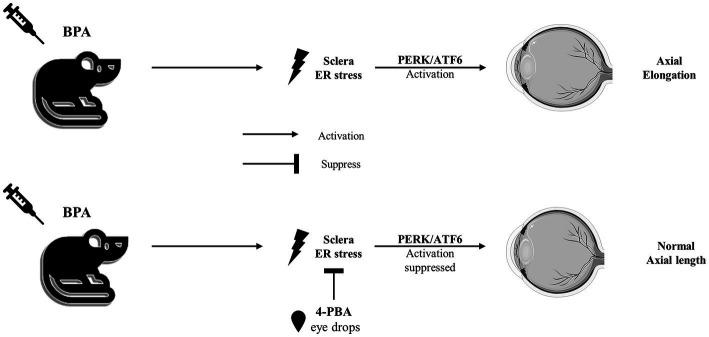
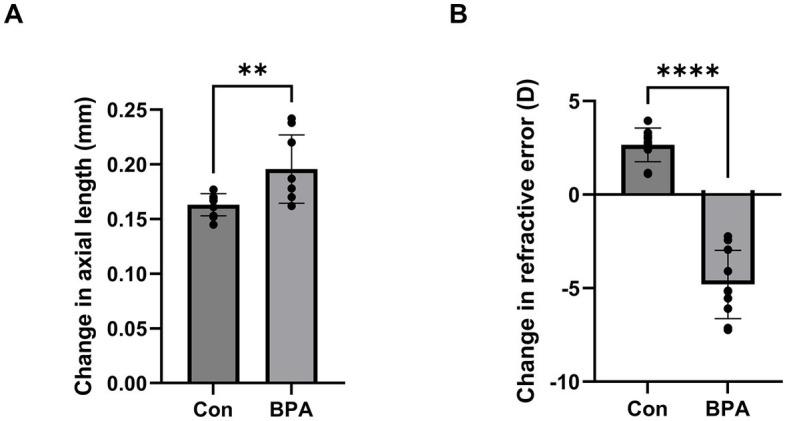
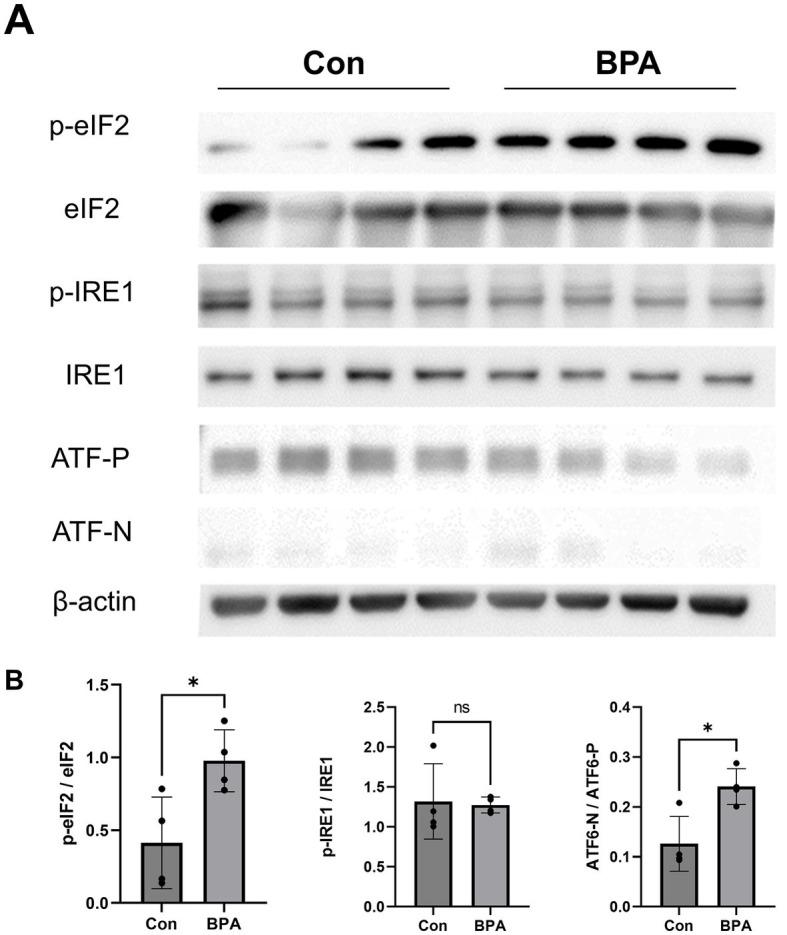
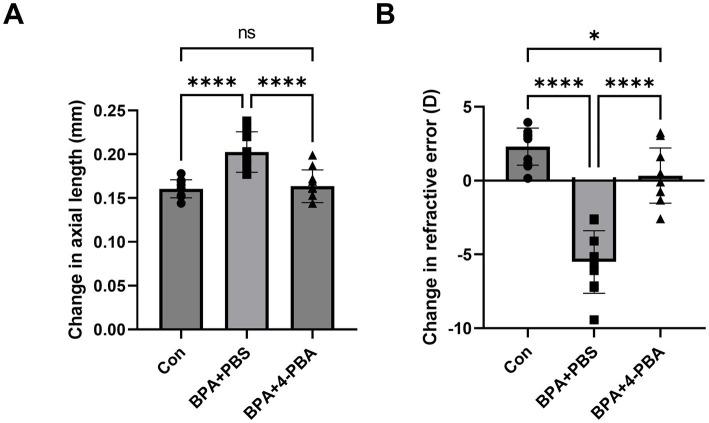
BPA-administered mice exhibit axial elongation and myopic refractive shift with endoplasmic reticulum stress in the sclera. BPA administration activated scleral PERK and ATF6 pathways, and 4-PBA eye drops attenuated ER stress response and suppressed myopia progression.
CONCLUSION
BPA controlled axial elongation during myopia development in a mouse model by inducing scleral ER stress and activation of the PERK/ATF6 pathway. 4-PBA eye drops as ER stress inhibitor suppressed BPA-induced myopia development.
背景
眼轴伸长是近视进展的特征之一。内质网(ER)应激相关的巩膜重塑在眼轴伸长中起重要作用。双酚A(BPA)是最常见的环境污染物之一,已知其通过内质网应激影响人体各个器官。然而,BPA是否对巩膜重塑有影响尚不清楚。本研究的目的是确定BPA对近视发展和巩膜内质网应激的影响。
方法
通过腹腔注射给予BPA。通过滴眼液给予4-PBA作为内质网应激抑制剂。用验光仪和SD-OCT系统测量屈光和眼轴长度。进行蛋白质免疫印迹法检测内质网应激相关蛋白的表达水平。
结果
给予BPA的小鼠出现眼轴伸长和近视性屈光偏移,同时巩膜出现内质网应激。给予BPA激活了巩膜PERK和ATF6通路,而4-PBA滴眼液减弱了内质网应激反应并抑制了近视进展。
结论
在小鼠模型中,BPA通过诱导巩膜内质网应激和激活PERK/ATF6通路来控制近视发展过程中的眼轴伸长。作为内质网应激抑制剂的4-PBA滴眼液抑制了BPA诱导的近视发展。

 Zotero 插件