
电子烟使用、环境毒物暴露与肺癌风险
Vaping, Environmental Toxicants Exposure, and Lung Cancer Risk.
作者信息
Shehata Shaimaa A, Toraih Eman A, Ismail Ezzat A, Hagras Abeer M, Elmorsy Ekramy, Fawzy Manal S
机构信息
Department of Forensic Medicine and Clinical Toxicology, Faculty of Medicine, Suez Canal University, Ismailia 41522, Egypt.
Division of Endocrine and Oncologic Surgery, Department of Surgery, School of Medicine, Tulane University, New Orleans, LA 70112, USA.
出版信息
Cancers (Basel). 2023 Sep 12;15(18):4525. doi: 10.3390/cancers15184525.
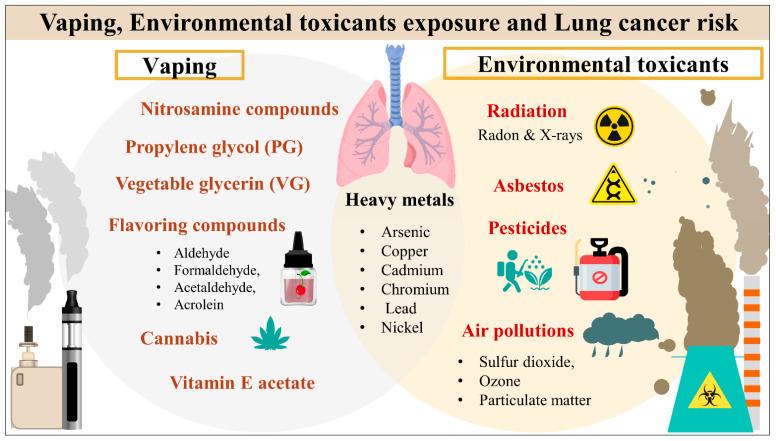
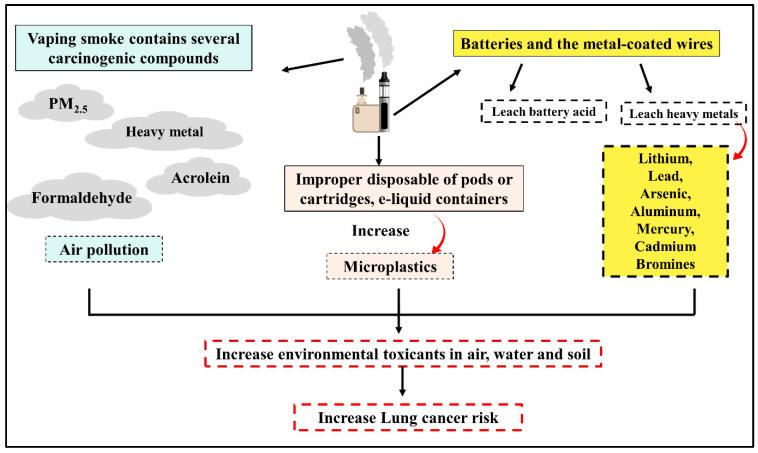
Lung cancer (LC) is the second-most prevalent tumor worldwide. According to the most recent GLOBOCAN data, over 2.2 million LC cases were reported in 2020, with an estimated new death incident of 1,796,144 lung cancer cases. Genetic, lifestyle, and environmental exposure play an important role as risk factors for LC. E-cigarette, or vaping, products (EVPs) use has been dramatically increasing world-wide. There is growing concern that EVPs consumption may increase the risk of LC because EVPs contain several proven carcinogenic compounds. However, the relationship between EVPs and LC is not well established. E-cigarette contains nicotine derivatives (e.g., nitrosnornicotine, nitrosamine ketone), heavy metals (including organometal compounds), polycyclic aromatic hydrocarbons, and flavorings (aldehydes and complex organics). Several environmental toxicants have been proven to contribute to LC. Proven and plausible environmental carcinogens could be physical (ionizing and non-ionizing radiation), chemicals (such as asbestos, formaldehyde, and dioxins), and heavy metals (such as cobalt, arsenic, cadmium, chromium, and nickel). Air pollution, especially particulate matter (PM) emitted from vehicles and industrial exhausts, is linked with LC. Although extensive environmental exposure prevention policies and smoking reduction strategies have been adopted globally, the dangers remain. Combined, both EVPs and toxic environmental exposures may demonstrate significant synergistic oncogenicity. This review aims to analyze the current publications on the importance of the relationship between EVPs consumption and environmental toxicants in the pathogenesis of LC.
肺癌(LC)是全球第二大常见肿瘤。根据最新的全球癌症负担数据(GLOBOCAN),2020年报告的肺癌病例超过220万例,估计有1796144例肺癌新发病例死亡。遗传、生活方式和环境暴露作为肺癌的危险因素发挥着重要作用。电子烟或雾化产品(EVPs)的使用在全球范围内急剧增加。人们越来越担心使用电子烟产品可能会增加患肺癌的风险,因为电子烟产品含有几种已被证实的致癌化合物。然而,电子烟产品与肺癌之间的关系尚未明确。电子烟含有尼古丁衍生物(如亚硝基去甲烟碱、亚硝胺酮)、重金属(包括有机金属化合物)、多环芳烃和调味剂(醛类和复杂有机物)。几种环境毒物已被证实与肺癌有关。已证实和可能的环境致癌物可能是物理性的(电离辐射和非电离辐射)、化学性的(如石棉、甲醛和二恶英)和重金属(如钴、砷、镉、铬和镍)。空气污染,尤其是车辆排放的颗粒物(PM)和工业废气,与肺癌有关。尽管全球已采取广泛的环境暴露预防政策和减少吸烟策略,但危险依然存在。电子烟产品和有毒环境暴露可能共同显示出显著的协同致癌性。本综述旨在分析当前关于电子烟产品消费与环境毒物之间的关系在肺癌发病机制中的重要性的出版物。


 Zotero 插件