
FA 滑动作为 ANT1 介导的脂肪酸阴离子在脂双层中转运的机制。
FA Sliding as the Mechanism for the ANT1-Mediated Fatty Acid Anion Transport in Lipid Bilayers.
机构信息
Institute of Physiology, Pathophysiology, and Biophysics, Department of Biomedical Sciences, University of Veterinary Medicine, 1210 Vienna, Austria.
Division of Organic Chemistry and Biochemistry, Rudjer Bošković Institute, 10000 Zagreb, Croatia.
出版信息
Int J Mol Sci. 2023 Sep 5;24(18):13701. doi: 10.3390/ijms241813701.
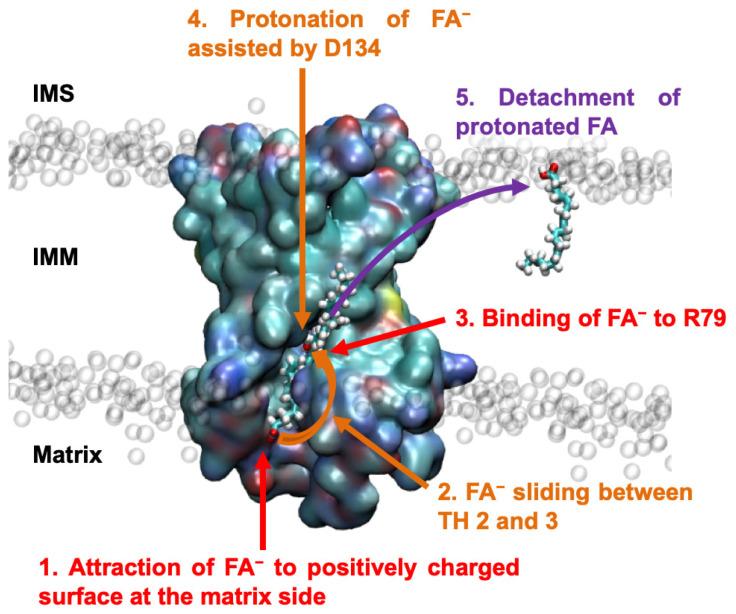
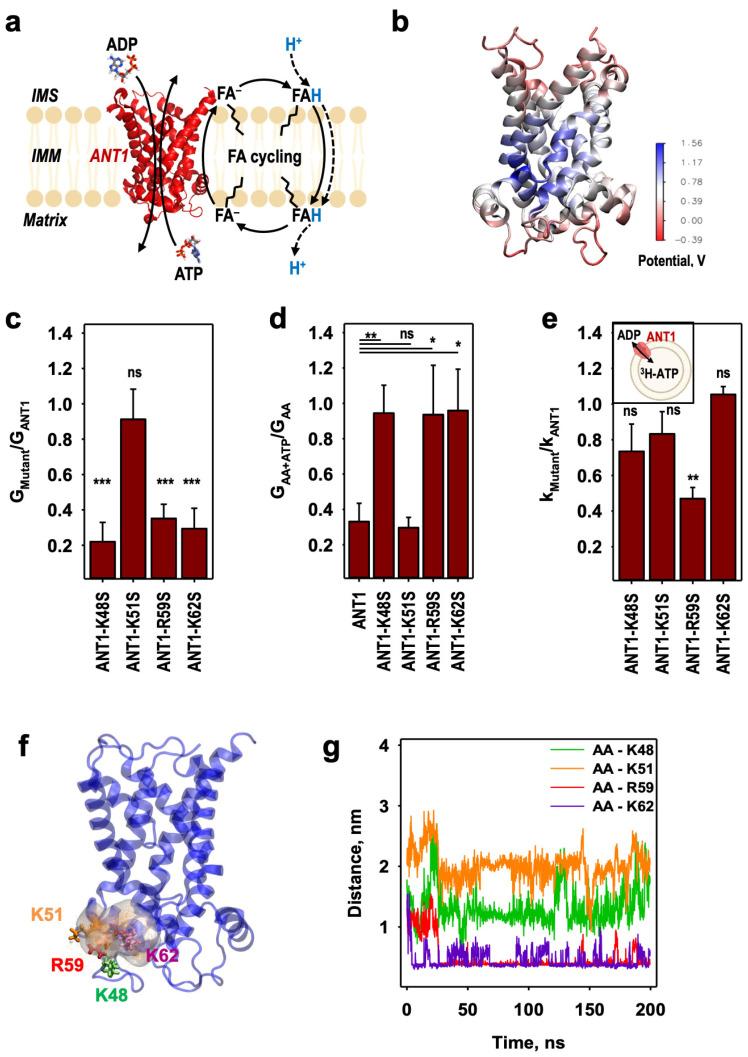
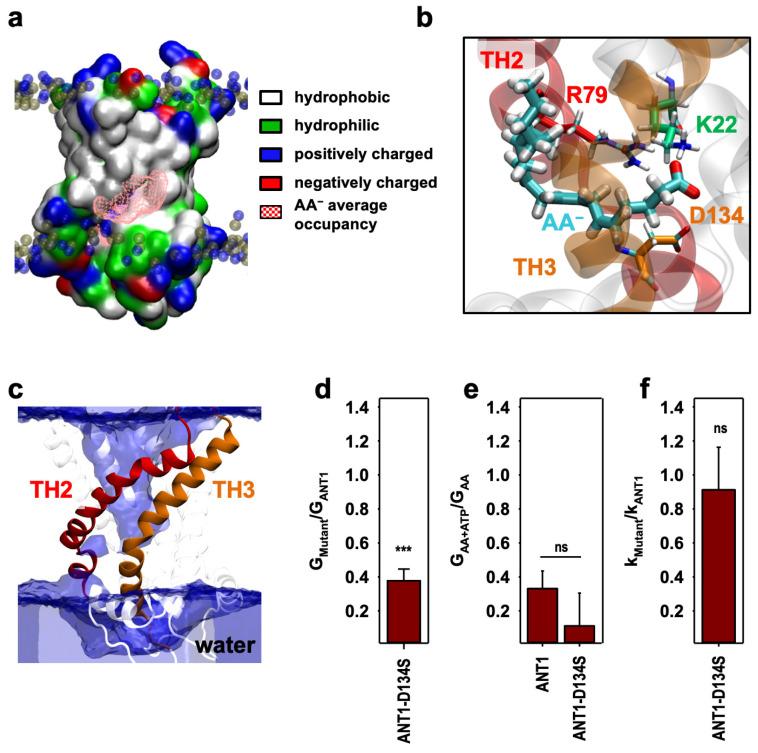
Mitochondrial adenine nucleotide translocase (ANT) exchanges ADP for ATP to maintain energy production in the cell. Its protonophoric function in the presence of long-chain fatty acids (FA) is also recognized. Our previous results imply that proton/FA transport can be best described with the FA cycling model, in which protonated FA transports the proton to the mitochondrial matrix. The mechanism by which ANT1 transports FA anions back to the intermembrane space remains unclear. Using a combined approach involving measurements of the current through the planar lipid bilayers reconstituted with ANT1, site-directed mutagenesis and molecular dynamics simulations, we show that the FA anion is first attracted by positively charged arginines or lysines on the matrix side of ANT1 before moving along the positively charged protein-lipid interface and binding to R79, where it is protonated. We show that R79 is also critical for the competitive binding of ANT1 substrates (ADP and ATP) and inhibitors (carboxyatractyloside and bongkrekic acid). The binding sites are well conserved in mitochondrial SLC25 members, suggesting a general mechanism for transporting FA anions across the inner mitochondrial membrane.
线粒体腺苷酸核苷酸转位酶(ANT)将 ADP 交换为 ATP,以维持细胞内的能量产生。人们还认识到它在存在长链脂肪酸(FA)时的质子传递功能。我们之前的研究结果表明,质子/FA 转运可以用 FA 循环模型来最好地描述,在该模型中,质子化的 FA 将质子转运到线粒体基质中。ANT1 将 FA 阴离子反向转运回膜间隙的机制仍不清楚。我们使用了一种结合方法,涉及用 ANT1 重建的平面脂质双层中的电流测量、定点突变和分子动力学模拟,结果表明 FA 阴离子首先被 ANT1 基质侧上带正电荷的精氨酸或赖氨酸吸引,然后沿着带正电荷的蛋白-脂界面移动,并与 R79 结合,在那里 FA 被质子化。我们还表明,R79 对于 ANT1 底物(ADP 和 ATP)和抑制剂(羧基三甲胺和邦克来酸)的竞争结合也很关键。结合位点在线粒体 SLC25 成员中高度保守,这表明 FA 阴离子穿过线粒体内膜的一般机制。



 Zotero 插件