
韩国青少年肥胖参数与骨密度之间的倒U形关系。
Inverted U-Shaped Relationship between Obesity Parameters and Bone Mineral Density in Korean Adolescents.
作者信息
Lee Jongseok, Yoon Insang, Cha Hwajung, Kim Ho-Jung, Ryu Ohk-Hyun
机构信息
School of Artificial Intelligence Convergence, Hallym University, Chuncheon 24253, Republic of Korea.
Division of Endocrinology and Metabolism, Department of Internal Medicine, Chuncheon Sacred Heart Hospital, Chuncheon 24253, Republic of Korea.
出版信息
J Clin Med. 2023 Sep 9;12(18):5869. doi: 10.3390/jcm12185869.
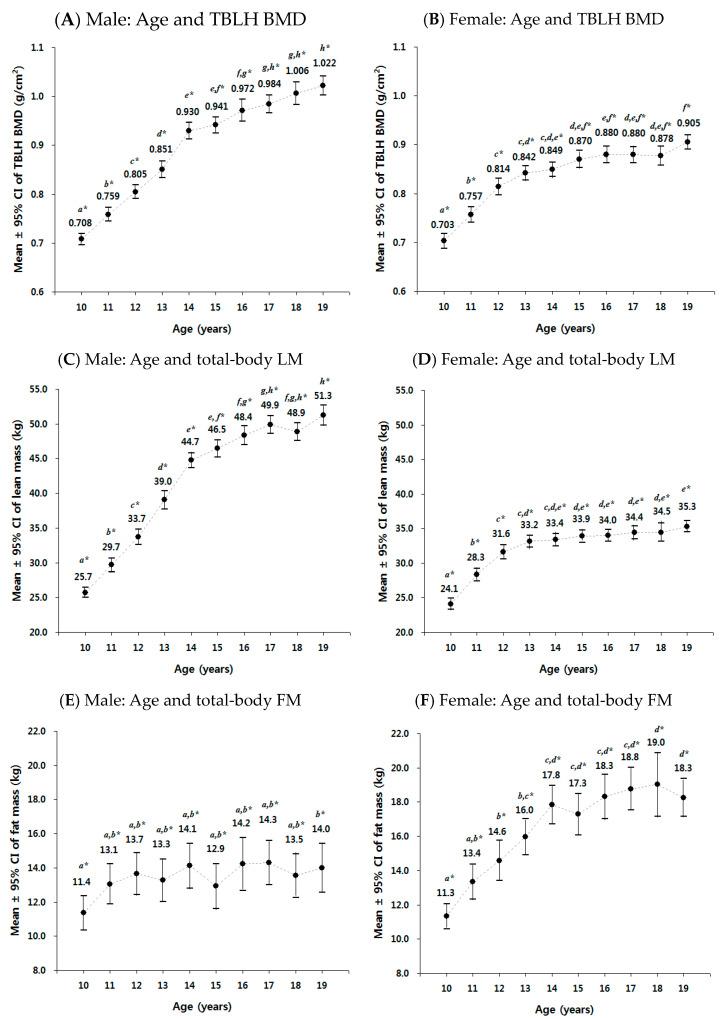
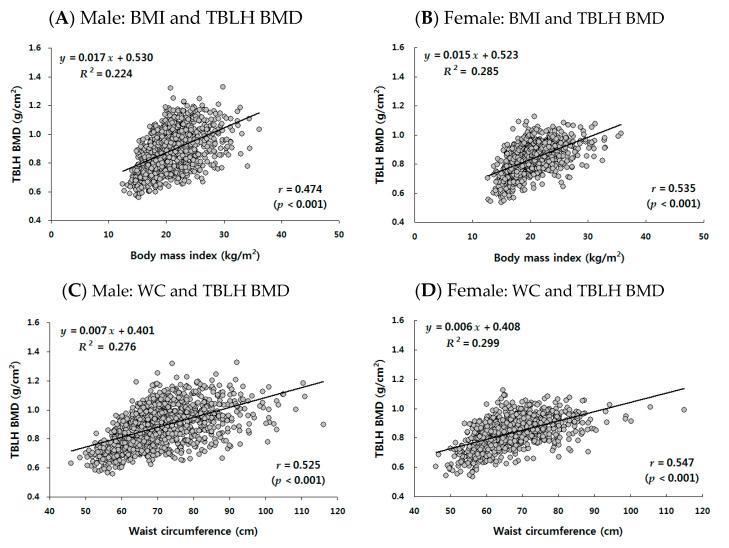
As the association between obesity and bone health remains controversial in children and adolescents, we investigate the effects of obesity parameters on bone mineral density (BMD) in 2060 Korean adolescents who participated in the 2008-2011 Korea National Health and Nutrition Examination Survey (KNHANES). Multiple regression analysis and analysis of covariance (ANCOVA) were conducted to examine both the linear and non-linear associations between total-body-less-head (TBLH) BMD and four obesity parameters: body mass index, waist circumference, waist-to-height ratio, and total-body fat mass (FM). In a multiple linear regression analysis adjusted for age, menarcheal status (in females only), and total-body lean mass, there was no significant linear association between obesity parameters and TBLH BMD, except for total-body FM in males. However, upon adding a second-order polynomial term for each obesity parameter, a significant quadratic relationship between all obesity parameters and TBLH BMD was observed, with the corresponding quadratic term being negative. The results of ANCOVA also revealed an inverted U-shaped relationship between each obesity parameter and TBLH BMD. Our findings suggest the existence of an optimal range of obesity parameters for developing or maintaining optimal bone health in Korean Adolescents. Deviation from this range, in either direction (being underweight or having obesity), may compromise bone health.
由于肥胖与儿童及青少年骨骼健康之间的关联仍存在争议,我们对2060名参与2008 - 2011年韩国国家健康与营养检查调查(KNHANES)的韩国青少年进行了研究,以探讨肥胖参数对骨密度(BMD)的影响。我们进行了多元回归分析和协方差分析(ANCOVA),以检验无头全身(TBLH)骨密度与四个肥胖参数之间的线性和非线性关联,这四个肥胖参数分别为体重指数、腰围、腰高比和全身脂肪量(FM)。在一项针对年龄、初潮状态(仅针对女性)和全身瘦体重进行调整的多元线性回归分析中,除男性的全身脂肪量外,肥胖参数与TBLH骨密度之间没有显著的线性关联。然而,在为每个肥胖参数添加二阶多项式项后,观察到所有肥胖参数与TBLH骨密度之间存在显著的二次关系,且相应的二次项为负。ANCOVA的结果也显示每个肥胖参数与TBLH骨密度之间呈倒U形关系。我们的研究结果表明,在韩国青少年中,存在一个肥胖参数的最佳范围,以促进或维持最佳的骨骼健康。偏离这个范围,无论是向哪个方向(体重过轻或肥胖),都可能损害骨骼健康。

 Zotero 插件