
疫苗诱导和感染诱导的全身性IgA抗SARS-CoV-2刺突反应的特征
Characteristics of Vaccine- and Infection-Induced Systemic IgA Anti-SARS-CoV-2 Spike Responses.
作者信息
Norton Natasha J, Ings Danielle P, Fifield Kathleen E, Barnes David A, Barnable Keeley A, Harnum Debbie O A, Holder Kayla A, Russell Rodney S, Grant Michael D
机构信息
Immunology & Infectious Diseases Program, Division of BioMedical Sciences, Faculty of Medicine, Memorial University of Newfoundland, St. John's, NL A1B 3V6, Canada.
Newfoundland and Labrador Health Services, St. John's, NL A1B 3V6, Canada.
出版信息
Vaccines (Basel). 2023 Sep 7;11(9):1462. doi: 10.3390/vaccines11091462.
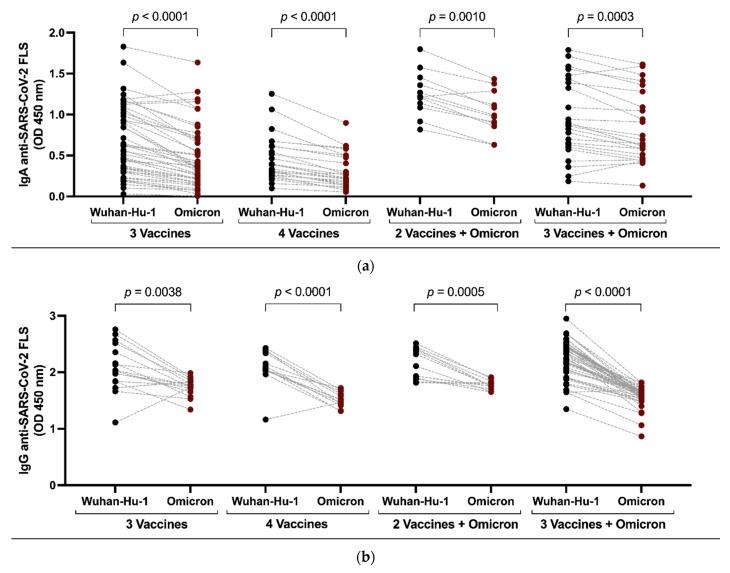
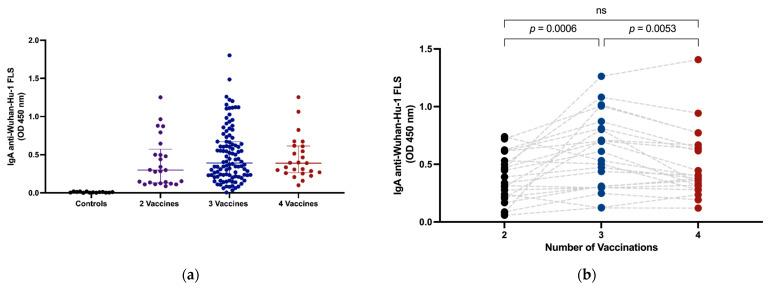
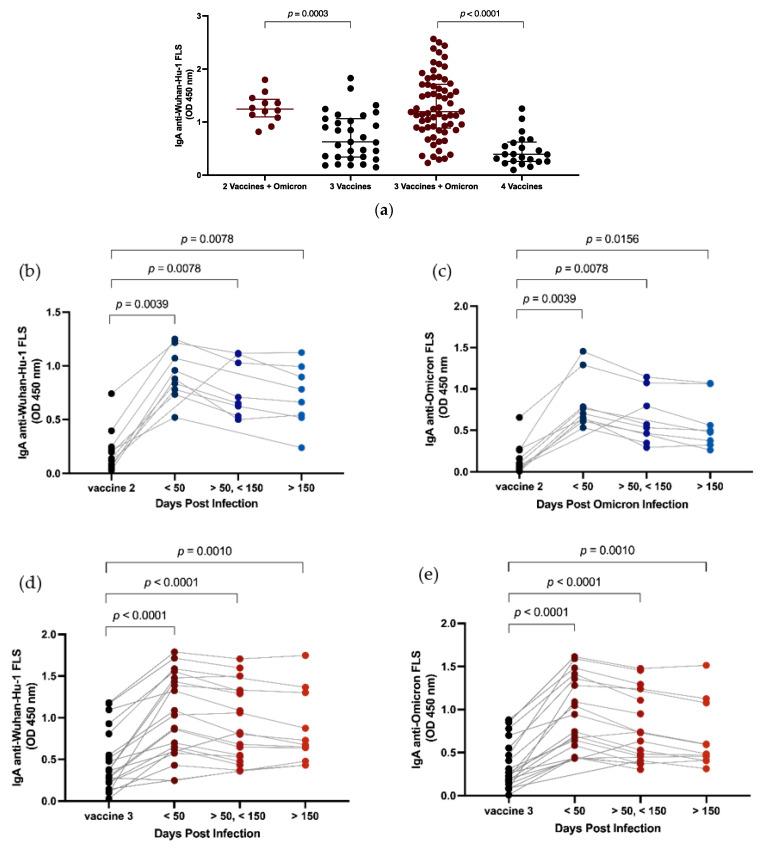
Mucosal IgA is widely accepted as providing protection against respiratory infections, but stimulation of mucosal immunity, collection of mucosal samples and measurement of mucosal IgA can be problematic. The relationship between mucosal and circulating IgA responses is unclear, however, whole blood is readily collected and circulating antigen-specific IgA easily measured. We measured circulating IgA against SARS-CoV-2 spike (S) to investigate vaccine- and infection-induced production and correlation with protection. Circulating IgA against ancestral (Wuhan-Hu-1) and Omicron (BA.1) S proteins was measured at different time points in a total of 143 subjects with varied backgrounds of vaccination and infection. Intramuscular vaccination induced circulating anti-SARS-CoV-2 S IgA. Subjects with higher levels of vaccine-induced IgA against SARS-CoV-2 S ( = 0.0333) or receptor binding domain (RBD) ( = 0.0266) were less likely to experience an Omicron breakthrough infection. The same associations did not hold for circulating IgG anti-SARS-CoV-2 S levels. Breakthrough infection following two vaccinations generated stronger IgA anti-SARS-CoV-2 S responses ( = 0.0002) than third vaccinations but did not selectively increase circulating IgA against Omicron over ancestral S, indicating immune imprinting of circulating IgA responses. Circulating IgA against SARS-CoV-2 S following breakthrough infection remained higher than vaccine-induced levels for over 150 days. In conclusion, intramuscular mRNA vaccination induces circulating IgA against SARS-CoV-2 S, and higher levels are associated with protection from breakthrough infection. Vaccination with ancestral S enacts imprinting within circulating IgA responses that become apparent after breakthrough infection with Omicron. Breakthrough infection generates stronger and more durable circulating IgA responses against SARS-CoV-2 S than vaccination alone.
黏膜IgA被广泛认为可提供针对呼吸道感染的保护作用,但刺激黏膜免疫、采集黏膜样本以及测量黏膜IgA可能存在问题。然而,黏膜和循环IgA反应之间的关系尚不清楚,不过全血易于采集,且循环中的抗原特异性IgA易于测量。我们检测了针对严重急性呼吸综合征冠状病毒2(SARS-CoV-2)刺突蛋白(S)的循环IgA,以研究疫苗和感染诱导的产生情况以及与保护作用的相关性。在总共143名具有不同疫苗接种和感染背景的受试者中,于不同时间点检测了针对原始株(武汉-1)和奥密克戎株(BA.1)S蛋白的循环IgA。肌肉注射疫苗可诱导循环中的抗SARS-CoV-2 S IgA产生。针对SARS-CoV-2 S(P = 0.0333)或受体结合域(RBD)(P = 0.0266)的疫苗诱导IgA水平较高的受试者发生奥密克戎突破性感染的可能性较小。对于循环中的抗SARS-CoV-2 S IgG水平,同样的关联并不成立。两次接种疫苗后的突破性感染产生的抗SARS-CoV-2 S IgA反应(P = 0.0002)比第三次接种更强,但并未选择性地增加针对奥密克戎株而非原始株S的循环IgA,这表明循环IgA反应存在免疫印记现象。突破性感染后针对SARS-CoV-2 S的循环IgA在超过150天的时间内仍高于疫苗诱导水平。总之,肌肉注射信使核糖核酸(mRNA)疫苗可诱导循环中的抗SARS-CoV-2 S IgA产生,较高水平与预防突破性感染相关。用原始株S进行疫苗接种会在循环IgA反应中产生印记,这种印记在奥密克戎突破性感染后变得明显。与单独接种疫苗相比,突破性感染产生的针对SARS-CoV-2 S的循环IgA反应更强且更持久。

 Zotero 插件