
管理 COVID-19 肺部炎症的免疫调节方法:一把双刃剑。
Immunomodulatory approaches in managing lung inflammation in COVID-19: A double-edge sword.
机构信息
Department of Experimental Medicine and Biotechnology, Post Graduate Institute of Medical Education and Research (PGIMER), Chandigarh, India.
Department of Microbiology, Punjab Agricultural University, Ludhiana, India.
出版信息
Immun Inflamm Dis. 2023 Sep;11(9):e1020. doi: 10.1002/iid3.1020.
INTRODUCTION
The novel coronavirus infectious disease 2019 (COVID-19) which is caused by severe acute respiratory syndrome coronavirus 2 (SARS-CoV-2) has emerged as a gigantic problem. The lung is the major target organ of SARS-CoV-2 and some of its variants like Delta and Omicron variant adapted in such a way that these variants can significantly damage this vital organ of the body. These variants raised a few eyebrows as the outbreaks have been seen in the vaccinated population. Patients develop severe respiratory illnesses which eventually prove fatal unless treated early.
MAIN BODY
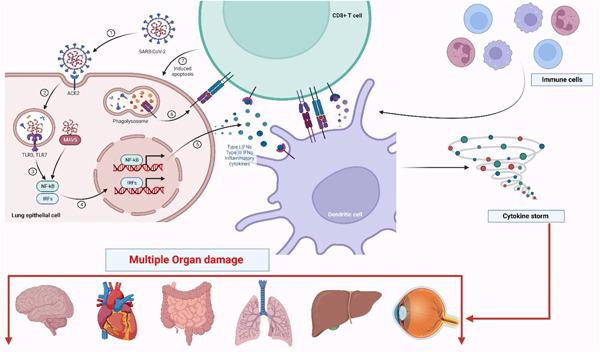
Studies have shown that SARS-CoV-2 causes the release of pro-inflammatory cytokines such as interleukin (IL)-6, IL-1β and tumor necrosis factor (TNF)-α which are mediators of lung inflammation, lung damage, fever, and fibrosis. Additionally, various chemokines have been found to play an important role in the disease progression. A plethora of pro-inflammatory cytokines "cytokine storm" has been observed in severe cases of SARS-CoV-2 infection leading to acute respiratory distress syndrome (ARDS) and pneumonia that may prove fatal. To counteract cytokine storm-inducing lung inflammation, several promising immunomodulatory approaches are being investigated in numerous clinical trials. However, the benefits of using these strategies should outweigh the risks involved as the use of certain immunosuppressive approaches might lead the host susceptible to secondary bacterial infections.
CONCLUSION
The present review discusses promising immunomodulatory approaches to manage lung inflammation in COVID-19 cases which may serve as potential therapeutic options in the future and may prove lifesaving.
简介
由严重急性呼吸综合征冠状病毒 2(SARS-CoV-2)引起的 2019 年新型冠状病毒传染病(COVID-19)已经成为一个巨大的问题。肺是 SARS-CoV-2 的主要靶器官,其一些变体,如 Delta 和奥密克戎变体,已经适应了这种方式,这些变体可以显著损害身体的这个重要器官。这些变体引起了一些关注,因为在接种疫苗的人群中已经看到了疫情爆发。患者会出现严重的呼吸道疾病,如果不早期治疗,最终会导致死亡。
正文
研究表明,SARS-CoV-2 会导致促炎细胞因子的释放,如白细胞介素(IL)-6、IL-1β 和肿瘤坏死因子(TNF)-α,这些都是肺部炎症、肺损伤、发热和纤维化的介质。此外,还发现了多种趋化因子在疾病进展中发挥重要作用。在 SARS-CoV-2 感染的严重病例中,大量的促炎细胞因子“细胞因子风暴”已经被观察到,导致急性呼吸窘迫综合征(ARDS)和肺炎,这可能是致命的。为了对抗细胞因子风暴引起的肺部炎症,正在进行大量临床试验来研究几种有前途的免疫调节方法。然而,使用这些策略的好处应该超过所涉及的风险,因为使用某些免疫抑制方法可能会使宿主容易受到继发细菌感染。
结论
本综述讨论了有前途的免疫调节方法来管理 COVID-19 病例中的肺部炎症,这些方法可能成为未来的潜在治疗选择,并可能证明是救生的。

 Zotero 插件