
严重 COVID-19 中失调的干扰素反应和免疫过度激活:靶向 STATs 作为一种新的治疗策略。
Dysregulated Interferon Response and Immune Hyperactivation in Severe COVID-19: Targeting STATs as a Novel Therapeutic Strategy.
机构信息
Laboratory of Human Molecular Genetics, Institute of Molecular Biology and Biotechnology, Faculty of Biology, Adam Mickiewicz University, Poznań, Poland.
Laboratory of High Throughput Technologies, Institute of Molecular Biology and Biotechnology, Faculty of Biology, Adam Mickiewicz University, Poznań, Poland.
出版信息
Front Immunol. 2022 May 17;13:888897. doi: 10.3389/fimmu.2022.888897. eCollection 2022.
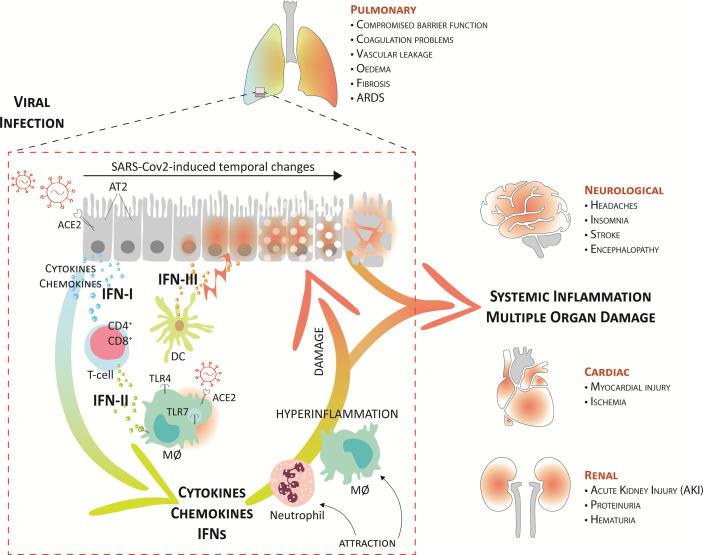
A disease outbreak in December 2019, caused by a novel coronavirus SARS-CoV-2, was named COVID-19. SARS-CoV-2 infects cells from the upper and lower respiratory tract system and is transmitted by inhalation or contact with infected droplets. Common clinical symptoms include fatigue, fever, and cough, but also shortness of breath and lung abnormalities. Still, some 5% of SARS-CoV-2 infections progress to severe pneumonia and acute respiratory distress syndrome (ARDS), with pulmonary edema, acute kidney injury, and/or multiple organ failure as important consequences, which can lead to death. The innate immune system recognizes viral RNAs and triggers the expression of interferons (IFN). IFNs activate anti-viral effectors and components of the adaptive immune system by activating members of the STAT and IRF families that induce the expression of IFN-stimulated genes (ISG)s. Among other coronaviruses, such as Middle East respiratory syndrome coronavirus (MERS-CoV) and SARS-CoV, common strategies have been identified to antagonize IFN signaling. This typically coincides with hyperactive inflammatory host responses known as the "cytokine storm" that mediate severe lung damage. Likewise, SARS-CoV-2 infection combines a dysregulated IFN response with excessive production of inflammatory cytokines in the lungs. This excessive inflammatory response in the lungs is associated with the local recruitment of immune cells that create a pathogenic inflammatory loop. Together, it causes severe lung pathology, including ARDS, as well as damage to other vulnerable organs, like the heart, spleen, lymph nodes, and kidney, as well as the brain. This can rapidly progress to multiple organ exhaustion and correlates with a poor prognosis in COVID-19 patients. In this review, we focus on the crucial role of different types of IFN that underlies the progression of SARS-CoV-2 infection and leads to immune cell hyper-activation in the lungs, exuberant systemic inflammation, and multiple organ damage. Consequently, to protect from systemic inflammation, it will be critical to interfere with signaling cascades activated by IFNs and other inflammatory cytokines. Targeting members of the STAT family could therefore be proposed as a novel therapeutic strategy in patients with severe COVID-19.
2019 年 12 月爆发的一种新型冠状病毒 SARS-CoV-2 引起的疾病被命名为 COVID-19。SARS-CoV-2 感染上、下呼吸道系统的细胞,并通过吸入或接触感染的飞沫传播。常见的临床症状包括疲劳、发热和咳嗽,但也有呼吸急促和肺部异常。然而,约有 5%的 SARS-CoV-2 感染进展为严重肺炎和急性呼吸窘迫综合征(ARDS),其重要后果是肺水肿、急性肾损伤和/或多器官衰竭,这可能导致死亡。先天免疫系统识别病毒 RNA 并触发干扰素(IFN)的表达。IFN 通过激活 STAT 和 IRF 家族成员来激活抗病毒效应物和适应性免疫系统成分,诱导 IFN 刺激基因(ISG)的表达。在其他冠状病毒(如中东呼吸综合征冠状病毒(MERS-CoV)和 SARS-CoV)中,已经确定了常见的拮抗 IFN 信号的策略。这通常与被称为“细胞因子风暴”的过度活跃的炎症宿主反应同时发生,该反应介导严重的肺损伤。同样,SARS-CoV-2 感染结合了失调的 IFN 反应和肺部过度产生炎症细胞因子。肺部过度炎症反应与免疫细胞在肺部的局部募集有关,这些细胞形成了一个致病的炎症循环。两者共同导致严重的肺病理学,包括 ARDS,以及对其他脆弱器官(如心脏、脾脏、淋巴结和肾脏以及大脑)的损伤。这可能迅速进展为多器官衰竭,并与 COVID-19 患者的不良预后相关。在这篇综述中,我们重点关注不同类型 IFN 的关键作用,这些 IFN 是 SARS-CoV-2 感染进展的基础,导致肺部免疫细胞过度激活、过度全身炎症和多器官损伤。因此,为了防止全身炎症,干扰 IFN 和其他炎症细胞因子激活的信号级联将是至关重要的。因此,针对 STAT 家族成员可能成为治疗严重 COVID-19 患者的一种新的治疗策略。


 Zotero 插件