
环状鸟苷酸-干扰素基因刺激物信号通路在自身免疫性疾病中的最新作用。
Updated roles of cGAS-STING signaling in autoimmune diseases.
机构信息
Department of Rheumatology and Immunology, Traditional Chinese and Western Medicine Hospital of Wuhan, Tongji Medical College, Huazhong University of Science and Technology, Wuhan, Hubei, China.
Hubei Key Laboratory of Skin Infection and Immunity, Wuhan No.1 Hospital, Wuhan, Hubei, China.
出版信息
Front Immunol. 2023 Sep 14;14:1254915. doi: 10.3389/fimmu.2023.1254915. eCollection 2023.
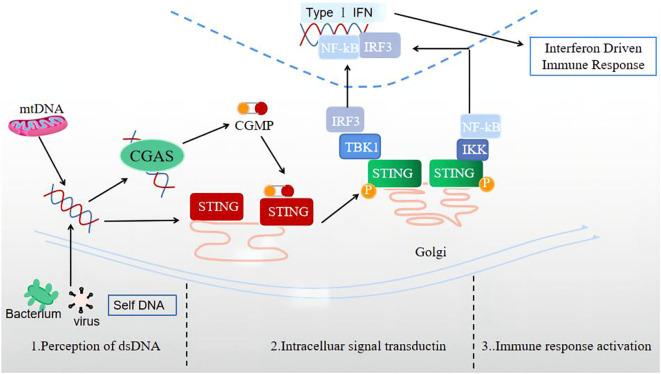
Natural immunity, the first line for the body to defense against the invasion of pathogen, serves as the body's perception of the presence of pathogens depends on nucleic acid recognition mechanisms. The cyclic GMP-AMP synthase-stimulator of the interferon gene (cGAS-STING) signaling pathway is considered an essential pattern recognition and effector pathway in the natural immune system and is mainly responsible for recognizing DNA molecules present in the cytoplasm and activating downstream signaling pathways to generate type I interferons and some other inflammatory factors. STING, a crucial junction protein in the innate immune system, exerts an essential role in host resistance to external pathogen invasion. Also, STING, with the same character of inflammatory molecules, is inseparable from the body's inflammatory response. In particular, when the expression of STING is upregulated or its related signaling pathways are overactivated, the body may develop serious infectious disorders due to the generation of excessive inflammatory responses, non-infectious diseases, and autoimmune diseases. In recent years, accumulating studies indicated that the abnormal activation of the natural immune cGAS-STING signaling pathway modulated by the nucleic acid receptor cGAS closely associated with the development and occurrence of autoimmune diseases (AID). Thereof, to explore an in-depth role of STING and its related signaling pathways in the diseases associated with inflammation may be helpful to provide new avenues for the treatment of these diseases in the clinic. This article reviews the activation process of the cGAS-STING signaling pathways and its related important roles, and therapeutic drugs in AID, aiming to improve our understanding of AID and achieve better diagnosis and treatment of AID.
天然免疫是机体抵御病原体入侵的第一道防线,作为机体感知病原体存在的依赖于核酸识别机制。环鸟苷酸-腺苷酸合成酶-干扰素基因刺激物(cGAS-STING)信号通路被认为是天然免疫系统中重要的模式识别和效应途径,主要负责识别细胞质中存在的 DNA 分子,并激活下游信号通路,产生 I 型干扰素和一些其他炎症因子。STING 作为先天免疫系统中的关键连接蛋白,在宿主抵抗外来病原体入侵方面发挥着重要作用。同时,作为炎症分子的 STING,与机体的炎症反应密不可分。特别是当 STING 的表达上调或其相关信号通路过度激活时,由于过度炎症反应的产生,机体可能会发生严重的感染性疾病、非传染性疾病和自身免疫性疾病。近年来,越来越多的研究表明,核酸受体 cGAS 调控的天然免疫 cGAS-STING 信号通路的异常激活与自身免疫性疾病(AID)的发生发展密切相关。因此,深入探讨 STING 及其相关信号通路在炎症相关疾病中的作用,可能有助于为这些疾病的临床治疗提供新的途径。本文综述了 cGAS-STING 信号通路的激活过程及其在 AID 中的相关重要作用和治疗药物,旨在提高对 AID 的认识,实现 AID 的更好诊断和治疗。
 Zotero 插件