
抑制 TLR4 信号传导以减轻骨关节炎的关节炎症。
Inhibition of TLR4 signalling to dampen joint inflammation in osteoarthritis.
机构信息
Experimental Rheumatology, Radboud University Medical Center, Nijmegen, The Netherlands.
Synthetic Organic Chemistry, Institute for Molecules and Materials, Radboud University, Nijmegen, The Netherlands.
出版信息
Rheumatology (Oxford). 2024 Mar 1;63(3):608-618. doi: 10.1093/rheumatology/kead493.
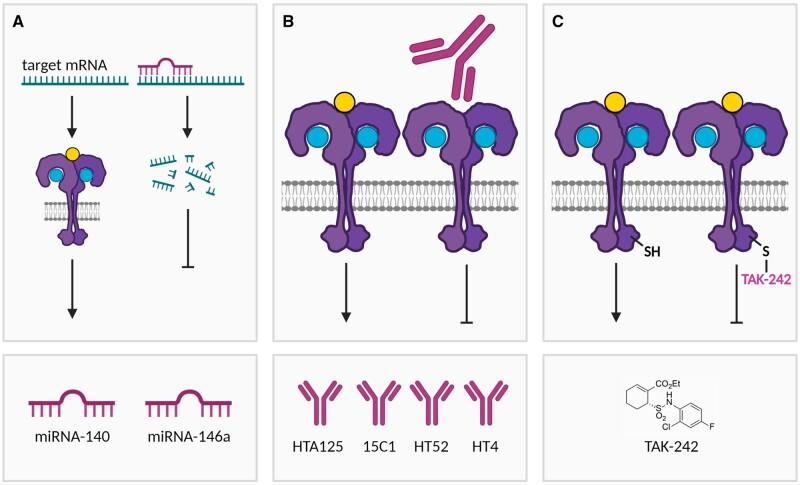
Local and systemic low-grade inflammation, mainly involving the innate immune system, plays an important role in the development of OA. A receptor playing a key role in initiation of this inflammation is the pattern-recognition receptor Toll-like receptor 4 (TLR4). In the joint, various ligands for TLR4, many of which are damage-associated molecular patterns (DAMPs), are present that can activate TLR4 signalling. This leads to the production of pro-inflammatory and catabolic mediators that cause joint damage. In this narrative review, we will first discuss the involvement of TLR4 ligands and signalling in OA. Furthermore, we will provide an overview of methods for inhibit, TLR4 signalling by RNA interference, neutralizing anti-TLR4 antibodies, small molecules and inhibitors targeting the TLR4 co-receptor MD2. Finally, we will focus on possible applications and challenges of these strategies in the dampening of inflammation in OA.
局部和全身低度炎症主要涉及固有免疫系统,在 OA 的发展中起重要作用。一种在炎症起始中起关键作用的受体是模式识别受体 Toll 样受体 4(TLR4)。在关节中,存在多种 TLR4 的配体,其中许多是损伤相关分子模式(DAMPs),可激活 TLR4 信号转导。这导致产生促炎和分解代谢介质,引起关节损伤。在本综述中,我们将首先讨论 TLR4 配体和信号转导在 OA 中的参与。此外,我们将概述通过 RNA 干扰、中和抗 TLR4 抗体、针对 TLR4 共受体 MD2 的小分子和抑制剂抑制 TLR4 信号转导的方法。最后,我们将重点关注这些策略在抑制 OA 炎症中的潜在应用和挑战。


 Zotero 插件