
肾脏受累于嗜酸性肉芽肿性多血管炎。
Renal involvement in eosinophilic granulomatosis with polyangiitis.
作者信息
Reggiani Francesco, L'Imperio Vincenzo, Calatroni Marta, Pagni Fabio, Sinico Renato Alberto
机构信息
Department of Biomedical Sciences, Humanitas University, Pieve Emanuele, Italy.
Nephrology and Dialysis Unit, IRCCS Humanitas Research Hospital, Rozzano, Italy.
出版信息
Front Med (Lausanne). 2023 Sep 18;10:1244651. doi: 10.3389/fmed.2023.1244651. eCollection 2023.
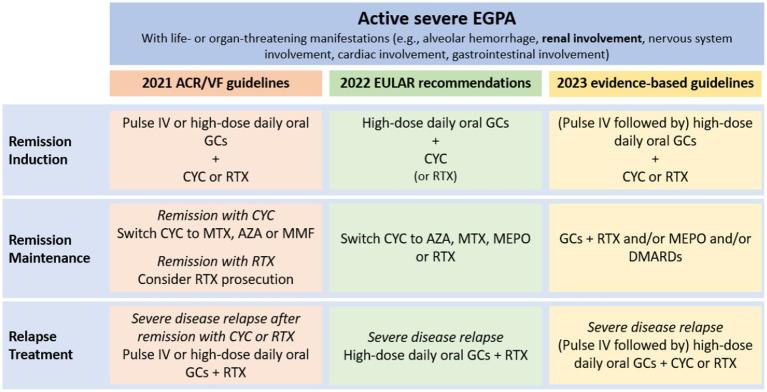
Eosinophilic granulomatosis with polyangiitis (EGPA) is a necrotizing vasculitis, which typically affects small-to medium-sized blood vessels. It is characterized by the presence of tissue infiltrates rich in eosinophils, along with the formation of granulomatous lesions. About 40% of cases have positive anti-neutrophil cytoplasm antibodies (ANCA), with predominant perinuclear staining, and anti-myeloperoxidase (anti-MPO) specificity in about 65% of cases. Typical manifestations of EGPA include the late onset of asthma, nasal and sinus-related symptoms, peripheral neuropathy, and significant eosinophilia observed in the peripheral blood. In contrast to granulomatosis with polyangiitis and microscopic polyangiitis, renal involvement in EGPA is less frequent (about 25%) and poorly studied. Necrotizing pauci-immune crescentic glomerulonephritis is the most common renal presentation in patients with ANCA-positive EGPA. Although rarely, other forms of renal involvement may also be observed, such as eosinophilic interstitial nephritis, mesangial glomerulonephritis, membranous nephropathy, or focal sclerosis. A standardized treatment for EGPA with renal involvement has not been defined, however the survival and the renal outcomes are usually better than in the other ANCA-associated vasculitides. Nonetheless, kidney disease is an adverse prognostic factor for EGPA patients. Larger studies are required to better describe the renal involvement, in particular for patterns different from crescentic glomerulonephritis, and to favor the development of a consensual therapeutic approach. In this article, in addition to personal data, we will review recent findings on patient clinical phenotypes based on ANCA, genetics and the impact of biological drugs on disease management.
嗜酸性肉芽肿性多血管炎(EGPA)是一种坏死性血管炎,通常累及小到中等大小的血管。其特征是存在富含嗜酸性粒细胞的组织浸润,并伴有肉芽肿性病变的形成。约40%的病例抗中性粒细胞胞浆抗体(ANCA)呈阳性,主要为核周染色,约65%的病例具有抗髓过氧化物酶(抗MPO)特异性。EGPA的典型表现包括哮喘起病较晚、鼻和鼻窦相关症状、周围神经病变以及外周血中显著的嗜酸性粒细胞增多。与肉芽肿性多血管炎和显微镜下多血管炎不同,EGPA患者肾脏受累较少见(约25%)且研究较少。坏死性寡免疫性新月体性肾小球肾炎是ANCA阳性EGPA患者最常见的肾脏表现。虽然罕见,但也可能观察到其他形式的肾脏受累,如嗜酸性间质性肾炎、系膜增生性肾小球肾炎、膜性肾病或局灶节段性肾小球硬化。目前尚未确定针对合并肾脏受累的EGPA的标准化治疗方法,然而其生存率和肾脏预后通常优于其他ANCA相关血管炎。尽管如此,肾脏疾病仍是EGPA患者的不良预后因素。需要开展更大规模的研究,以更好地描述肾脏受累情况,特别是不同于新月体性肾小球肾炎的模式,并推动达成共识的治疗方法的发展。在本文中,除了个人数据外,我们还将回顾基于ANCA、遗传学以及生物药物对疾病管理影响的患者临床表型的最新研究结果。


 Zotero 插件