
使用可穿戴传感器和机器学习识别帕金森病的运动进展
Identification of motor progression in Parkinson's disease using wearable sensors and machine learning.
作者信息
Sotirakis Charalampos, Su Zi, Brzezicki Maksymilian A, Conway Niall, Tarassenko Lionel, FitzGerald James J, Antoniades Chrystalina A
机构信息
NeuroMetrology Lab, Nuffield Department of Clinical Neurosciences, University of Oxford, Oxford, UK.
Institute of Biomedical Engineering, Department of Engineering Science, University of Oxford, Oxford, UK.
出版信息
NPJ Parkinsons Dis. 2023 Oct 7;9(1):142. doi: 10.1038/s41531-023-00581-2.
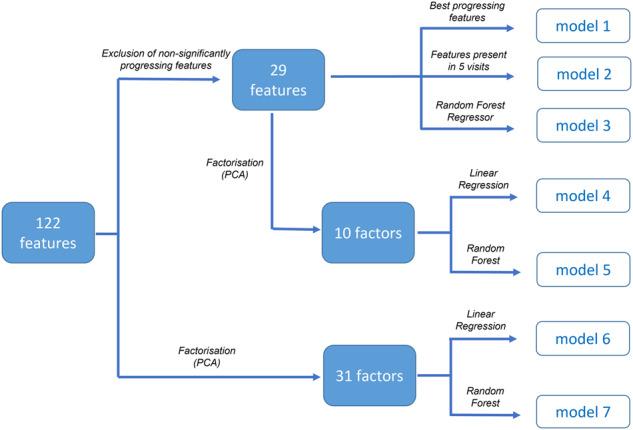
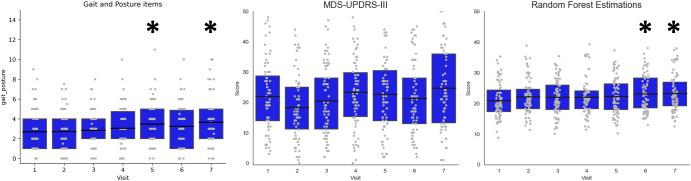
Wearable devices offer the potential to track motor symptoms in neurological disorders. Kinematic data used together with machine learning algorithms can accurately identify people living with movement disorders and the severity of their motor symptoms. In this study we aimed to establish whether a combination of wearable sensor data and machine learning algorithms with automatic feature selection can estimate the clinical rating scale and whether it is possible to monitor the motor symptom progression longitudinally, for people with Parkinson's Disease. Seventy-four patients visited the lab seven times at 3-month intervals. Their walking (2-minutes) and postural sway (30-seconds,eyes-closed) were recorded using six Inertial Measurement Unit sensors. Simple linear regression and Random Forest algorithms were utilised together with different routines of automatic feature selection or factorisation, resulting in seven different machine learning algorithms to estimate the clinical rating scale (Movement Disorder Society- Unified Parkinson's Disease Rating Scale part III; MDS-UPDRS-III). Twenty-nine features were found to significantly progress with time at group level. The Random Forest model revealed the most accurate estimation of the MDS-UPDRS-III among the seven models. The model estimations detected a statistically significant progression of the motor symptoms within 15 months when compared to the first visit, whereas the MDS-UPDRS-III did not capture any change. Wearable sensors and machine learning can track the motor symptom progression in people with PD better than the conventionally used clinical rating scales. The methods described in this study can be utilised complimentary to the clinical rating scales to improve the diagnostic and prognostic accuracy.
可穿戴设备为追踪神经疾病中的运动症状提供了可能性。运动学数据与机器学习算法结合使用,可以准确识别患有运动障碍的人群及其运动症状的严重程度。在本研究中,我们旨在确定可穿戴传感器数据与具有自动特征选择功能的机器学习算法相结合,是否能够估计临床评分量表,以及是否有可能对帕金森病患者的运动症状进展进行纵向监测。74名患者每隔3个月到实验室就诊7次。使用六个惯性测量单元传感器记录他们的步行(2分钟)和姿势摇摆(30秒,闭眼)情况。简单线性回归和随机森林算法与不同的自动特征选择或分解程序一起使用,产生了七种不同的机器学习算法来估计临床评分量表(运动障碍协会统一帕金森病评定量表第三部分;MDS-UPDRS-III)。在组水平上发现有29个特征随时间有显著进展。随机森林模型在七个模型中对MDS-UPDRS-III的估计最为准确。与首次就诊相比,该模型估计在15个月内检测到运动症状有统计学意义的进展,而MDS-UPDRS-III未发现任何变化。与传统使用的临床评分量表相比,可穿戴传感器和机器学习能够更好地追踪帕金森病患者的运动症状进展。本研究中描述的方法可与临床评分量表互补使用,以提高诊断和预后准确性。


 Zotero 插件