
神经外科重症监护病房中临床药师主导的抗菌药物管理计划的评估:一项干预前后队列研究。
Evaluation of a clinical pharmacist-led antimicrobial stewardship program in a neurosurgical intensive care unit: a pre-and post-intervention cohort study.
作者信息
Yu Jing, Liu Yan, Qu Ruochen, Wang Ziyang, Zhao Yan, Zhao Yuanyuan, Zhou Chunhua
机构信息
Department of Clinical Pharmacy, The First Hospital of Hebei Medical University, Shijiazhuang, China.
The Technology Innovation Center for Artificial Intelligence in Clinical Pharmacy of Hebei Province, The First Hospital of Hebei Medical University, Shijiazhuang, China.
出版信息
Front Pharmacol. 2023 Sep 22;14:1263618. doi: 10.3389/fphar.2023.1263618. eCollection 2023.
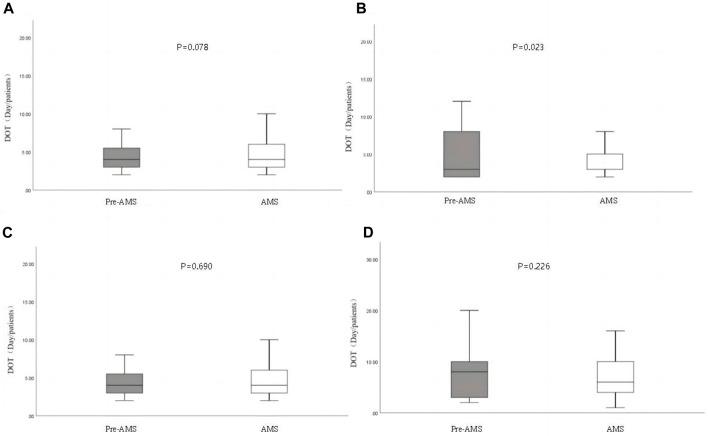
Antimicrobial resistance poses a significant challenge in neurosurgical intensive care units (ICU). The excessive use of broad-spectrum antibiotics is closely linked to the emergence and dissemination of drug-resistant bacteria within neurosurgical ICUs. This study assessed the effects of implementing a comprehensive Antimicrobial Stewardship (AMS) program in a neurosurgical ICU setting. From April 2022 to September 2022, an AMS program was implemented in the neurosurgical ICU. The program involved the regular presence of a pharmacist and an infectious disease physician who conducted prospective audits and provided feedback. To assess the impact of the AMS program, the outcome measures were compared between the AMS period and the 6 months before AMS implementation (pre-AMS period). The primary outcome was the use of antibacterial agents, including anti-pseudomonal beta-lactams (APBLs), polymyxin, and tigecycline. Additionally, the study evaluated the appropriateness of antimicrobial de-escalation and the susceptibility of Gram-negative bacilli to antimicrobial agents. A total of 526 were included during the AMS period, while 487 patients were included in the pre-AMS period. The two groups had no significant differences in disease severity and mortality rates. During the AMS period, there was a notable decrease in the use of APBLs as empiric treatment (43.92% vs. 60.99%, < 0.001). Multi-drug resistant organism (MDRO) infections decrease significantly during AMS period (11.03% vs. 18.48%, < 0.001). The number of prescription adjustment increased significantly in all patients (0 item vs. 0 item, < 0.001) and MDRO-positive patients (3 items vs. 2 items, < 0.001) during the AMS period. Additionally, appropriate antimicrobial de-escalation for patients with MDRO showed improvement during the AMS period (39.66% vs. 20%, = 0.001). Polymyxin utilization also decreased during the AMS period (15.52% vs. 31.11%, = 0.034). Furthermore, the susceptibility of Gram-negative Bacilli isolates to APBLs was significantly higher during the AMS period. Implementing a comprehensive pharmacist-led AMS program led to a decrease in the use of antibacterial agents. This reduction in usage is significant because it can potentially delay the emergence of bacterial resistance.
抗菌药物耐药性在神经外科重症监护病房(ICU)中构成了重大挑战。广谱抗生素的过度使用与神经外科ICU内耐药菌的出现和传播密切相关。本研究评估了在神经外科ICU环境中实施全面抗菌药物管理(AMS)计划的效果。2022年4月至2022年9月,在神经外科ICU实施了AMS计划。该计划包括定期有一名药剂师和一名传染病医生进行前瞻性审核并提供反馈。为评估AMS计划的影响,对AMS实施期间与AMS实施前6个月(AMS前期)的结果指标进行了比较。主要结果是抗菌药物的使用情况,包括抗假单胞菌β-内酰胺类药物(APBLs)、多粘菌素和替加环素。此外,该研究还评估了抗菌药物降阶梯治疗的适宜性以及革兰氏阴性杆菌对抗菌药物的敏感性。AMS期间共纳入526例患者,而AMS前期纳入了487例患者。两组在疾病严重程度和死亡率方面无显著差异。在AMS期间,作为经验性治疗的APBLs使用量显著下降(43.92%对60.99%,<0.001)。多重耐药菌(MDRO)感染在AMS期间显著减少(11.03%对18.48%,<0.001)。在AMS期间,所有患者(0项对0项,<0.001)和MDRO阳性患者(3项对2项,<0.001)的处方调整次数显著增加。此外,在AMS期间,MDRO患者的抗菌药物降阶梯治疗适宜性有所改善(39.66%对20%,=0.001)。多粘菌素的使用在AMS期间也有所下降(15.52%对31.11%,=0.034)。此外,在AMS期间,革兰氏阴性杆菌分离株对APBLs的敏感性显著更高。实施由药剂师主导的全面AMS计划导致抗菌药物使用量减少。这种使用量的减少具有重要意义,因为它可能会延迟细菌耐药性的出现。

 Zotero 插件