
条件性敲除破骨细胞中的 PDK1 抑制破骨细胞生成,并改善了小鼠模型中前列腺癌诱导的溶骨性骨破坏。
Conditional knockout of PDK1 in osteoclasts suppressed osteoclastogenesis and ameliorated prostate cancer-induced osteolysis in murine model.
机构信息
Guangxi Collaborative Innovation Center for Biomedicine, Guangxi Medical University, Nanning, China.
Department of Spine Osteopathia, The First Affiliated Hospital of Guangxi Medical University, Nanning, China.
出版信息
Eur J Med Res. 2023 Oct 13;28(1):433. doi: 10.1186/s40001-023-01425-8.
BACKGROUND
The development and maintenance of normal bone tissue is maintained by balanced communication between osteoblasts and osteoclasts. The invasion of cancer cells disrupts this balance, leading to osteolysis. As the only bone resorbing cells in vivo, osteoclasts play important roles in cancer-induced osteolysis. However, the role of 3-phosphoinositide-dependent protein kinase-1 (PDK1) in osteoclast resorption remains unclear.
METHODS
In our study, we used a receptor activator of nuclear factor-kappa B (RANK) promoter-driven Cre-LoxP system to conditionally delete the PDK1 gene in osteoclasts in mice. We observed the effect of osteoclast-specific knockout of PDK1 on prostate cancer-induced osteolysis. Bone marrow-derived macrophage cells (BMMs) were extracted and induced to differentiate osteoclasts in vitro to explore the role of PDK1 in osteoclasts.
RESULTS
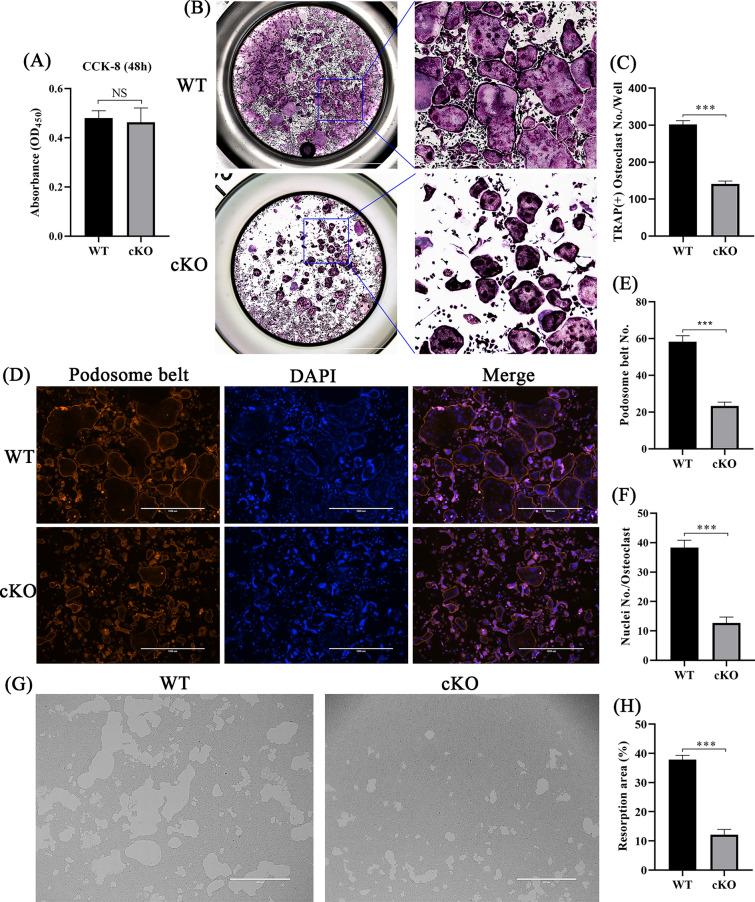
In this study, we found that PDK1 conditional knockout (cKO) mice exhibited smaller body sizes when compared to the wild-type (WT) mice. Moreover, deletion of PDK1 in osteoclasts ameliorated osteolysis and rPDK1educed bone resorption markers in the murine model of prostate cancer-induced osteolysis. In vivo, we discovered that osteoclast-specific knockout of suppressed RANKL-induced osteoclastogenesis, bone resorption function, and osteoclast-specific gene expression (Ctsk, TRAP, MMP-9, NFATc1). Western blot analyses of RANKL-induced signaling pathways showed that conditional knockout of PDK1 in osteoclasts inhibited the early nuclear factor κB (NF-κB) activation, which consequently suppressed the downstream induction of NFATc1.
CONCLUSION
These findings demonstrated that PDK1 performs an important role in osteoclastogenesis and prostate cancer-induced osteolysis by modulating the PDK1/AKT/NF-κB signaling pathway.
背景
成骨细胞和破骨细胞之间的平衡通讯维持着正常骨组织的发育和维持。癌细胞的侵袭破坏了这种平衡,导致溶骨性。破骨细胞作为体内唯一的骨吸收细胞,在癌诱导的溶骨性中起着重要作用。然而,3-磷酸肌醇依赖性蛋白激酶-1(PDK1)在破骨细胞吸收中的作用尚不清楚。
方法
在我们的研究中,我们使用核因子-κB(NF-κB)受体激活剂(RANK)启动子驱动的 Cre-LoxP 系统在小鼠中条件性敲除破骨细胞中的 PDK1 基因。我们观察了破骨细胞特异性敲除 PDK1 对前列腺癌诱导的溶骨性的影响。从骨髓来源的巨噬细胞(BMM)中提取并体外诱导分化为破骨细胞,以探讨 PDK1 在破骨细胞中的作用。
结果
在这项研究中,我们发现 PDK1 条件性敲除(cKO)小鼠的体型比野生型(WT)小鼠小。此外,破骨细胞中 PDK1 的缺失改善了前列腺癌诱导的溶骨性和 rPDK1 降低的骨吸收标志物在小鼠模型中的作用。在体内,我们发现,破骨细胞特异性敲除抑制了 RANKL 诱导的破骨细胞生成、骨吸收功能和破骨细胞特异性基因表达(Ctsk、TRAP、MMP-9、NFATc1)。RANKL 诱导的信号通路的 Western blot 分析表明,破骨细胞中 PDK1 的条件性敲除抑制了早期核因子 κB(NF-κB)的激活,从而抑制了 NFATc1 的下游诱导。
结论
这些发现表明,PDK1 通过调节 PDK1/AKT/NF-κB 信号通路在破骨细胞生成和前列腺癌诱导的溶骨性中发挥重要作用。



 Zotero 插件