
将调节性T细胞作为自身免疫性疾病和癌症的细胞疗法进行调控。
Regulating the regulatory T cells as cell therapies in autoimmunity and cancer.
作者信息
Hosseinalizadeh Hamed, Rabiee Fatemeh, Eghbalifard Negar, Rajabi Hamid, Klionsky Daniel J, Rezaee Aryan
机构信息
Department of Medical Biotechnology, Faculty of Paramedicine, Guilan University of Medical Sciences, Rasht, Iran.
Department of Pharmacology and Pharmaceutical Sciences Research Center, Isfahan University of Medical Sciences, Isfahan, Iran.
出版信息
Front Med (Lausanne). 2023 Sep 27;10:1244298. doi: 10.3389/fmed.2023.1244298. eCollection 2023.
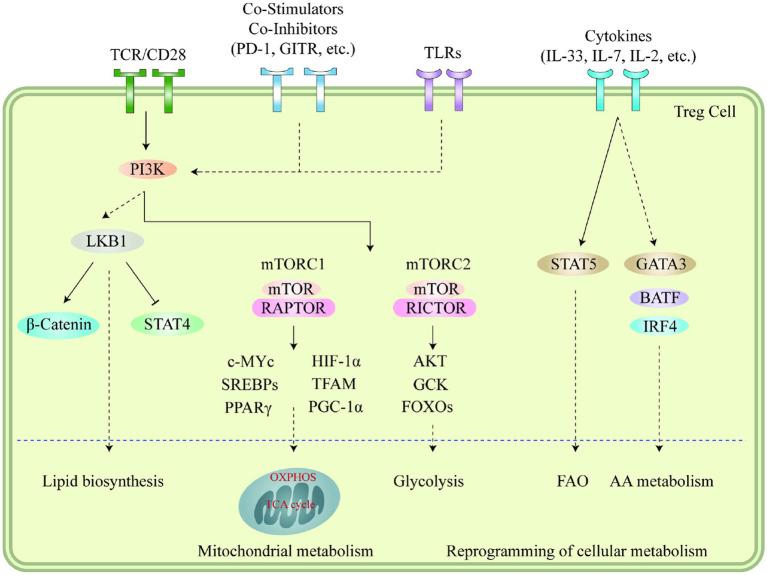
Regulatory T cells (Tregs), possess a pivotal function in the maintenance of immune homeostasis. The dysregulated activity of Tregs has been associated with the onset of autoimmune diseases and cancer. Hence, Tregs are promising targets for interventions aimed at steering the immune response toward the desired path, either by augmenting the immune system to eliminate infected and cancerous cells or by dampening it to curtail the damage to self-tissues in autoimmune disorders. The activation of Tregs has been observed to have a potent immunosuppressive effect against T cells that respond to self-antigens, thus safeguarding our body against autoimmunity. Therefore, promoting Treg cell stability presents a promising strategy for preventing or managing chronic inflammation that results from various autoimmune diseases. On the other hand, Tregs have been found to be overactivated in several forms of cancer, and their role as immune response regulators with immunosuppressive properties poses a significant impediment to the successful implementation of cancer immunotherapy. However, the targeting of Tregs in a systemic manner may lead to the onset of severe inflammation and autoimmune toxicity. It is imperative to develop more selective methods for targeting the function of Tregs in tumors. In this review, our objective is to elucidate the function of Tregs in tumors and autoimmunity while also delving into numerous therapeutic strategies for reprogramming their function. Our focus is on reprogramming Tregs in a highly activated phenotype driven by the activation of key surface receptors and metabolic reprogramming. Furthermore, we examine Treg-based therapies in autoimmunity, with a specific emphasis on Chimeric Antigen Receptor (CAR)-Treg therapy and T-cell receptor (TCR)-Treg therapy. Finally, we discuss key challenges and the future steps in reprogramming Tregs that could lead to the development of novel and effective cancer immunotherapies.
调节性T细胞(Tregs)在维持免疫稳态中发挥着关键作用。Tregs活性失调与自身免疫性疾病和癌症的发生有关。因此,Tregs是有前景的干预靶点,旨在通过增强免疫系统以消除感染细胞和癌细胞,或通过抑制免疫系统以减少自身免疫性疾病中对自身组织的损伤,从而引导免疫反应朝着期望的方向发展。已观察到Tregs的激活对响应自身抗原的T细胞具有强大的免疫抑制作用,从而保护我们的身体免受自身免疫的侵害。因此,促进Treg细胞稳定性是预防或管理由各种自身免疫性疾病引起的慢性炎症的一种有前景的策略。另一方面,已发现Tregs在几种癌症形式中过度激活,并且它们作为具有免疫抑制特性的免疫反应调节因子的作用对癌症免疫治疗的成功实施构成了重大障碍。然而,以全身方式靶向Tregs可能会导致严重炎症和自身免疫毒性的发生。开发更具选择性的方法来靶向肿瘤中Tregs的功能势在必行。在本综述中,我们的目标是阐明Tregs在肿瘤和自身免疫中的功能,同时深入探讨重编程其功能的众多治疗策略。我们的重点是在由关键表面受体激活和代谢重编程驱动的高度激活表型中重编程Tregs。此外,我们研究自身免疫中基于Tregs的疗法,特别强调嵌合抗原受体(CAR)-Treg疗法和T细胞受体(TCR)-Treg疗法。最后,我们讨论重编程Tregs的关键挑战和未来步骤,这可能会导致新型有效癌症免疫疗法的开发。
 Zotero 插件