
提高大麻二酚溶解度的当前挑战和机遇。
Current Challenges and Opportunities for Improved Cannabidiol Solubility.
机构信息
School of Life Sciences, University of Technology Sydney, Sydney, NSW 2007, Australia.
ARC Research Hub for Integrated Device for End-User Analysis at Low-Levels (IDEAL), Faculty of Science, University of Technology Sydney, Sydney, NSW 2007, Australia.
出版信息
Int J Mol Sci. 2023 Sep 25;24(19):14514. doi: 10.3390/ijms241914514.
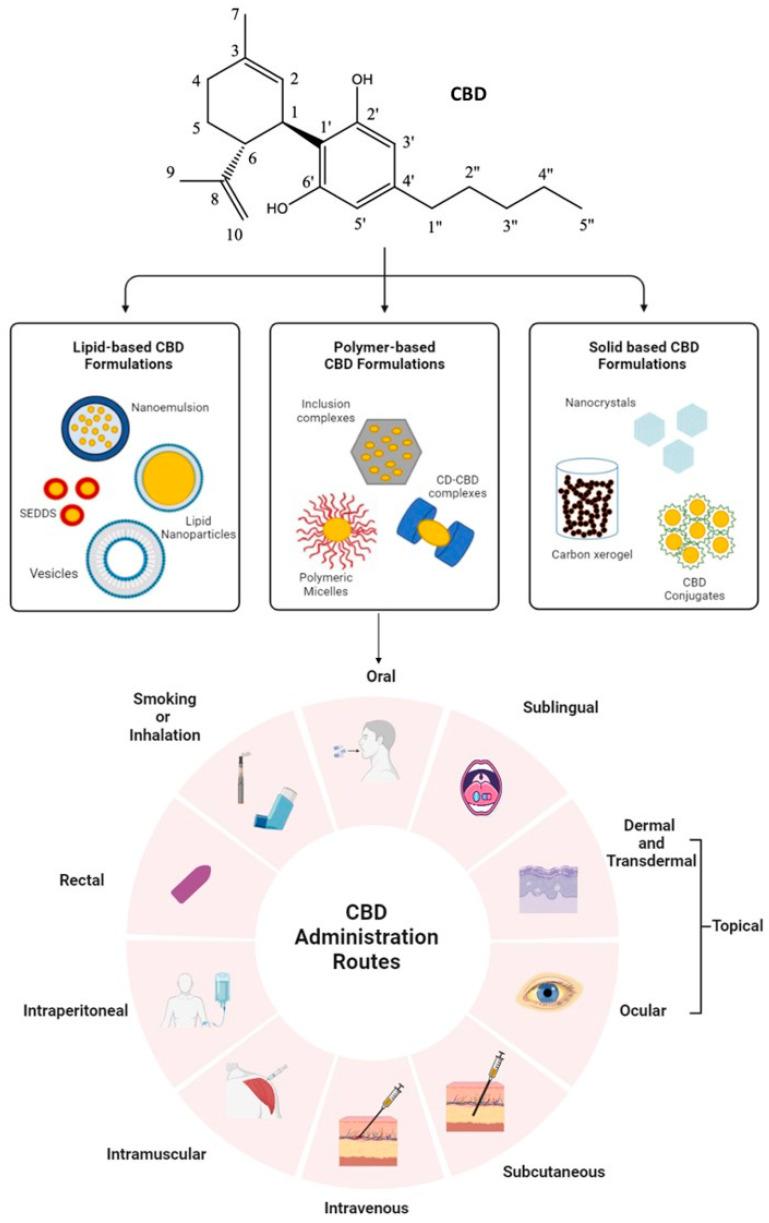
Cannabidiol (CBD), derived from the cannabis plant, has gained significant attention due to its potential therapeutic benefits. However, one of the challenges associated with CBD administration is its low bioavailability, which refers to the fraction of an administered dose that reaches systemic circulation. This limitation necessitates the exploration of various approaches to enhance the bioavailability of CBD, thus helping to maximize its therapeutic potential. A variety of approaches are now emerging, including nanoemulsion-based systems, lipid-based formulations, prodrugs, nanocarriers, and alternative routes of administration, which hold promise for improving the bioavailability of CBD and pave the way for novel formulations that maximize the therapeutic potential of CBD in various medical conditions. This opinion piece presents the current understanding surrounding CBD bioavailability and considers strategies aimed at improving both its absorption and its bioavailability.
大麻二酚(CBD)源自大麻植物,由于其具有潜在的治疗益处,因此备受关注。然而,与 CBD 给药相关的挑战之一是其生物利用度低,这是指给药剂量中到达全身循环的部分。这一限制需要探索各种方法来提高 CBD 的生物利用度,从而最大限度地发挥其治疗潜力。现在出现了多种方法,包括基于纳米乳液的系统、基于脂质的制剂、前药、纳米载体和替代给药途径,这些方法有望提高 CBD 的生物利用度,并为各种医疗条件下最大限度地发挥 CBD 的治疗潜力的新型制剂铺平道路。这篇观点文章介绍了目前对 CBD 生物利用度的理解,并考虑了旨在提高其吸收和生物利用度的策略。
 Zotero 插件