
应激角蛋白17是一种预测性生物标志物,与头颈部鳞状细胞癌及其他癌症中免疫检查点阻断治疗的反应呈负相关。
Stress Keratin 17 Is a Predictive Biomarker Inversely Associated with Response to Immune Check-Point Blockade in Head and Neck Squamous Cell Carcinomas and Beyond.
作者信息
Lozar Taja, Laklouk Israa, Golfinos Athena E, Gavrielatou Niki, Xu Jin, Flynn Christopher, Keske Aysenur, Yu Menggang, Bruce Justine Y, Wang Wei, Grasic Kuhar Cvetka, Bailey Howard H, Harari Paul M, Dinh Huy Q, Rimm David L, Hu Rong, Lambert Paul F, Fitzpatrick Megan B
机构信息
McArdle Laboratory for Cancer Research, University of Wisconsin School of Medicine and Public Health, 6459 Wisconsin Institute for Medical Research, 1111 Highland Ave., Madison, WI 53705, USA.
University of Wisconsin Carbone Cancer Center, Madison, 53705 WI, USA.
出版信息
Cancers (Basel). 2023 Oct 9;15(19):4905. doi: 10.3390/cancers15194905.
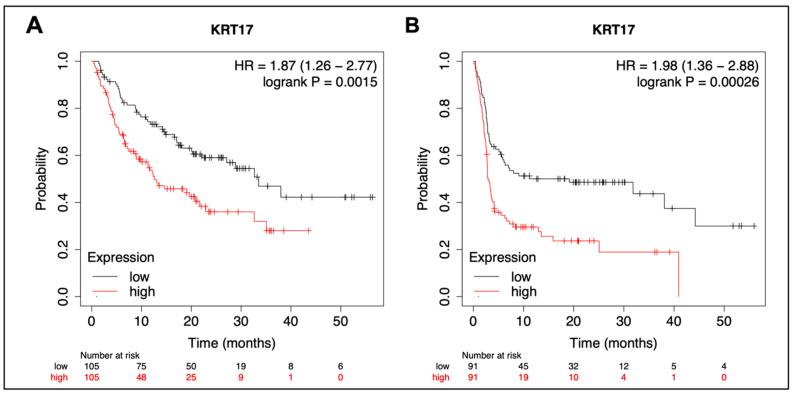
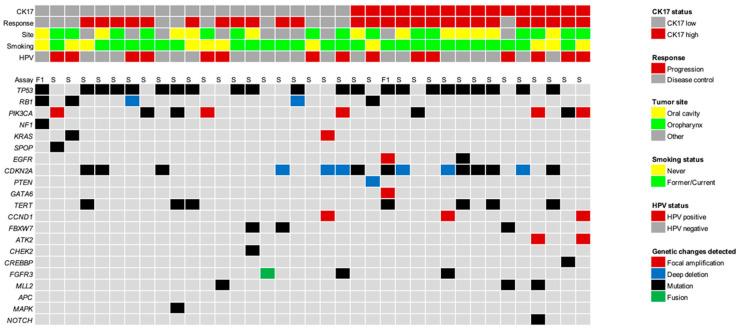
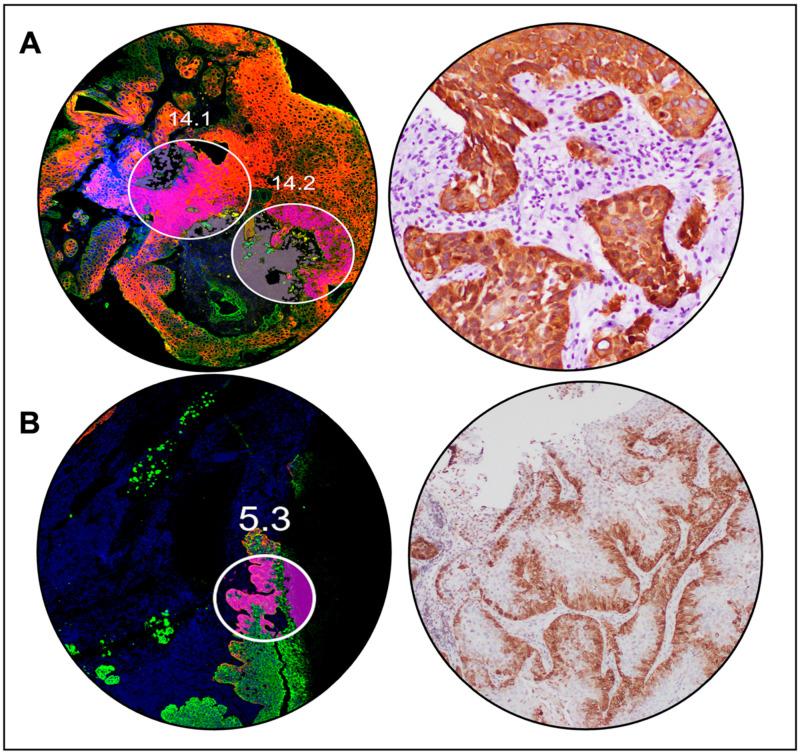
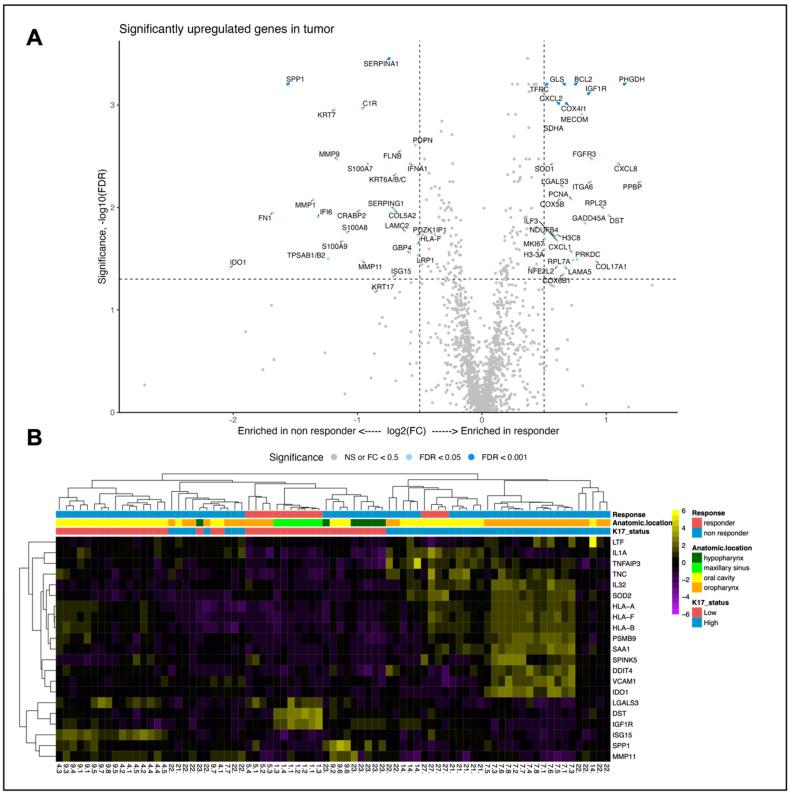
Low response rates in immune check-point blockade (ICB)-treated head and neck squamous cell carcinoma (HNSCC) drive a critical need for robust, clinically validated predictive biomarkers. Our group previously showed that stress keratin 17 (CK17) suppresses macrophage-mediated CXCL9/CXCL10 chemokine signaling involved in attracting activated CD8+ T cells into tumors, correlating with decreased response rate to pembrolizumab-based therapy in a pilot cohort of ICB-treated HNSCC ( = 26). Here, we performed an expanded analysis of the predictive value of CK17 in ICB-treated HNSCC according to the REMARK criteria and investigated the gene expression profiles associated with high CK17 expression. Pretreatment samples from pembrolizumab-treated HNSCC patients were stained via immunohistochemistry using a CK17 monoclonal antibody ( = 48) and subjected to spatial transcriptomic profiling ( = 8). Our findings were validated in an independent retrospective cohort ( = 22). CK17 RNA expression in pembrolizumab-treated patients with various cancer types was investigated for predictive significance. Of the 48 patients (60% male, median age of 61.5 years), 21 (44%) were CK17 high, and 27 (56%) were CK17 low. A total of 17 patients (35%, 77% CK17 low) had disease control, while 31 patients (65%, 45% CK17 low) had progressive disease. High CK17 expression was associated with a lack of disease control ( = 0.037), shorter time to treatment failure ( = 0.025), and progression-free survival (PFS, = 0.004), but not overall survival (OS, = 0.06). A high CK17 expression was associated with lack of disease control in an independent validation cohort ( = 0.011). PD-L1 expression did not correlate with CK17 expression or clinical outcome. CK17 RNA expression was predictive of PFS and OS in 552 pembrolizumab-treated cancer patients. Our findings indicate that high CK17 expression may predict resistance to ICB in HNSCC patients and beyond.
免疫检查点阻断(ICB)治疗的头颈部鳞状细胞癌(HNSCC)的低反应率促使人们迫切需要强大的、经过临床验证的预测性生物标志物。我们的研究小组之前表明,应激角蛋白17(CK17)抑制巨噬细胞介导的CXCL9/CXCL10趋化因子信号传导,该信号传导参与将活化的CD8+T细胞吸引到肿瘤中,这与ICB治疗的HNSCC试点队列(n = 26)中基于派姆单抗治疗的反应率降低相关。在此,我们根据REMARK标准对CK17在ICB治疗的HNSCC中的预测价值进行了扩展分析,并研究了与高CK17表达相关的基因表达谱。使用CK17单克隆抗体通过免疫组织化学对派姆单抗治疗的HNSCC患者的预处理样本进行染色(n = 48),并进行空间转录组分析(n = 8)。我们的研究结果在一个独立的回顾性队列(n = 22)中得到了验证。研究了派姆单抗治疗的各种癌症类型患者中CK17 RNA表达的预测意义。在48例患者(60%为男性,中位年龄61.5岁)中,21例(44%)CK17高,27例(56%)CK17低。共有17例患者(35%,CK17低者占77%)疾病得到控制,而31例患者(65%,CK17低者占45%)病情进展。高CK17表达与缺乏疾病控制(P = 0.037)、较短的治疗失败时间(P = 0.025)和无进展生存期(PFS,P = 0.004)相关,但与总生存期(OS,P = 0.06)无关。在一个独立的验证队列中,高CK17表达与缺乏疾病控制相关(P = 0.011)。PD-L1表达与CK17表达或临床结果无关。CK17 RNA表达可预测552例接受派姆单抗治疗的癌症患者的PFS和OS。我们的研究结果表明,高CK17表达可能预测HNSCC患者及其他患者对ICB的耐药性。


 Zotero 插件