
糖尿病足溃疡感染的经验性抗生素治疗会增加住院率。
Empirical Antibiotic Therapy in Diabetic Foot Ulcer Infection Increases Hospitalization.
作者信息
Schmidt Brian M, Kaye Keith S, Armstrong David G, Pop-Busui Rodica
机构信息
Division of Metabolism, Endocrinology, and Diabetes, Department of Internal Medicine, University of Michigan Health, Ann Arbor, Michigan, USA.
Robert Wood Johnson Medical School, New Brunswick, New Jersey, USA.
出版信息
Open Forum Infect Dis. 2023 Oct 5;10(10):ofad495. doi: 10.1093/ofid/ofad495. eCollection 2023 Oct.
BACKGROUND
We evaluated the outcomes associated with initial antibiotic management strategies for infected diabetic foot ulcers (DFUs) diagnosed in an outpatient multidisciplinary center.
METHODS
Consecutive outpatient individuals with infected DFUs, stratified according to Infectious Diseases Society of America infection severity, were followed for 1 year from the initial antibiotic administration to treat acute infection. The main outcomes were hospitalization rates for a diabetes-related foot complication within 30 days of diagnosis and requiring an amputation or death during follow-up. Outcomes were analyzed by regression analysis, accounting for demographics, clinical characteristics, and antibiotic therapy.
RESULTS
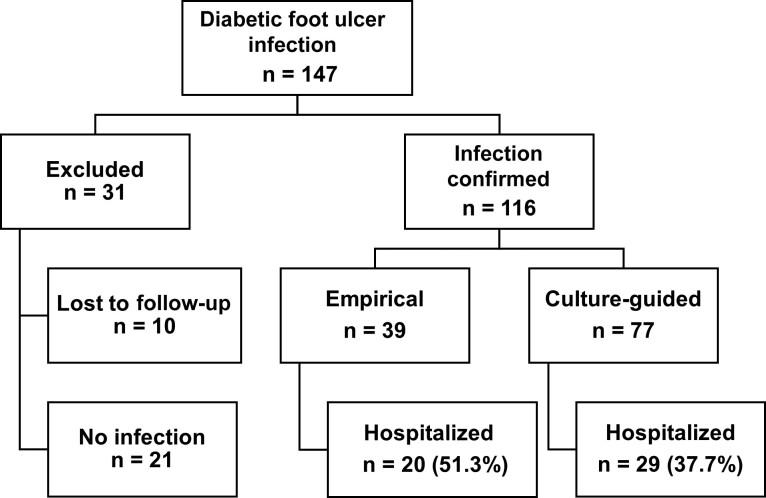
Among 147 outpatients with infected DFUs, 116 were included. Infections were categorized as mild (68%), moderate (26%), and severe (6%). Empirical antibiotics (not culture-guided) were prescribed as initial treatment in 39 individuals, while 77 received culture-based antibiotics. There were no differences in demographic or clinical characteristics between the antibiotic administration groups, except for a higher body mass index and prevalence of chronic kidney disease in the empirical cohort. Forty-two infected DFU patients required hospitalization within 30 days of diagnosis for the same reason. The relative risk for hospitalizations was 1.87 greater in those with mild infections when treated with empirical antibiotics compared with culture-directed antibiotics. There were no differences in amputations and/or death at 1 year follow-up.
CONCLUSIONS
These data support obtaining tissue culture to guide antibiotic therapy, regardless of DFU infection severity, to decrease hospitalizations.
背景
我们评估了在门诊多学科中心诊断的感染性糖尿病足溃疡(DFU)初始抗生素管理策略的相关结果。
方法
对患有感染性DFU的连续门诊患者,根据美国传染病学会的感染严重程度进行分层,从初始使用抗生素治疗急性感染开始随访1年。主要结局为诊断后30天内与糖尿病相关的足部并发症的住院率以及随访期间需要截肢或死亡的情况。通过回归分析对结局进行分析,同时考虑人口统计学、临床特征和抗生素治疗情况。
结果
在147例患有感染性DFU的门诊患者中,116例被纳入研究。感染分为轻度(68%)、中度(26%)和重度(6%)。39例患者初始治疗采用经验性抗生素(非培养指导),77例接受基于培养结果的抗生素治疗。抗生素给药组之间在人口统计学或临床特征方面无差异,但经验性治疗组的体重指数和慢性肾病患病率较高。42例感染性DFU患者在诊断后30天内因相同原因需要住院治疗。与基于培养结果的抗生素治疗相比,轻度感染患者使用经验性抗生素治疗时住院的相对风险高1.87倍。在1年随访时截肢和/或死亡情况无差异。
结论
这些数据支持无论DFU感染严重程度如何,均应获取组织培养结果以指导抗生素治疗,从而降低住院率。
 Zotero 插件