
加速的 DNA 甲基化年龄在心血管风险因素对人类心脏的影响中发挥作用。
Accelerated DNA methylation age plays a role in the impact of cardiovascular risk factors on the human heart.
机构信息
UCL MRC Unit for Lifelong Health and Ageing, University College London, 1-19 Torrington Place, London, UK.
UCL Institute of Cardiovascular Science, University College London, 62 Huntley St, London, WC1E 6BT, UK.
出版信息
Clin Epigenetics. 2023 Oct 18;15(1):164. doi: 10.1186/s13148-023-01576-9.
BACKGROUND
DNA methylation (DNAm) age acceleration (AgeAccel) and cardiac age by 12-lead advanced electrocardiography (A-ECG) are promising biomarkers of biological and cardiac aging, respectively. We aimed to explore the relationships between DNAm age and A-ECG heart age and to understand the extent to which DNAm AgeAccel relates to cardiovascular (CV) risk factors in a British birth cohort from 1946.
RESULTS
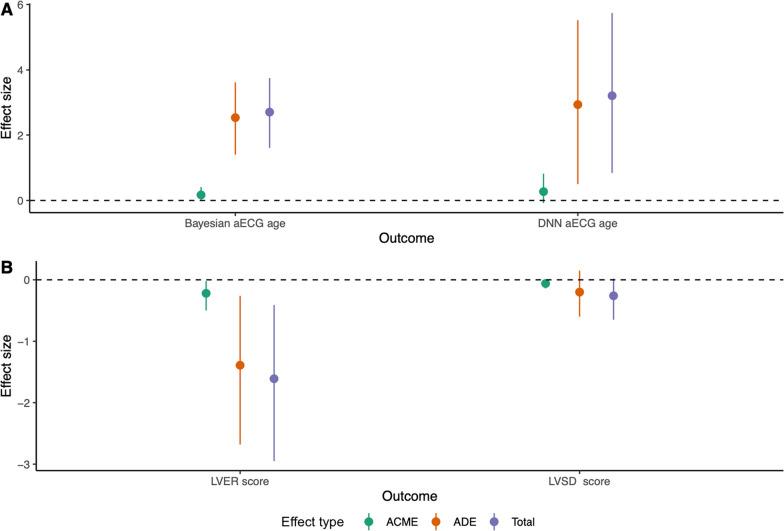
We studied four DNAm ages (AgeHannum, AgeHorvath, PhenoAge, and GrimAge) and their corresponding AgeAccel. Outcomes were the results from two publicly available ECG-based cardiac age scores: the Bayesian A-ECG-based heart age score of Lindow et al. 2022 and the deep neural network (DNN) ECG-based heart age score of Ribeiro et al. 2020. DNAm AgeAccel was also studied relative to results from two logistic regression-based A-ECG disease scores, one for left ventricular (LV) systolic dysfunction (LVSD), and one for LV electrical remodeling (LVER). Generalized linear models were used to explore the extent to which any associations between biological cardiometabolic risk factors (body mass index, hypertension, diabetes, high cholesterol, previous cardiovascular disease [CVD], and any CV risk factor) and the ECG-based outcomes are mediated by DNAm AgeAccel. We derived the total effects, average causal mediation effects (ACMEs), average direct effects (ADEs), and the proportion mediated [PM] with their 95% confidence intervals [CIs]. 498 participants (all 60-64 years) were included, with the youngest ECG heart age being 27 and the oldest 90. When exploring the associations between cardiometabolic risk factors and Bayesian A-ECG cardiac age, AgeAccelPheno appears to be a partial mediator, as ACME was 0.23 years [0.01, 0.52] p = 0.028 (i.e., PM≈18%) for diabetes, 0.34 [0.03, 0.74] p = 0.024 (i.e., PM≈15%) for high cholesterol, and 0.34 [0.03, 0.74] p = 0.024 (PM≈15%) for any CV risk factor. Similarly, AgeAccelGrim mediates ≈30% of the relationship between diabetes or high cholesterol and the DNN ECG-based heart age. When exploring the link between cardiometabolic risk factors and the A-ECG-based LVSD and LVER scores, it appears that AgeAccelPheno or AgeAccelGrim mediate 10-40% of these associations.
CONCLUSION
By the age of 60, participants with accelerated DNA methylation appear to have older, weaker, and more electrically impaired hearts. We show that the harmful effects of CV risk factors on cardiac age and health, appear to be partially mediated by DNAm AgeAccelPheno and AgeAccelGrim. This highlights the need to further investigate the potential cardioprotective effects of selective DNA methyltransferases modulators.
背景
DNA 甲基化(DNAm)年龄加速(AgeAccel)和 12 导联高级心电图(A-ECG)的心脏年龄分别是生物和心脏老化的有前途的生物标志物。我们旨在探索 DNAm 年龄与 A-ECG 心脏年龄之间的关系,并了解 DNAm AgeAccel 在多大程度上与来自 1946 年的英国出生队列的心血管(CV)危险因素相关。
结果
我们研究了四个 DNAm 年龄(AgeHannum、AgeHorvath、PhenoAge 和 GrimAge)及其对应的 AgeAccel。结果来自两个公开的基于心电图的心脏年龄评分:Lindow 等人的基于贝叶斯的 A-ECG 心脏年龄评分。2022 年和 Ribeiro 等人的基于深度神经网络(DNN)的 ECG 心脏年龄评分。2020 年。还研究了 DNAm AgeAccel 与两个基于逻辑回归的 A-ECG 疾病评分之间的关系,一个用于左心室(LV)收缩功能障碍(LVSD),另一个用于 LV 电重塑(LVER)。使用广义线性模型来探索任何与生物代谢危险因素(体重指数、高血压、糖尿病、高胆固醇、先前的心血管疾病[CVD]和任何心血管危险因素)之间的关联程度,以及这些关联是否由 DNAm AgeAccel 介导。我们得出了总效应、平均因果中介效应(ACME)、平均直接效应(ADE)和比例中介 [PM]及其 95%置信区间 [CI]。498 名参与者(均为 60-64 岁)被纳入研究,最小的心电图心脏年龄为 27 岁,最大的为 90 岁。当探索代谢危险因素与基于贝叶斯的 A-ECG 心脏年龄之间的关系时,AgeAccelPheno 似乎是一个部分中介,ACME 为 0.23 岁 [0.01,0.52] p = 0.028(即 PM≈18%)对于糖尿病,0.34 [0.03,0.74] p = 0.024(即 PM≈15%)对于高胆固醇,以及 0.34 [0.03,0.74] p = 0.024(PM≈15%)对于任何心血管危险因素。同样,AgeAccelGrim 介导了糖尿病或高胆固醇与 DNN 心电图心脏年龄之间关系的≈30%。当探索代谢危险因素与基于 A-ECG 的 LVSD 和 LVER 评分之间的联系时,似乎 AgeAccelPheno 或 AgeAccelGrim 介导了这些关联的 10-40%。
结论
到 60 岁时,DNA 甲基化加速的参与者似乎拥有更老、更弱和电功能受损更严重的心脏。我们表明,心血管危险因素对心脏年龄和健康的有害影响,似乎部分由 DNAm AgeAccelPheno 和 AgeAccelGrim 介导。这凸显了进一步研究选择性 DNA 甲基转移酶调节剂的潜在心脏保护作用的必要性。

 Zotero 插件