
小鼠围产期铅或邻苯二甲酸二(2-乙基己基)酯暴露:不同时间对心脏DNA甲基化和基因表达的性别特异性影响。
Perinatal Exposure to Lead or Diethylhexyl Phthalate in Mice: Sex-Specific Effects on Cardiac DNA Methylation and Gene Expression across Time.
作者信息
Wang Kai, Li Minghua, Sartor Maureen A, Colacino Justin A, Dolinoy Dana C, Svoboda Laurie K
机构信息
Department of Computational Medicine and Bioinformatics, Medical School, University of Michigan, Ann Arbor, Michigan, USA.
Department of Biostatistics, School of Public Health, University of Michigan, Ann Arbor, Michigan, USA.
出版信息
Environ Health Perspect. 2025 Jun;133(6):67014. doi: 10.1289/EHP15503. Epub 2025 Jun 16.
BACKGROUND
Global and site-specific changes in DNA methylation and gene expression are associated with cardiovascular development, aging, and disease, but how the transcriptome and epigenome of the heart change across the life course in males vs. females and how chemical exposures early in life influence this programming have not yet been investigated.
OBJECTIVES
We used an established mouse model of developmental exposures to investigate the effects of perinatal exposure to either lead (Pb) or diethylhexyl phthalate (DEHP), two ubiquitous environmental contaminants that are both strongly associated with cardiovascular diseases (CVDs), on DNA methylation and gene expression across the life course in whole hearts.
METHODS
Dams were randomly assigned to receive human physiologically relevant levels of Pb ( in water), DEHP ( chow), or control water and chow. Exposures started 2 weeks prior to mating and continued until weaning at postnatal day 21 (3 wk of age). Approximately 1 male and 1 female offspring per litter were followed to 3 wk, 5 months, or 10 months of age, at which time whole hearts were collected ( per sex per exposure). Enhanced reduced representation bisulfite sequencing (ERRBS) was used to assess the cardiac DNA methylome at 3 wk and 10 months, and RNA-Seq was conducted at all three time points. MethylSig and edgeR were used to identify age-related differentially methylated regions (DMRs) and differentially expressed genes (DEGs), respectively, within each sex and exposure group. Cell type deconvolution of bulk RNA-Seq data was conducted using the MuSiC algorithm and publicly available single-cell RNA-Seq data.
RESULTS
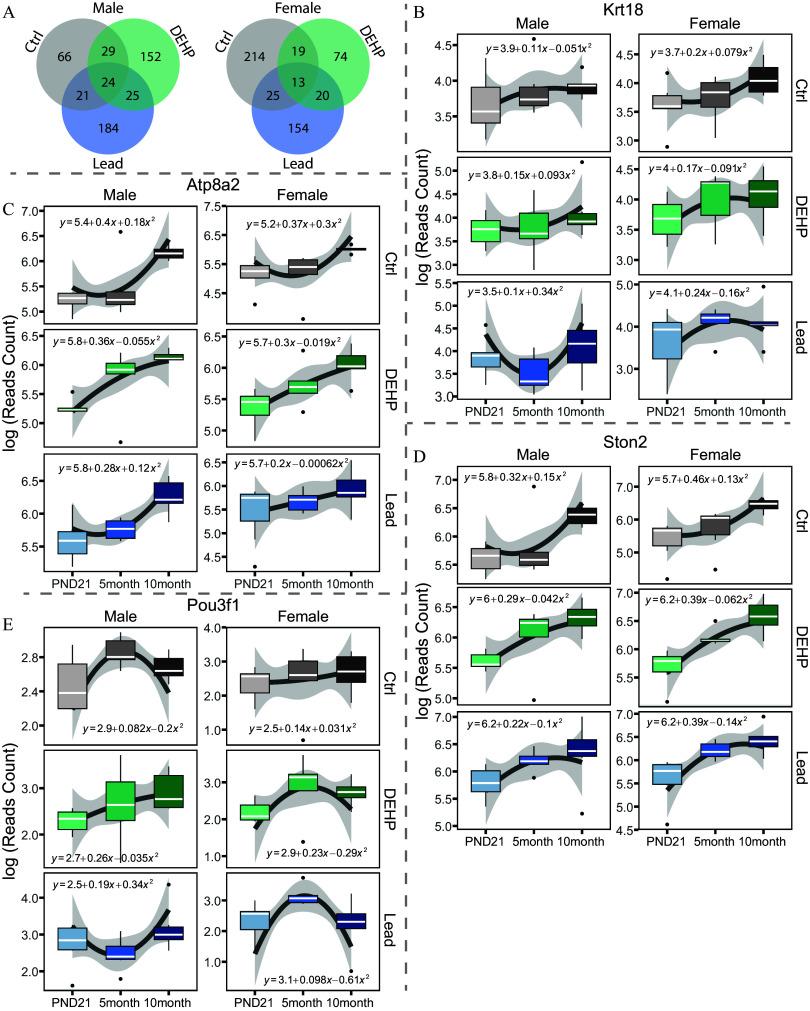
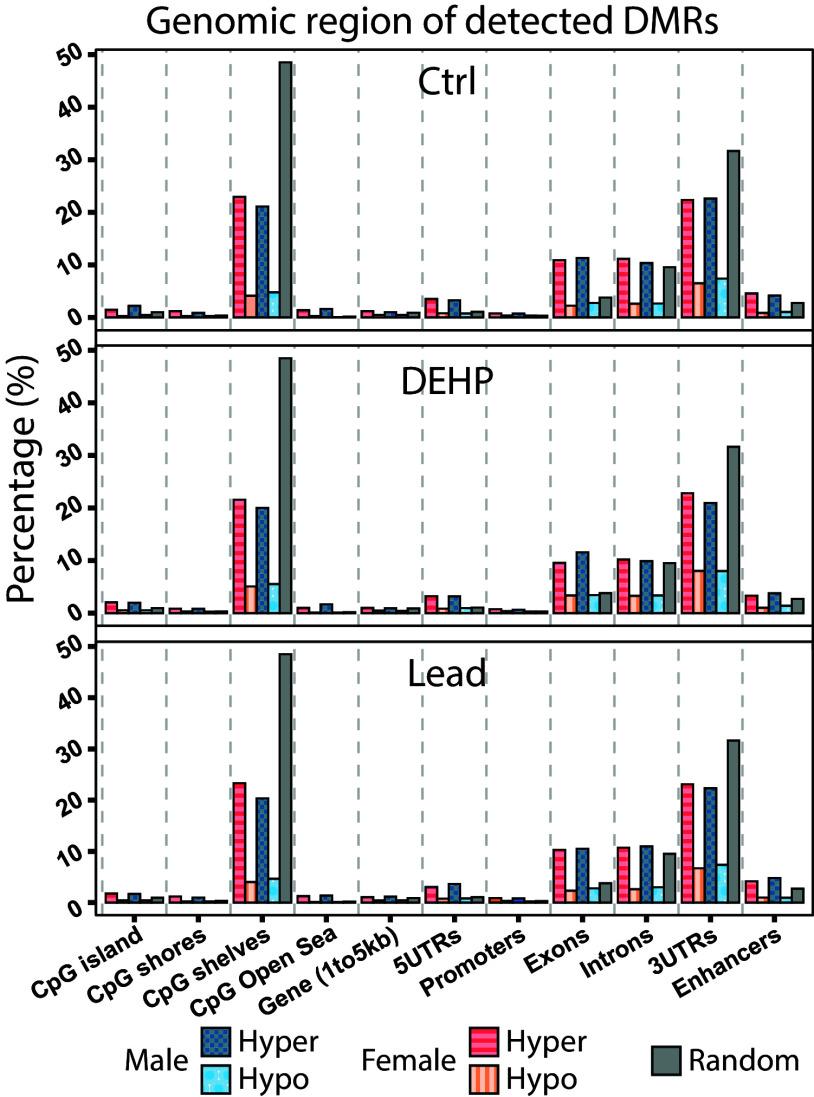
Thousands of DMRs and hundreds of DEGs were identified in control, DEHP, and Pb-exposed hearts across time between 3 wk and 10 months of age. A closer look at the genes and pathways showing differential DNA methylation revealed that the majority were unique to each sex and exposure group. Overall, pathways governing development and differentiation changed across time in all conditions. A small number of genes in each group showed significant differences in DNA methylation and gene expression with life stage, including several that were different in toxicant-exposed but not control mice. We also observed subtle but significant differences in the proportion of several cell types that were associated with life stage, sex, or developmental exposure.
DISCUSSION
Together these data suggest that gene expression and DNA methylation programs, as well as cellular composition, may differ across the life course long after cessation of exposure in perinatal Pb- or DEHP-exposed mice compared to controls and highlight potential biomarkers of developmental toxicant exposures; however, additional studies are required for confirmation. Further studies are also needed to investigate how epigenetic and transcriptional differences impact cardiovascular health across the life course, particularly in old age when the risk of cardiovascular diseases is markedly increased. https://doi.org/10.1289/EHP15503.
背景
DNA甲基化和基因表达的整体及位点特异性变化与心血管发育、衰老和疾病相关,但心脏的转录组和表观基因组在男性和女性的生命历程中如何变化,以及生命早期的化学物质暴露如何影响这种编程尚未得到研究。
目的
我们使用一种已建立的发育暴露小鼠模型,研究围产期暴露于铅(Pb)或邻苯二甲酸二(2-乙基己基)酯(DEHP)这两种与心血管疾病(CVD)密切相关的普遍存在的环境污染物,对全心脏生命历程中的DNA甲基化和基因表达的影响。
方法
将母鼠随机分配接受人体生理相关水平的铅(溶于水)、DEHP(添加到食物中),或对照水和食物。暴露在交配前2周开始,持续到出生后第21天(3周龄)断奶。每窝大约1只雄性和1只雌性后代被追踪到3周、5个月或10个月龄,此时收集全心脏(每种性别每种暴露情况)。增强型简化代表性亚硫酸氢盐测序(ERRBS)用于评估3周和10个月龄时的心脏DNA甲基化组,在所有三个时间点进行RNA测序。甲基化信号分析(MethylSig)和edgeR分别用于识别每个性别和暴露组内与年龄相关的差异甲基化区域(DMR)和差异表达基因(DEG)。使用MuSiC算法和公开可用的单细胞RNA测序数据对大量RNA测序数据进行细胞类型反卷积分析。
结果
在3周龄至10个月龄期间,在对照、DEHP和铅暴露的心脏中鉴定出数千个DMR和数百个DEG。仔细观察显示DNA甲基化差异的基因和通路发现,大多数在每个性别和暴露组中都是独特的。总体而言,在所有条件下,控制发育和分化的通路随时间而变化。每组中有少数基因在DNA甲基化和基因表达上随生命阶段有显著差异,包括一些在接触毒物但非对照小鼠中不同的基因。我们还观察到与生命阶段、性别或发育暴露相关的几种细胞类型比例存在细微但显著的差异。
讨论
这些数据共同表明,与对照组相比,围产期暴露于铅或DEHP的小鼠在停止暴露后很长时间内,基因表达和DNA甲基化程序以及细胞组成在生命历程中可能存在差异,并突出了发育毒物暴露的潜在生物标志物;然而,需要进一步研究进行确认。还需要进一步研究来调查表观遗传和转录差异如何在生命历程中影响心血管健康,特别是在心血管疾病风险显著增加老年时期。https://doi.org/10.1289/EHP15503



 Zotero 插件