
与年龄相关的全基因组DNA高甲基化增强了心脏对缺血再灌注损伤的敏感性。
Age-associated global DNA hypermethylation augments the sensitivity of hearts towards ischemia-reperfusion injury.
作者信息
Boovarahan Sri Rahavi, Ali Nemat, AlAsmari Abdullah F, Alameen Alaa Alnoor, Khan Rehan, Kurian Gino A
机构信息
Vascular Biology Lab, School of Chemical and Biotechnology, SASTRA Deemed University, Thanjavur, India.
Department of Pharmacology and Toxicology, College of Pharmacy, King Saud University, Riyadh, Saudi Arabia.
出版信息
Front Genet. 2022 Nov 15;13:995887. doi: 10.3389/fgene.2022.995887. eCollection 2022.
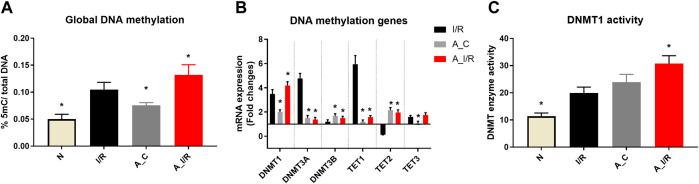
Most pre-clinical studies in cardiac ischemia-reperfusion injury (I/R) are carried out in young or old animals, which does not cater to the adult age in humans who encounter I/R. Not many studies in the literature are available that emphasize the sensitivity of the adult heart to injury from the young heart, where there exist distinct alterations in DNA methylation and mitochondrial function that contribute to injury. In the present study, we utilized young (8 weeks old) and adult (24 weeks old) rat hearts to evaluate distinct DNA methylation alterations that contribute to I/R injury. The cardiac basal physiological activities in young and adult rat hearts were insignificantly changed from normal. But the DNA hypermethylation and expression level of mitochondrial genes were slightly higher in adult rat hearts. The consequential effect of these changes was measured in the I/R heart to understand its response to additional stress. Accordingly, we noted an increase in global DNA hypermethylation levels by 40% and 62% in young and adult I/R hearts, respectively, from their respective control. Subsequently, a decline in mitochondrial genes (ND1, ND4L, ND6, Cyt B, COX1, COX2, and ATP8) that regulate cardiac contractility was observed in adult I/R hearts. These changes, in turn, reduced hemodynamics (Rate pressure product) by 51% and 32% in adult and young I/R hearts, respectively, from their controls. Besides, the I/R-linked infarct size was higher in adult hearts (58%) than in young hearts (37%). Correlation analysis showed a significant negative correlation of global DNA methylation with the MT-ND1 expression (r = -0.7591), MFN2 expression (r = -0.8561) and cardiac RPP (r = -0.8015) in adult I/R hearts. Based on the above observations, we concluded that age promoted DNA methylation and deteriorated cardiac responsive ability to resist I/R injury.
大多数关于心脏缺血再灌注损伤(I/R)的临床前研究是在幼龄或老龄动物身上进行的,这并不适用于遭遇I/R的成年人类。文献中没有很多研究强调成年心脏对幼龄心脏损伤的敏感性,幼龄心脏存在导致损伤的DNA甲基化和线粒体功能的明显改变。在本研究中,我们利用幼龄(8周龄)和成年(24周龄)大鼠心脏来评估导致I/R损伤的不同DNA甲基化改变。幼龄和成年大鼠心脏的基础心脏生理活动与正常相比无显著变化。但成年大鼠心脏中的DNA高甲基化和线粒体基因表达水平略高。在I/R心脏中测量了这些变化的后续影响,以了解其对额外应激的反应。因此,我们注意到幼龄和成年I/R心脏中的总体DNA高甲基化水平分别比各自的对照组增加了40%和62%。随后,在成年I/R心脏中观察到调节心脏收缩力的线粒体基因(ND1、ND4L、ND6、Cyt B、COX1、COX2和ATP8)减少。这些变化进而使成年和幼龄I/R心脏的血流动力学(速率压力乘积)分别比各自的对照组降低了51%和32%。此外,成年心脏中与I/R相关的梗死面积(58%)高于幼龄心脏(37%)。相关性分析显示,成年I/R心脏中总体DNA甲基化与MT-ND1表达(r = -0.7591)、MFN2表达(r = -0.8561)和心脏速率压力乘积(r = -0.8015)呈显著负相关。基于上述观察结果,我们得出结论,年龄促进了DNA甲基化,并降低了心脏抵抗I/R损伤的反应能力。




 Zotero 插件