
急性A型主动脉夹层所致心脏压塞中肌钙蛋白I与巨噬细胞的关联
Association of troponin I and macrophages in cardiac tamponade with Stanford type A aortic dissection.
作者信息
Kimura Satoshi, Sato Hiroaki, Shimajiri Shohei, Umehara Takahiro, Noguchi Hirotsugu, Niino Daisuke, Nakayama Toshiyuki
机构信息
Department of Clinical Pathology, Kitakyushu City Yahata Hospital, Kitakyushu, Japan.
Department of Pathology, School of Medicine, University of Occupational and Environmental Health, Kitakyushu, Japan.
出版信息
Heliyon. 2023 Oct 9;9(10):e20791. doi: 10.1016/j.heliyon.2023.e20791. eCollection 2023 Oct.
BACKGROUND
Acute aortic dissection has a high mortality rate, especially for Stanford type A with a dissected ascending aorta. Cardiac tamponade is one of the most common complications of acute type A aortic dissection (ATAAD) and can cause death. However, the pathogenesis is often unclear. We aimed to examine laboratory findings at the onset of disease and macrophage involvement.
METHODS
Hematological and biochemical parameters, and D-dimer, brain natriuretic peptide (BNP), and high-sensitivity troponin I (hs-cTnI) levels in 70 patients with ATAAD at our hospital were investigated. Additionally, the myocardium and aorta after autopsy of an ATAAD case with cardiac tamponade were pathologically examined.
RESULTS
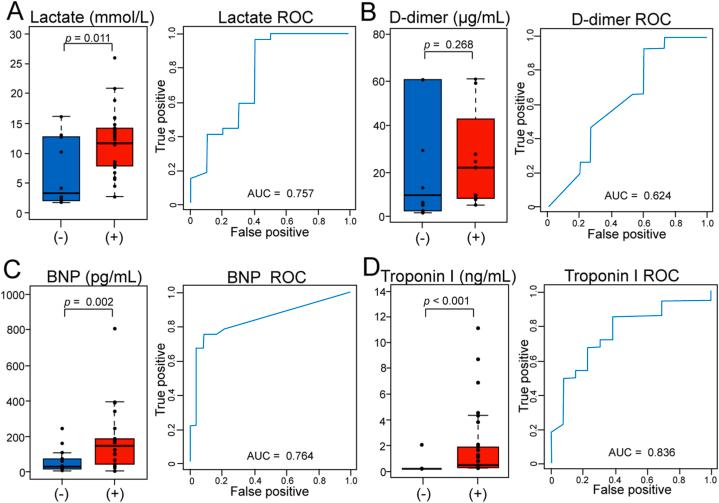
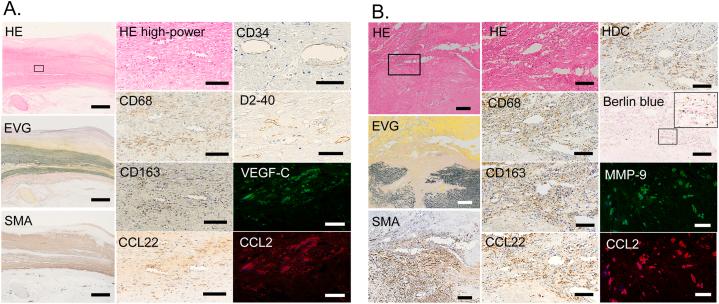
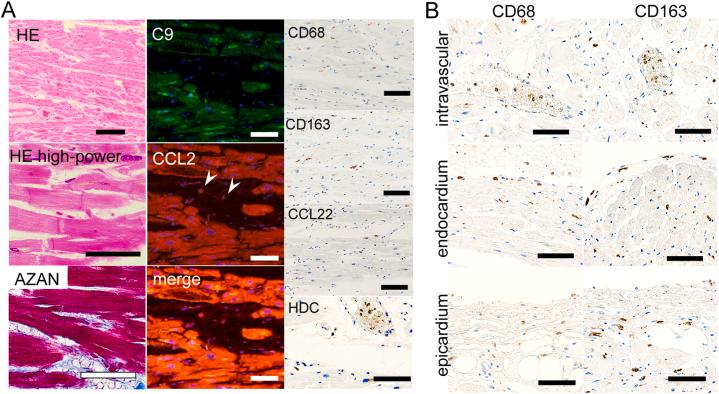
Forty-four ATAAD cases were complicated by cardiac tamponade. The mean age of patients with cardiac tamponade and proportion of patients over 70 years of age were both significantly higher than for those without cardiac tamponade. Evaluable D-dimer values were higher than 0.5 μg/mL in all patients. Significantly elevated laboratory parameters in patients with cardiac tamponade included: lactate dehydrogenase, aspartate aminotransferase, C-reactive protein, lactate, BNP, and hs-cTnI. However, multivariate analysis showed only hs-cTnI was significantly associated with cardiac tamponade. Histological examination revealed numerous M2-like macrophages infiltrating the myocardium and dissecting aorta, expressing CC chemokine ligand (CCL)2 together with vascular endothelial growth factor-C and matrix metalloproteinase-9. The peripheral monocyte-to-neutrophil ratio (MNR) was also significantly higher in cardiac tamponade.
CONCLUSIONS
In ATAAD patients with cardiac tamponade, hs-cTnI was significantly elevated and CCL2 expression was observed, which may be involved in the expression of M2-like macrophages via an increased MNR.
背景
急性主动脉夹层死亡率高,尤其是升主动脉受累的斯坦福A型。心脏压塞是急性A型主动脉夹层(ATAAD)最常见的并发症之一,可导致死亡。然而,其发病机制往往不明。我们旨在研究疾病发作时的实验室检查结果及巨噬细胞的参与情况。
方法
对我院70例ATAAD患者的血液学和生化参数、D - 二聚体、脑钠肽(BNP)和高敏肌钙蛋白I(hs - cTnI)水平进行了研究。此外,对1例因ATAAD并发心脏压塞患者的心肌和主动脉进行了尸检病理检查。
结果
44例ATAAD患者并发心脏压塞。心脏压塞患者的平均年龄及70岁以上患者的比例均显著高于无心脏压塞者。所有患者的可评估D - 二聚体值均高于0.5μg/mL。心脏压塞患者中显著升高的实验室参数包括:乳酸脱氢酶、天冬氨酸转氨酶、C反应蛋白、乳酸、BNP和hs - cTnI。然而,多变量分析显示只有hs - cTnI与心脏压塞显著相关。组织学检查显示大量M2样巨噬细胞浸润心肌和主动脉夹层,同时表达CC趋化因子配体(CCL)2、血管内皮生长因子 - C和基质金属蛋白酶 - 9。心脏压塞患者外周血单核细胞与中性粒细胞比值(MNR)也显著升高。
结论
在并发心脏压塞的ATAAD患者中,hs - cTnI显著升高且观察到CCL2表达,这可能通过升高的MNR参与M2样巨噬细胞的表达。


 Zotero 插件