
新冠疫情对全球、区域和国家层面出生时预期寿命的影响:一项连接点时间序列分析。
Effects of the COVID-19 pandemic on life expectancy at birth at the global, regional, and national levels: A joinpoint time-series analysis.
作者信息
Cao Guiying, Liu Jue, Liu Min, Liang Wannian
机构信息
School of Public Health, Peking University, Beijing, China.
Key Laboratory of Epidemiology of Major Diseases, Ministry of Education, Peking University, Beijing, China.
出版信息
J Glob Health. 2023 Oct 20;13:06042. doi: 10.7189/jogh.13.06042.
BACKGROUND
Current estimates indicate that coronavirus disease 2019 (COVID-19) caused 14.9 million excess deaths in 2020 and 2021. Thus, estimating the change in life expectancy at birth due to the COVID-19 pandemic could aid in understanding its impact and implementing public health initiatives.
METHODS
We collected data on the life expectancy at birth of the combined population between 1990 and 2021 at the global, regional, and national levels from the 2022 Revision of World Population Prospects. In this time series study, we estimated the trend segments, the change of trend years (joinpoints), the annual percentage change (APC) in life expectancy at birth within each trend segment, and the average APC (AAPC) in life expectancy at birth during the full study period using joinpoint regression analysis.
RESULTS
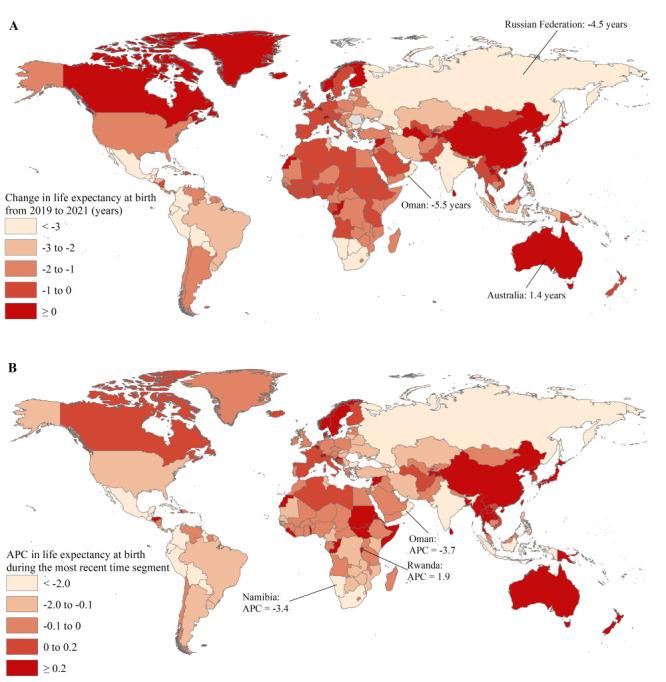
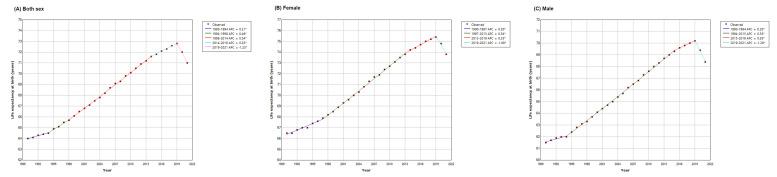
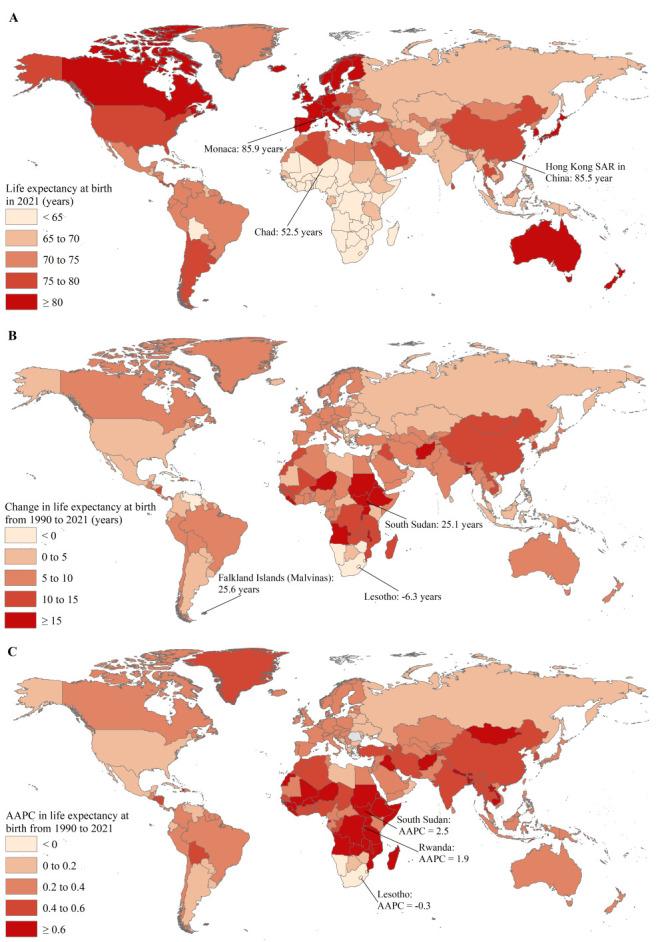
The global life expectancy at birth decreased from 72.8 years in 2019 to 71.0 years in 2021, with an annual decrease of 1.2% (95% confidence interval (CI) = 1.0, 1.5) during the 2019-2021 period, despite an overall increasing trend during the entire period from 1990 to 2021 (AAPC = 0.3%; 95% CI = 0.3, 0.4). We observed a significantly increasing trend in life expectancy at birth in all regions and nearly 87.7% (207/236) of the world's countries and areas during the entire period (1990-2021). All continental regions except Africa and Oceania experienced a significant decreasing trend in life expectancy at birth in 2019-2021, with an APC of -1.2% (95% CI = -1.5, -0.9) for Asia, -2.1% (95% CI = -2.7, -1.6) for Latin America and the Caribbean, -1.1% (95% CI = -1.6, -0.6) for Northern America, and -1.4% (95% CI = -1.9, -0.9) for Europe. Among all countries and areas, 107 countries and areas (45.3%) experienced a significant decreasing trend in life expectancy at birth in the most recent time segment, with 77 countries and areas (32.6%) experiencing a significant decreasing trend during the 2019-2021 period.
CONCLUSIONS
The world experienced a significant decreasing trend in life expectancy at birth in 2019-2021, with a decrease of 1.8 years; all continental regions except Africa and Oceania and 77 countries and areas experienced a significant decreasing trend in life expectancy at birth. These decreasing trends at global, regional, and national levels during the 2019-2021 period reflected the COVID-19 pandemic's direct and indirect adverse effects on life expectancy at birth.
背景
目前的估计表明,2019年冠状病毒病(COVID-19)在2020年和2021年导致了1490万人超额死亡。因此,估计COVID-19大流行导致的出生时预期寿命变化有助于理解其影响并实施公共卫生举措。
方法
我们从《世界人口展望:2022年修订版》中收集了1990年至2021年全球、区域和国家层面合并人口的出生时预期寿命数据。在这项时间序列研究中,我们使用连接点回归分析估计了趋势段、趋势年份的变化(连接点)、每个趋势段内出生时预期寿命的年度百分比变化(APC)以及整个研究期间出生时预期寿命的平均APC(AAPC)。
结果
全球出生时预期寿命从2019年的72.8岁降至2021年的71.0岁,在2019 - 2021年期间每年下降1.2%(95%置信区间(CI)= 1.0,1.5),尽管在1990年至2021年的整个期间总体呈上升趋势(AAPC = 0.3%;95% CI = 0.3,0.4)。在整个期间(1990 - 2021年),我们观察到所有地区以及世界上近87.7%(207/236)的国家和地区出生时预期寿命呈显著上升趋势。除非洲和大洋洲外,所有大陆地区在2019 - 2021年出生时预期寿命均呈显著下降趋势,亚洲的APC为 -1.2%(95% CI = -1.5,-0.9),拉丁美洲和加勒比地区为 -2.1%(95% CI = -2.7,-1.6),北美洲为 -1.1%(95% CI = -1.6,-0.6),欧洲为 -1.4%(95% CI = -1.9,-0.9)。在所有国家和地区中,107个国家和地区(45.3%)在最近时间段出生时预期寿命呈显著下降趋势,77个国家和地区(32.6%)在2019 - 2021年期间呈显著下降趋势。
结论
2019 - 2021年世界出生时预期寿命呈显著下降趋势,下降了1.8岁;除非洲和大洋洲外的所有大陆地区以及77个国家和地区出生时预期寿命呈显著下降趋势。2019 - 2021年期间全球、区域和国家层面的这些下降趋势反映了COVID-19大流行对出生时预期寿命的直接和间接不利影响。

 Zotero 插件