
应用人工智能和指南协助医学生识别心力衰竭患者:一项随机试验方案
Applying AI and Guidelines to Assist Medical Students in Recognizing Patients With Heart Failure: Protocol for a Randomized Trial.
作者信息
Joo Hyeon, Mathis Michael R, Tam Marty, James Cornelius, Han Peijin, Mangrulkar Rajesh S, Friedman Charles P, Vydiswaran V G Vinod
机构信息
Department of Learning Health Sciences, University of Michigan, Ann Arbor, MI, United States.
Department of Anesthesiology, University of Michigan, Ann Arbor, MI, United States.
出版信息
JMIR Res Protoc. 2023 Oct 24;12:e49842. doi: 10.2196/49842.
BACKGROUND
The integration of artificial intelligence (AI) into clinical practice is transforming both clinical practice and medical education. AI-based systems aim to improve the efficacy of clinical tasks, enhancing diagnostic accuracy and tailoring treatment delivery. As it becomes increasingly prevalent in health care for high-quality patient care, it is critical for health care providers to use the systems responsibly to mitigate bias, ensure effective outcomes, and provide safe clinical practices. In this study, the clinical task is the identification of heart failure (HF) prior to surgery with the intention of enhancing clinical decision-making skills. HF is a common and severe disease, but detection remains challenging due to its subtle manifestation, often concurrent with other medical conditions, and the absence of a simple and effective diagnostic test. While advanced HF algorithms have been developed, the use of these AI-based systems to enhance clinical decision-making in medical education remains understudied.
OBJECTIVE
This research protocol is to demonstrate our study design, systematic procedures for selecting surgical cases from electronic health records, and interventions. The primary objective of this study is to measure the effectiveness of interventions aimed at improving HF recognition before surgery, the second objective is to evaluate the impact of inaccurate AI recommendations, and the third objective is to explore the relationship between the inclination to accept AI recommendations and their accuracy.
METHODS
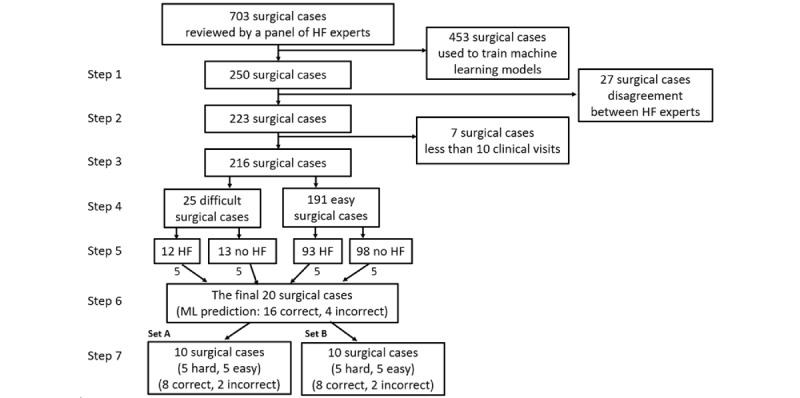
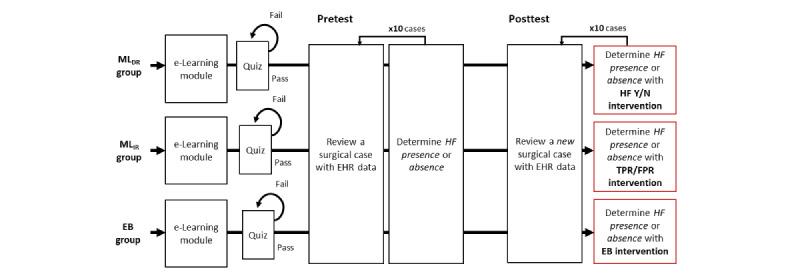
Our study used a 3 × 2 factorial design (intervention type × order of prepost sets) for this randomized trial with medical students. The student participants are asked to complete a 30-minute e-learning module that includes key information about the intervention and a 5-question quiz, and a 60-minute review of 20 surgical cases to determine the presence of HF. To mitigate selection bias in the pre- and posttests, we adopted a feature-based systematic sampling procedure. From a pool of 703 expert-reviewed surgical cases, 20 were selected based on features such as case complexity, model performance, and positive and negative labels. This study comprises three interventions: (1) a direct AI-based recommendation with a predicted HF score, (2) an indirect AI-based recommendation gauged through the area under the curve metric, and (3) an HF guideline-based intervention.
RESULTS
As of July 2023, 62 of the enrolled medical students have fulfilled this study's participation, including the completion of a short quiz and the review of 20 surgical cases. The subject enrollment commenced in August 2022 and will end in December 2023, with the goal of recruiting 75 medical students in years 3 and 4 with clinical experience.
CONCLUSIONS
We demonstrated a study protocol for the randomized trial, measuring the effectiveness of interventions using AI and HF guidelines among medical students to enhance HF recognition in preoperative care with electronic health record data.
INTERNATIONAL REGISTERED REPORT IDENTIFIER (IRRID): DERR1-10.2196/49842.
背景
将人工智能(AI)整合到临床实践中正在改变临床实践和医学教育。基于AI的系统旨在提高临床任务的效率,提高诊断准确性并量身定制治疗方案。随着其在医疗保健中越来越普遍以实现高质量的患者护理,医疗保健提供者负责任地使用这些系统以减轻偏差、确保有效结果并提供安全的临床实践至关重要。在本研究中,临床任务是在手术前识别心力衰竭(HF),以提高临床决策技能。HF是一种常见且严重的疾病,但由于其表现细微、常与其他病症并发且缺乏简单有效的诊断测试,检测仍然具有挑战性。虽然已经开发了先进的HF算法,但在医学教育中使用这些基于AI的系统来增强临床决策仍未得到充分研究。
目的
本研究方案旨在展示我们的研究设计、从电子健康记录中选择手术病例的系统程序以及干预措施。本研究的主要目的是衡量旨在提高手术前HF识别能力的干预措施的有效性,第二个目的是评估不准确的AI建议的影响,第三个目的是探索接受AI建议的倾向与其准确性之间的关系。
方法
我们的研究针对该医学生随机试验采用了3×2析因设计(干预类型×前后测试集顺序)。学生参与者被要求完成一个30分钟的电子学习模块,其中包括有关干预措施的关键信息和一个5道题的测验,以及对20个手术病例进行60分钟的审查以确定是否存在HF。为了减轻前后测试中的选择偏差,我们采用了基于特征的系统抽样程序。从703个经过专家审查的手术病例库中,根据病例复杂性、模型性能以及阳性和阴性标签等特征选择了20个病例。本研究包括三种干预措施:(1)基于AI的直接建议及预测的HF评分,(2)通过曲线下面积指标衡量的基于AI的间接建议,(3)基于HF指南的干预措施。
结果
截至2023年7月,已招募的62名医学生完成了本研究的参与,包括完成一个简短测验和对20个手术病例的审查。受试者招募于2022年8月开始,将于2023年12月结束,目标是招募75名具有临床经验的三、四年级医学生。
结论
我们展示了一项随机试验的研究方案,该方案使用AI和HF指南来衡量医学生干预措施的有效性,以利用电子健康记录数据增强术前护理中的HF识别能力。
国际注册报告标识符(IRRID):DERR1-10.2196/49842。
 Zotero 插件