
新冠疫情后韩国光州人偏肺病毒的再次出现。
Re-Emergence of HMPV in Gwangju, South Korea, after the COVID-19 Pandemic.
作者信息
Cho Sun-Ju, Kim Sun-Hee, Lee Hongsu, Lee Yeong-Un, Mun Jeongeun, Park Sujung, Park Jungwook, Park Ji-Su, Lee Kwangho, Lee Cheong-Mi, Seo Jinjong, Kim Yonghwan, Chung Yoon-Seok
机构信息
Division of Emerging Infectious Disease, Department of Infectious Disease Research, Health and Environment Research Institute of Gwangju, Gwangju 61954, Republic of Korea.
Division of High-Risk Pathogen, Bureau of Infectious Diseases Diagnosis Control, Korea Disease Control and Prevention Agency (KDCA), Cheongju 28159, Republic of Korea.
出版信息
Pathogens. 2023 Oct 4;12(10):1218. doi: 10.3390/pathogens12101218.
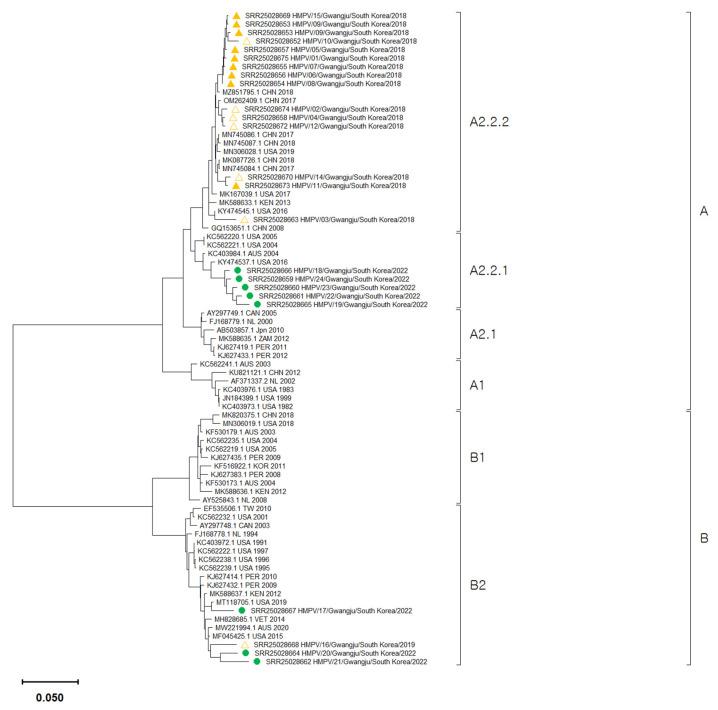
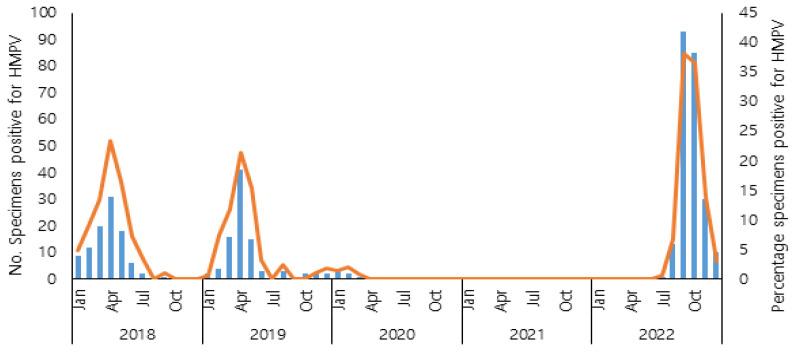
The non-pharmaceutical interventions implemented to prevent the spread of COVID-19 have affected the epidemiology of other respiratory viruses. In South Korea, Human metapneumovirus (HMPV) typically occurs from winter to the following spring; however, it was not detected for two years during the COVID-19 pandemic and re-emerged in the fall of 2022, which is a non-epidemic season. To examine the molecular genetic characteristics of HMPV before and after the COVID-19 pandemic, we analyzed 427 HMPV-positive samples collected in the Gwangju area from 2018 to 2022. Among these, 24 samples were subjected to whole-genome sequencing. Compared to the period before the COVID-19 pandemic, the incidence rate of HMPV in 2022 increased by 2.5-fold. Especially in the age group of 6-10 years, the incidence rate increased by more than 4.5-fold. In the phylogenetic analysis results, before the COVID-19 pandemic, the A2.2.2 lineage was predominant, while in 2022, the A2.2.1 and B2 lineage were observed. The non-pharmaceutical interventions implemented after COVID-19, such as social distancing, have reduced opportunities for exposure to HMPV, subsequently leading to decreased acquisition of immunity. As a result, HMPV occurred during non-epidemic seasons, influencing the age distribution of its occurrences.
为预防新冠病毒传播而实施的非药物干预措施,已经影响了其他呼吸道病毒的流行病学特征。在韩国,人偏肺病毒(HMPV)通常在冬季至次年春季出现;然而,在新冠疫情期间的两年里未检测到该病毒,它于2022年秋季再次出现,而这是一个非流行季节。为了研究新冠疫情前后HMPV的分子遗传学特征,我们分析了2018年至2022年在光州地区收集的427份HMPV阳性样本。其中,24份样本进行了全基因组测序。与新冠疫情之前的时期相比,2022年HMPV的发病率增加了2.5倍。特别是在6至10岁年龄组,发病率增加了4.5倍以上。在系统发育分析结果中,新冠疫情之前,A2.2.2谱系占主导地位,而在2022年,观察到A2.2.1和B2谱系。新冠疫情后实施的非药物干预措施,如社交距离,减少了接触HMPV的机会,随后导致免疫力获得减少。结果,HMPV在非流行季节出现,影响了其发病的年龄分布。
 Zotero 插件