
[某种疾病]中碳青霉烯类耐药性的出现是否会增加病死率?系统评价与Meta分析。
Does Emerging Carbapenem Resistance in Increase the Case Fatality Rate? Systematic Review and Meta-Analysis.
作者信息
Boral Jale, Pınarlık Fatihan, Ekinci Güz, Can Füsun, Ergönül Önder
机构信息
Graduate School of Health Sciences, Koç University, Istanbul 34010, Türkiye.
Koç University İşBank Center for Infectious Diseases, Koç University Hospital (KUISCID), Istanbul 34010, Türkiye.
出版信息
Infect Dis Rep. 2023 Sep 27;15(5):564-575. doi: 10.3390/idr15050055.
BACKGROUND
In the era of rising carbapenem resistance, we aimed to investigate the change in mortality rate and positivity of carbapenemase genes in .
METHODS
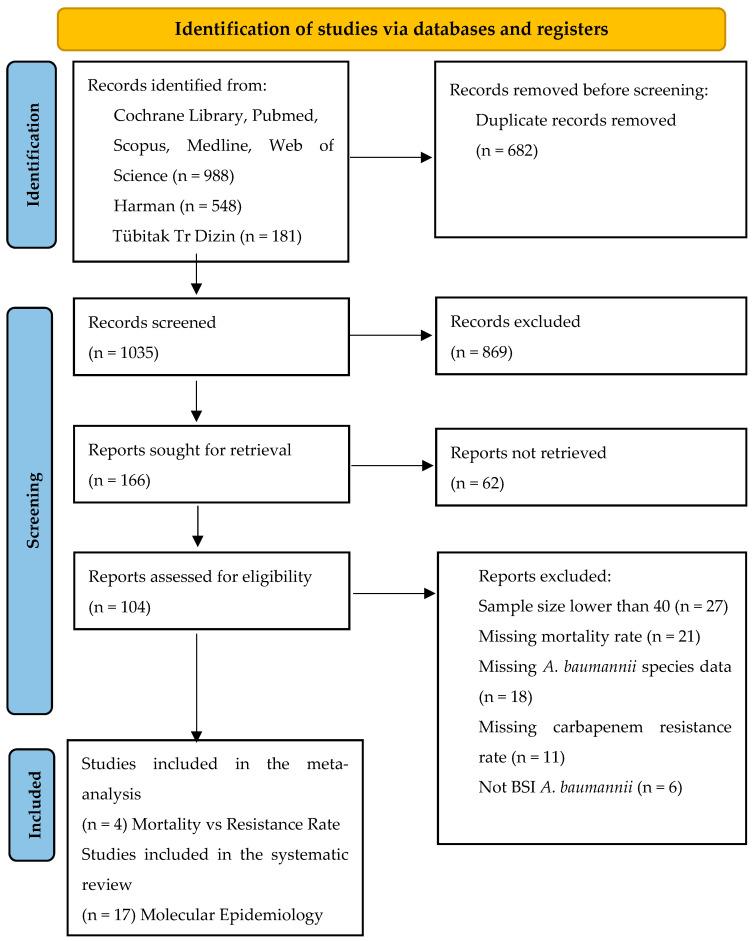
Preferred Reporting Items for Systematic Review (PRISMA) guidelines were adopted in this systematic review. Our literature search included the Cochrane Library, Pubmed, Scopus, Web of Science, Medline, Tubitak TR Dizin, and Harman databases for studies dating back from 2003 to 2023 reporting bloodstream infections in Türkiye. A simple linear regression model was used to determine the association between resistance, mortality, and time.
RESULTS
A total of 1717 studies were identified through a literature search, and 21 articles were selected based on the availability of the data regarding mortality and resistance rate (four articles) or the molecular epidemiology of carbapenem-resistant (17 articles) in Türkiye. From 2007 to 2018, the carbapenem resistance rate increased ( = 0.025). The OXA-23 and OXA-58 positivities were inversely correlated ( = 0.025).
CONCLUSIONS
Despite the emergence of carbapenem resistance, mortality did not increase in parallel, which may be due to improved medical advancements or the fitness cost of bacteria upon prolonged antimicrobial exposure. Therefore, we suggest further global research with the foresight to assess clonal relatedness that might affect the carbapenem resistance rate.
背景
在碳青霉烯耐药性不断上升的时代,我们旨在调查[具体对象]中死亡率的变化以及碳青霉烯酶基因的阳性率。
方法
本系统评价采用系统评价的首选报告项目(PRISMA)指南。我们的文献检索包括Cochrane图书馆、PubMed、Scopus、科学网、Medline、Tubitak TR Dizin和Harman数据库,以查找2003年至2023年期间报告土耳其血流感染情况的研究。使用简单线性回归模型来确定耐药性、死亡率和时间之间的关联。
结果
通过文献检索共识别出1717项研究,根据土耳其关于死亡率和耐药率的数据(4篇文章)或耐碳青霉烯类的分子流行病学(17篇文章)的可得性,选择了21篇文章。从2007年到2018年,碳青霉烯耐药率上升(=0.025)。OXA-23和OXA-58阳性率呈负相关(=0.025)。
结论
尽管出现了碳青霉烯耐药性,但死亡率并未随之上升,这可能是由于医疗进步或细菌在长期接触抗菌药物后的适应性代价。因此,我们建议进行进一步的全球研究,前瞻性地评估可能影响碳青霉烯耐药率的克隆相关性。


 Zotero 插件