
2019 年与 33 种细菌病原体相关的全球死亡率:2019 年全球疾病负担研究的系统分析。
Global mortality associated with 33 bacterial pathogens in 2019: a systematic analysis for the Global Burden of Disease Study 2019.
出版信息
Lancet. 2022 Dec 17;400(10369):2221-2248. doi: 10.1016/S0140-6736(22)02185-7. Epub 2022 Nov 21.
BACKGROUND
Reducing the burden of death due to infection is an urgent global public health priority. Previous studies have estimated the number of deaths associated with drug-resistant infections and sepsis and found that infections remain a leading cause of death globally. Understanding the global burden of common bacterial pathogens (both susceptible and resistant to antimicrobials) is essential to identify the greatest threats to public health. To our knowledge, this is the first study to present global comprehensive estimates of deaths associated with 33 bacterial pathogens across 11 major infectious syndromes.
METHODS
We estimated deaths associated with 33 bacterial genera or species across 11 infectious syndromes in 2019 using methods from the Global Burden of Diseases, Injuries, and Risk Factors Study (GBD) 2019, in addition to a subset of the input data described in the Global Burden of Antimicrobial Resistance 2019 study. This study included 343 million individual records or isolates covering 11 361 study-location-years. We used three modelling steps to estimate the number of deaths associated with each pathogen: deaths in which infection had a role, the fraction of deaths due to infection that are attributable to a given infectious syndrome, and the fraction of deaths due to an infectious syndrome that are attributable to a given pathogen. Estimates were produced for all ages and for males and females across 204 countries and territories in 2019. 95% uncertainty intervals (UIs) were calculated for final estimates of deaths and infections associated with the 33 bacterial pathogens following standard GBD methods by taking the 2·5th and 97·5th percentiles across 1000 posterior draws for each quantity of interest.
FINDINGS
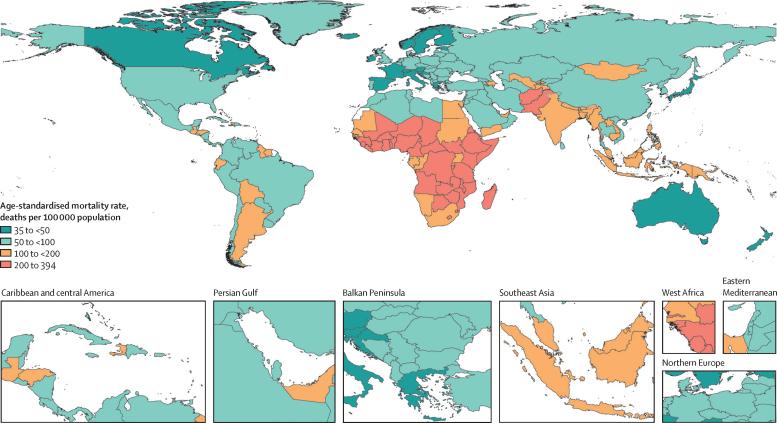
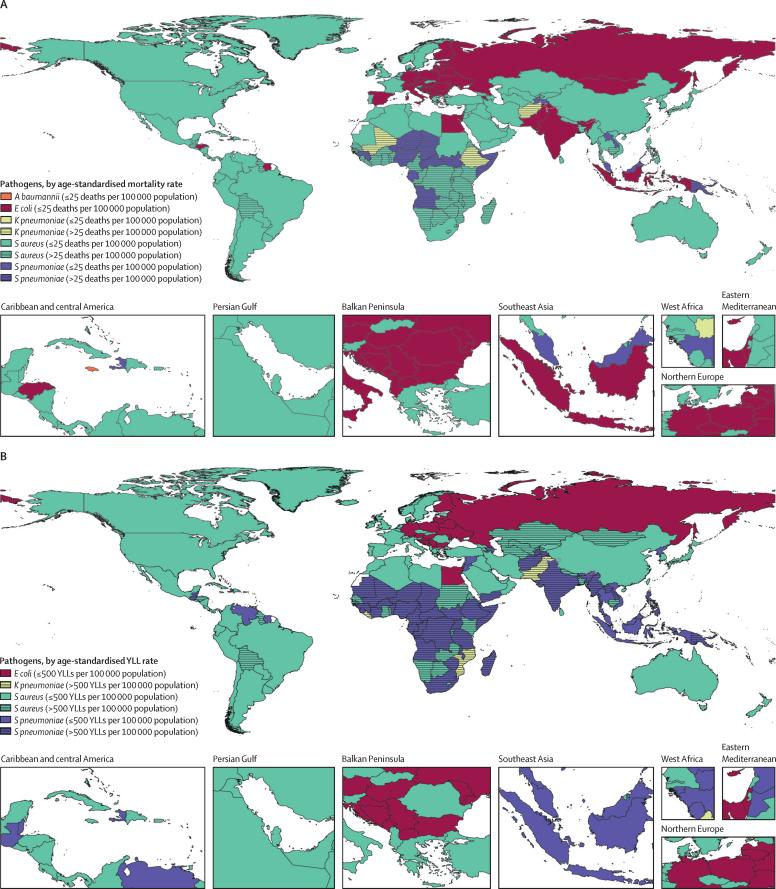
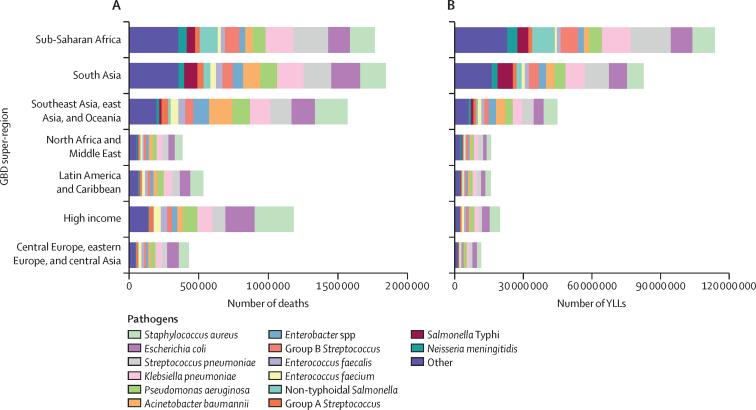
From an estimated 13·7 million (95% UI 10·9-17·1) infection-related deaths in 2019, there were 7·7 million deaths (5·7-10·2) associated with the 33 bacterial pathogens (both resistant and susceptible to antimicrobials) across the 11 infectious syndromes estimated in this study. We estimated deaths associated with the 33 bacterial pathogens to comprise 13·6% (10·2-18·1) of all global deaths and 56·2% (52·1-60·1) of all sepsis-related deaths in 2019. Five leading pathogens-Staphylococcus aureus, Escherichia coli, Streptococcus pneumoniae, Klebsiella pneumoniae, and Pseudomonas aeruginosa-were responsible for 54·9% (52·9-56·9) of deaths among the investigated bacteria. The deadliest infectious syndromes and pathogens varied by location and age. The age-standardised mortality rate associated with these bacterial pathogens was highest in the sub-Saharan Africa super-region, with 230 deaths (185-285) per 100 000 population, and lowest in the high-income super-region, with 52·2 deaths (37·4-71·5) per 100 000 population. S aureus was the leading bacterial cause of death in 135 countries and was also associated with the most deaths in individuals older than 15 years, globally. Among children younger than 5 years, S pneumoniae was the pathogen associated with the most deaths. In 2019, more than 6 million deaths occurred as a result of three bacterial infectious syndromes, with lower respiratory infections and bloodstream infections each causing more than 2 million deaths and peritoneal and intra-abdominal infections causing more than 1 million deaths.
INTERPRETATION
The 33 bacterial pathogens that we investigated in this study are a substantial source of health loss globally, with considerable variation in their distribution across infectious syndromes and locations. Compared with GBD Level 3 underlying causes of death, deaths associated with these bacteria would rank as the second leading cause of death globally in 2019; hence, they should be considered an urgent priority for intervention within the global health community. Strategies to address the burden of bacterial infections include infection prevention, optimised use of antibiotics, improved capacity for microbiological analysis, vaccine development, and improved and more pervasive use of available vaccines. These estimates can be used to help set priorities for vaccine need, demand, and development.
FUNDING
Bill & Melinda Gates Foundation, Wellcome Trust, and Department of Health and Social Care, using UK aid funding managed by the Fleming Fund.
背景
降低因感染而导致的死亡负担是一项紧迫的全球公共卫生优先事项。之前的研究已经估算了与耐药感染和脓毒症相关的死亡人数,并发现感染仍然是全球死亡的主要原因。了解常见细菌病原体(对和对抗生素敏感和耐药的)的全球负担对于确定对公共卫生的最大威胁至关重要。据我们所知,这是第一项针对全球 33 种细菌病原体在 11 种主要传染病综合征中相关死亡人数的全面综合估算研究。
方法
我们使用 2019 年全球疾病、伤害和危险因素研究(GBD)2019 中的方法,以及全球抗生素耐药性 2019 研究中描述的部分输入数据,对 2019 年 11 种传染病综合征中的 33 个细菌属或种的死亡人数进行了估算。本研究共涉及 3430 万个个体记录或分离株,涵盖 11361 个研究地点年。我们使用三个建模步骤来估算与每个病原体相关的死亡人数:感染起作用的死亡人数、归因于特定传染病综合征的死亡人数中因感染而导致的部分,以及归因于特定病原体的传染病综合征导致的死亡人数中因感染而导致的部分。为 204 个国家和地区的所有年龄和男性和女性在 2019 年估算了这些数据。根据 GBD 标准方法,通过对每个感兴趣的数量进行 1000 次后验抽取的第 2.5 百分位数和第 97.5 百分位数,为与 33 种细菌病原体相关的感染和死亡的最终估计值计算了 95%的不确定性区间(UI)。
发现
在 2019 年估计的 1370 万(95%UI 1090-1710)与感染相关的死亡中,有 770 万(570-1020)与我们在这项研究中估计的 11 种传染病综合征中 33 种细菌病原体(对抗生素敏感和耐药)有关。我们估计与 33 种细菌病原体相关的死亡占全球所有死亡的 13.6%(1020-1810),占 2019 年所有脓毒症相关死亡的 56.2%(521-601)。五种主要病原体-金黄色葡萄球菌、大肠杆菌、肺炎链球菌、肺炎克雷伯菌和铜绿假单胞菌-导致了调查细菌中 54.9%(529-569)的死亡。最致命的传染病综合征和病原体因地点和年龄而异。与这些细菌病原体相关的标准化死亡率在撒哈拉以南非洲超区域最高,每 10 万人中有 230 人(185-285)死亡,在高收入超区域最低,每 10 万人中有 52.2 人(37.4-71.5)死亡。金黄色葡萄球菌是全球 135 个国家的主要细菌死因,也是全球年龄大于 15 岁人群中死亡人数最多的病原体。在 5 岁以下儿童中,肺炎链球菌是与死亡人数相关的病原体。2019 年,有超过 600 万人的死亡是由三种细菌感染综合征引起的,下呼吸道感染和血流感染导致的死亡人数均超过 200 万,腹膜和腹腔内感染导致的死亡人数超过 100 万。
解释
我们在这项研究中调查的 33 种细菌病原体是全球健康损失的一个重要来源,它们在传染病综合征和地点的分布上存在很大差异。与 GBD 三级潜在死因相比,这些细菌引起的死亡将成为 2019 年全球第二大主要死因;因此,它们应被视为全球卫生界干预的紧急优先事项。解决细菌感染负担的策略包括感染预防、优化抗生素使用、提高微生物分析能力、疫苗开发以及改进和更广泛地使用现有疫苗。这些估计可以帮助确定疫苗需求、需求和开发的优先事项。
资金
比尔和梅琳达·盖茨基金会、惠康信托基金会和英国卫生部和社会保障部,使用由 Fleming 基金管理的英国援助资金。


 Zotero 插件